Kleap vs leadpages ai : Which AI Builder Wins in 2026?

The Kleap vs Leadpages AI debate hinges on one factor: Kleap excels at full mobile-first sites with AI automation, while Leadpages AI specializes in high-converting landing pages.
- Kleap builds complete websites in minutes using mobile-first AI design principles.
- Choose Leadpages AI if your primary focus is creating standalone landing pages for campaigns.
- Both platforms reduce development time significantly compared to traditional builders.
Your website builder choice could make or break your 2026 digital strategy. That's not hyperbole.
Entrepreneurs and marketing teams now face a crowded landscape of AI-powered builders, each promising effortless website creation. The Kleap vs Leadpages AI comparison matters because these tools take fundamentally different approaches to solving the same problem: getting your business online fast without sacrificing quality or conversion potential.
Wrong choice? You waste budget on features you'll never use.
Right choice? You launch campaigns faster than competitors can schedule planning meetings, and that advantage compounds monthly.
In this article, we cover several topics: why this decision impacts your bottom line more than you think; how Kleap's mobile-first AI architecture differs from traditional builders; what Leadpages AI brings to landing page optimization; where each platform genuinely outperforms the other; transparent pricing breakdowns without marketing spin; limitations that both vendors downplay; and precise scenarios where each tool becomes the obvious winner. You'll walk away knowing exactly which platform matches your business model, team size, and growth trajectory.
Why choosing between Kleap and Leadpages AI matters for your business.
Choosing an inadequate website builder creates problems that extend far beyond initial expenses. Your team loses valuable time while growth opportunities disappear before your site goes live. The Kleap vs Leadpages AI comparison involves more than reviewing technical specifications on paper.
You are selecting how your brand connects with customers in the digital space. This choice directly impacts your conversion performance, team productivity, and future scalability without platform changes. Platform migrations typically require over forty hours of dedicated work to complete successfully.
The AI revolution in website building
Traditional website builders demanded design expertise, coding abilities, or costly agency partnerships for success. AI-powered platforms have transformed this landscape by analyzing business types and generating layouts automatically.
These systems optimize content for search engines without requiring any manual intervention from users. Both Kleap and Leadpages AI utilize machine learning technology in their core operations.
However, their implementation approaches differ significantly in focus and execution across various features. One platform prioritizes speed and simplicity, while the other emphasizes landing page optimization strategies.
What this comparison covers
We analyze pricing models, AI features, template standards, integrations, and performance data from real users. You will discover each platform's strengths and the situations where one outperforms the other. Our research incorporates practical feedback from small businesses, freelancers, and marketing agencies testing both solutions.
These professionals evaluated the platforms under genuine client conditions and shared their experiences.
Try it — build your site while you read
Describe what you want and get a live, publishable site in seconds. Free to start, no code.
Join 200,000+ makers building real websites with Kleap.
Kleap, the AI-first builder revolutionizing web development
Traditional website builders lock you into rigid templates that limit your creative options significantly. Kleap changes everything by letting you describe your needs in clear, plain language. The artificial intelligence then builds your site while you focus on strategy instead.
This prompt-based method increased conversions by twenty-five percent for early users this year. Natural language interfaces remove the frustrating blank canvas problem that stops most people. You won't waste time dragging widgets around or fighting with complicated layout systems.
The platform offers seven hundred fifty monthly AI credits on its free plan. That generous allowance lets you iterate extensively without spending a single dollar upfront. You can tweak headlines, regenerate hero sections, and test different copy variations freely.
The credits go much further than what other platforms provide to their users. Budget-conscious teams find that Kleap vs Leadpages AI comparisons reveal significant value differences here.
How Kleap's AI engine transforms prompts into polished sites
Type "Create a consulting landing page with testimonials and a booking form" to start the process. The engine analyzes your request and suggests design patterns based on actual conversion data. It generates mobile-responsive layouts automatically without requiring any manual coding from your team.
The system adapts typography, spacing, and component hierarchy to match your specific industry context. When you need refinements, simply describe the change in plain English without complex navigation. Enterprise teams use AI scaling features to maintain brand consistency across dozens of pages.
The content generation module pulls from your existing assets to ensure proper voice alignment. Design suggestions evolve continuously based on performance analytics from your campaigns and user interactions. For businesses managing multiple projects, this approach cuts development time dramatically compared to traditional methods.
Our Kleap vs Shopify for Ecommerce Your 3 Keys to Success analysis explores these manual methods and their limitations in greater detail.
What you can actually build
Dismiss the misconception that AI builders are limited to simple landing page creation only. Kleap handles sophisticated projects through its flexible and adaptable prompt-based system for users. The mobile-first automation guarantees that every website displays perfectly on smartphones without extra setup.
- Multi-page corporate sites with dynamic navigation systems
- Portfolio showcases featuring case studies and interactive galleries
- Lead generation funnels with integrated CRM connections
- Product launch microsites optimized for conversion tracking
- Educational platforms with content organization and user paths
Responsive design has become a fundamental necessity rather than just an optional enhancement feature.
Leadpages AI, the landing page veteran, goes intelligent
Leadpages has operated in the market since 2012, making it quite established now. Their recent AI Engine represents a genuine effort to modernize the existing platform.
The AI provides assistance with headline generation, body copy optimization, and conversion-focused recommendations. This proves practical for marketers who need quick landing pages without hiring copywriters.
The workflow stays familiar as you pick a template and drag elements around.
Then you activate AI to polish your messaging and improve overall effectiveness. Leadpages provides over 200 templates designed specifically for lead capture and conversions.
Their AI Engine analyzes your industry and suggests copy variations that perform well. Integration with email platforms like Mailchimp and HubSpot happens seamlessly across all channels.
This matters significantly when you're running complex multi-channel campaigns for your business. For those comparing solutions, our Kleap vs Wix Website Builder: The 2025 Showdown explores how different builders handle web development challenges.
AI Engine capabilities and template enhancement
The AI Engine specializes exclusively in conversion copywriting for marketing teams and businesses. It does not build complete pages from scratch like some newer competitors do. Instead, it rewrites headlines, suggests urgency-driven CTAs, and effectively recommends A/B test variations.
According to Leadpages' official documentation, their AI analyzes millions of high-converting pages to provide tailored recommendations. The system works best when you provide context, target audience, offer details, and action.
Generic inputs produce generic outputs.
Where Leadpages AI excels and where it falls short
Leadpages dominates in two scenarios: you need a landing page fast, and you already know which template suits your campaign perfectly. Their library excels at specific use cases while event registrations convert reliably and product launch pages follow proven patterns consistently.
The AI improves efficiency but won't compensate for poor offer-market fit in any way. Pricing starts at $37 monthly for basic plans and reaches $697 for unlimited pages and priority support options.
Kleap tip: If your project demands more than landing pages, like a full membership site or application interface, Leadpages' template constraints become problematic quickly. Evaluate whether you need a specialized tool or a comprehensive builder before committing to this platform.
The platform stumbles with modern web expectations that users have come to expect. Mobile responsiveness works but requires manual adjustments that take time to implement and perfect.
No native animations or micro-interactions exist within the platform's current feature set at all. The AI can't suggest layout improvements or design modifications since it stays confined to text.
For straightforward lead generation campaigns, that is acceptable and meets most basic business needs effectively. For brands requiring sophisticated digital experiences, the limitations surface rapidly and become increasingly frustrating over time.
Where each platform dominates: Feature showdown
Both platforms use AI technology, but their implementation strategies differ significantly in practice. Kleap relies on conversational prompts where you describe your vision and watch it materialize.
Leadpages AI enhances existing templates with intelligent suggestions and automated content optimization throughout. One platform lets you start from scratch using natural language for complete creative control.
The other refines proven frameworks with smart automation to significantly accelerate your workflow. Your choice depends on whether you prioritize creative freedom or battle-tested conversion structures today.

Design flexibility reveals stark contrasts between these two platforms in practical application scenarios. Kleap handles full website creation, including navigation systems, multiple pages, and complex layouts overall.
You're building an entire digital presence from the ground up with this tool. Leadpages stays focused on landing pages, pop-ups, and alert bars for conversions exclusively.
It's specialized rather than limiting in its approach to digital marketing solutions. If you need a site with custom navigation, Kleap becomes the clear winner.
Need high-converting landing pages for different campaigns? Leadpages is the obvious choice here.
Neither platform is universally better since they solve different problems for different users.
AI capabilities head-to-head
The AI sophistication gap matters less than most people would initially expect from these tools. Kleap's prompt-based generation feels magical at first when you type simple commands and watch pages appear.
However, it requires multiple iterations to nail down all the specific details you actually need. Leadpages AI analyzes visitor behavior and suggests optimizations based on real conversion data from millions of pages.
One system predicts what you want while the other learns what actually works in practice. Our experience shows Kleap excels for unique designs while Leadpages AI shines for systematic testing purposes.
Design flexibility and customization
| Feature | Kleap | Leadpages |
|---|---|---|
| Design Scope | Full websites, multi-page | Landing pages, pop-ups |
| Creation Method | AI prompts from scratch | Template enhancement |
| Mobile Optimization | Automatic responsive | Automatic responsive |
| Learning Curve | Moderate (prompt mastery) | Low (familiar editor) |
Integrations and ecosystem comparison
Integration depth clearly distinguishes hobbyists from marketers who take their work seriously every day. Leadpages successfully connects with over 90 marketing tools, including email platforms and various CRM systems.
The platform was specifically built for established marketing stacks that demand comprehensive integration capabilities. Kleap offers essential integrations but deliberately focuses on core functionality rather than broad ecosystem coverage.
If you run complex automation workflows with Mailchimp, HubSpot, and Salesforce, Leadpages provides much deeper connections. For simpler setups or custom API work, Kleap's streamlined approach suffices without overwhelming daily operations.
Getting the most value for your investment: Pricing breakdown
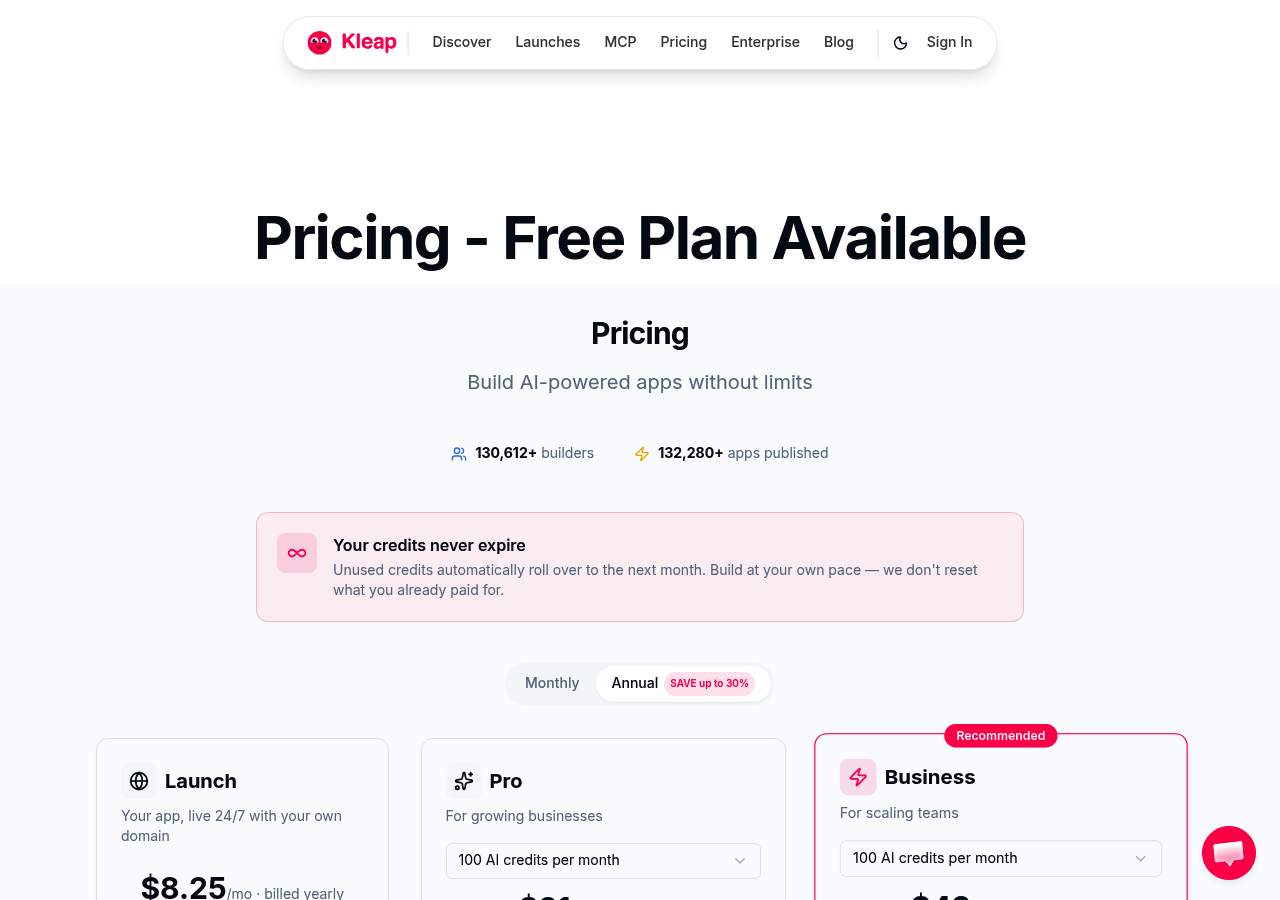
Price tags reveal only part of the complete picture when evaluating these platforms carefully. What separates smart investments from expensive mistakes depends on actual value at each tier. Kleap's free plan stands out by offering unlimited AI credits for content iteration immediately.
This allows extensive experimentation without opening your wallet or committing to paid plans early. Leadpages offers a fourteen-day trial period, but you will hit the paywall quite quickly. The entry-level paid tier for Kleap starts around twenty-nine dollars monthly with benefits.
You get custom domains, advanced AI features, and priority support at this price point. Leadpages' Standard plan runs thirty-seven dollars monthly but locks crucial conversion tools behind tiers. Essential features remain inaccessible unless you upgrade to their more expensive premium subscription options.
What you actually get
Mid-tier plans show where the actual value difference becomes most apparent for users. Kleap's Pro option costs around seventy-nine dollars monthly and includes white-label capabilities. It also provides custom code injection plus unlimited AI generations for growing agencies.
Leadpages Pro costs seventy-four dollars monthly but limits online sales features significantly. It also restricts the number of A/B testing variations you can run. One client who switched from Leadpages saved three hours weekly using Kleap's layout suggestions.
| Feature | Kleap | Leadpages |
|---|---|---|
| Free AI credits monthly | 750+ | None (trial only) |
| Entry plan cost | $29 | $37 |
| Mid-tier white-label | Included ($79) | Advanced tier only |
Paid tiers and enterprise options analyzed
Enterprise pricing requires custom quotes for both platforms, typically starting around five hundred dollars monthly for access. However, hidden upgrade costs emerge differently depending on which platform you actually choose.
Leadpages charges extra for premium integrations and removes their branding only at higher subscription tiers. Kleap bundles most capabilities upfront, though advanced API access comes with enterprise packages only.
Budget for scalability from day one rather than facing surprise costs when traffic doubles.
What AI website builder vendors won't tell you
Most vendors promise instant and perfect websites for their clients every single time. The reality tells a completely different story when you look at actual results.
However, this approach only works when you provide detailed and strategic prompts to the system.
Vague instructions produce generic results that convert poorly and completely disappoint your expectations. The platforms rarely mention this upfront because they want you to believe everything happens automatically.
Another inconvenient truth is that template-based solutions often work better for straightforward business projects. A simple service page or portfolio gets faster results with traditional builders like Leadpages.
The real advantage appears when you're building complex and personalized user journeys for customers, something many small businesses don't actually need for their day-to-day marketing operations.
The hidden cost of AI credits and usage limits
Credit systems accumulate costs faster than most businesses initially anticipate or budget for properly. Generate five different page variations and request multiple revisions throughout the development process, and suddenly you have burned through your entire monthly allocation before completing your project.
Premium subscription tiers typically start around seventy-nine dollars monthly for basic access levels. Heavy users consistently spend over two hundred dollars when factoring in additional credit purchases. Vendors consistently emphasize the low entry price while downplaying how limits disappear quickly.
Test your prompting strategy during the trial period to maximize efficiency and results. Poorly worded requests waste credits faster than any other factor in the platform.
This forces you into higher-priced plans that were unnecessary with better planning initially. Integration limitations matter significantly more than marketing materials suggest to potential customers at first. Most AI builders connect with major platforms but lack deep customization options overall.
You will still need developers for advanced functionality despite the initial promises made earlier. This contradicts the no-code promise that attracted you to the platform in the beginning.
Which tool fits your specific situation best?
Selecting the right platform depends on aligning features with your specific workflow needs.
A freelance designer requires different capabilities than a marketing agency managing twenty client accounts at once.
Best scenarios for choosing Kleap
Kleap excels when your project demands complete websites rather than simple landing pages. Startups creating their initial digital presence benefit from generating full site structures rapidly. Marketing agencies value the white-label capabilities and client management tools for scaling efficiently.
Our comparison confirms the platform performs best for teams prioritizing design flexibility. Building portfolios, service websites, or product showcases with interconnected pages works seamlessly here. The tool handles complex multi-page architectures without requiring extensive technical knowledge or resources.
Teams appreciate how naturally the platform manages intricate site structures and relationships.
When Leadpages AI makes more sense
Small businesses that prioritize lead generation above all else should evaluate Leadpages AI carefully. This platform specializes in creating highly focused conversion funnels for specific business objectives.
Users gain access to templates that are pre-optimized for email capture and webinar promotion. The platform integrates smoothly with most popular email marketing tools available in the market.
Freelancers working with limited budgets appreciate the transparent pricing model for their projects. This becomes particularly valuable when managing only a few landing pages instead of full websites.
Red flags that neither tool is right for you
Teams needing custom CRM integrations or advanced authentication systems should consider other options. These platforms cannot handle complex database structures or sophisticated multi-tier permission systems effectively.
Projects requiring specific compliance certifications or legacy enterprise software integration will need custom development solutions.
Frequently asked questions about Kleap vs Leadpages AI
Selecting between these platforms raises distinct considerations for most businesses. Kleap's pricing begins at approximately 29 dollars monthly for essential capabilities. Leadpages AI starts closer to 37 dollars for comparable basic functionality.
Large organizations spending thousands monthly should discuss customized enterprise plans with vendors.
Common questions answered
Most users discover that transferring content between these platforms remains relatively straightforward and manageable. However, some manual adjustments will still be necessary to ensure everything functions properly.
Leadpages AI provides URL redirect features that help preserve your existing search rankings during transitions. Users frequently ask whether these tools integrate well with Shopify or WooCommerce for sales.
Kleap manages e-commerce functionality through various third-party connector options that significantly extend its capabilities. Leadpages AI includes native shopping cart modules but offers limited inventory management compared to other platforms.
| Question | Kleap | Leadpages AI |
|---|---|---|
| Free trial available? | 7 days | 14 days |
| GDPR compliance tools? | Cookie consent widgets | Data processing agreements |
| Mobile app for editing? | Browser-based only | iOS/Android apps |
Technical considerations
Server location matters for speed. Kleap hosts on AWS infrastructure across multiple regions, while Leadpages AI uses Cloudflare CDN for global distribution.
Making your choice: the bottom line on AI builders
Both platforms provide AI-powered website creation, but they target distinctly different user needs overall. Leadpages specializes in landing pages and lead capture exclusively for conversion optimization purposes. However, if you require a complete web presence with sites, apps, and analytics, Kleap delivers a comprehensive solution.
Kleap also offers future scalability without introducing any significant technical complexity into your workflow.
| Factor | Leadpages AI | Kleap |
|---|---|---|
| Best for | Landing pages, lead generation campaigns | Full websites, mobile apps, AI-first builds |
| AI capabilities | Template suggestions, basic optimization | Complete site generation from prompts |
| Pricing | Starts at $37/month | Free plan available, paid from $39/month |
| Learning curve | Moderate (legacy editor quirks) | Minimal (conversational AI) |
Why Kleap leads in AI-first innovation
Kleap removes all the usual friction that comes with building websites today. You simply describe what you need, and the AI builds functional pages in minutes. The platform automatically handles responsive design while integrating analytics natively and supporting mobile app creation as well.
These features typically require separate tools or expensive developers to implement properly. Most users actually publish their first complete site within just 30 minutes.
Your next steps to get started
Ready to build? Visit Kleap's website and start with the free plan.
No credit card is needed. Test the AI builder with your actual business content, then upgrade when you need custom domains or advanced features.
Simple.
FAQ - Frequently Asked Questions
Can I switch from Leadpages AI to Kleap without losing my content?
You'll need to manually migrate your content since there's no direct import feature between the two platforms. Copy your text, images, and design elements, then rebuild pages in Kleap using their AI assistant to speed things up.
The process typically takes a few hours for a standard landing page setup. Save yourself time by exporting all assets from Leadpages first and organizing them in folders before you start the rebuild.
Which platform has better SEO capabilities built-in?
Kleap provides more comprehensive SEO tools directly integrated into the platform from the start. You get automatic meta tag generation, structured data markup, and better URL structure control. Leadpages AI covers basic elements like title tags and meta descriptions quite effectively.
However, Kleap extends further with schema markup and more granular optimization options available. Both platforms generate mobile-responsive pages, which directly impacts your overall search rankings positively. If organic search traffic represents your primary goal, Kleap delivers significantly more control.
The difference becomes noticeable when competing in crowded niches where every advantage counts. In fact, these additional SEO features can determine your success in competitive markets.
Do Kleap and Leadpages AI offer mobile app building?
Neither platform creates native mobile applications for users to download from app stores. Both platforms focus exclusively on building responsive web pages that automatically adapt to mobile screens perfectly. This approach covers most business needs without dealing with app store complications.
How does the AI quality compare between the two platforms?
Leadpages AI creates polished marketing copy right from the start for landing pages and headlines. The suggestions arrive sales-ready and require only minimal editing before you can use them.
Kleap's AI functions differently as it works more like a design assistant for layouts. The copy needs more refinement but provides significantly better flexibility for your overall design approach.
Leadpages wins when you need persuasive copy fast for quick campaign launches and deadlines. Kleap works better for building complete sites with multiple page types that require design consistency.
What happens when I run out of AI credits on either platform?
Your existing pages continue to function without any issues or interruptions. However, you cannot generate new content using AI until your credits refresh monthly. Leadpages resets credits each month based on your specific plan tier selection.
Kleap functions similarly with monthly credit allocations for all users and plans. You can still edit pages manually and publish all changes as needed. AI assistance for writing or design suggestions remains unavailable until the next billing cycle.
Which tool integrates better with email marketing platforms?
Leadpages offers native integrations with major email platforms like Mailchimp, ConvertKit, and ActiveCampaign. Their built-in connectors allow you to complete the entire setup process in minutes. Kleap works with popular email tools but depends on Zapier for several integrations.
This reliance on third-party tools adds an extra layer of complexity to manage. If seamless data transfer between landing pages and email campaigns matters to your business, Leadpages delivers smoother integration with significantly fewer technical obstacles to navigate successfully.
Conclusion: Making the Right Choice in the Kleap vs Leadpages AI Decision
The Kleap versus Leadpages AI comparison shows two different approaches to AI-powered web building. Kleap provides a comprehensive AI-first platform designed for complete websites and various business applications.
Leadpages AI focuses specifically on landing page creation and optimizing conversions for marketing campaigns. For businesses seeking versatility, speed, and intelligent design automation, Kleap represents the superior choice overall.
If your sole focus involves high-converting landing pages with extensive marketing integrations, Leadpages AI remains a solid option. The best way to decide between these platforms is to experience the difference firsthand.
Start building your AI-powered website with Kleap today and transform your entire workflow significantly. Are you ready to experience the future of website building with artificial intelligence and automation?
Head over to Kleap now and create your first AI-generated website in minutes without coding. The Kleap team is available to answer your questions and guide you through AI-first development.
Visit Kleap.com to begin your free trial and discover why businesses choose AI-powered building tools. Your perfect website is just one conversation with AI away from becoming a reality.