Why Your AI Generated Website Builder Fails Your Business

It feels like magic.
You type a few words about your coffee shop or freelance design business, hit a button, and poof! A full digital presence appears on your screen.
The promise of the AI generated website builder is incredibly seductive for busy entrepreneurs. We understand that time is money, and who really wants to spend weeks fighting with code or shelling out a fortune for an agency?

But here’s where things get tricky. While these tools seem like a total game-changer for web design, promising something fast, affordable, and easy, there's a hidden catch.
A pretty big one, actually. For small businesses and freelancers like us, going all-in on automation can seriously backfire.
The reality is usually more complicated than the sales pitch.
An AI generated website builder sounds great until you realize it does not actually know your business. It guesses, and often, those guesses are generic strategic dead ends.
While we at Kleap believe in the power of AI to accelerate the process, we also know that AI should be the starting engine, not the driver. You still need your hands on the wheel.
Today, we will examine what is really happening behind the scenes of purely automated design tools. We will break down the problem with relying solely on generation and why maintaining control is the only way to actually convert visitors into customers.
Key takeaways
- Most people think a website is just a collection of pages.
- We have all walked into those franchise hotels that look exactly the same whether you are in New York.
- So, the AI builds the site.
- Have you ever read a website that sounded like it was written by a robot?
- When you start, you simply want a site that works.
Why an AI Generated Website Builder Often Lacks Strategy
Most people think a website is just a collection of pages. It isn't.
It is a sales funnel.
The most fundamental problem with an AI-generated website builder is that it creates tactics without strategy. It blindly executes tasks.
Think about it this way.
An AI can easily generate a contact form. It knows what the code looks like. But, as noted by experts at Hemisphere DM, it is unable to identify which contact method is more effective for your specific business model.
Should you prioritize a phone call because you close sales better verbally?
Or should you use a qualifier form to filter out bad leads?
The AI doesn't know. It just slaps a form on the page.
This lack of strategic thinking is dangerous. AI tools excel at executing defined tasks but struggle with decision-making that requires understanding market positioning and customer psychology.
Hemisphere DM highlights that most AI-built websites end up as "digital brochures." They look professional enough, but they don't actively work to grow your business. They exist, but they don't perform.
Your website needs to serve specific business objectives, whether that is generating qualified leads or establishing authority. If you just let the machine decide the flow, you miss opportunities to guide visitors through a logical decision-making process.
You end up with a site that looks nice but sells nothing.
Try it — build your site while you read
Describe what you want and get a live, publishable site in seconds. Free to start, no code.
Join 200,000+ makers building real websites with Kleap.
The "Cookie-Cutter" Design Trap
We have all walked into those franchise hotels that look exactly the same whether you are in New York or Nebraska. It is efficient, but it has zero soul.
There is a legitimate risk that your website will suffer the same fate.
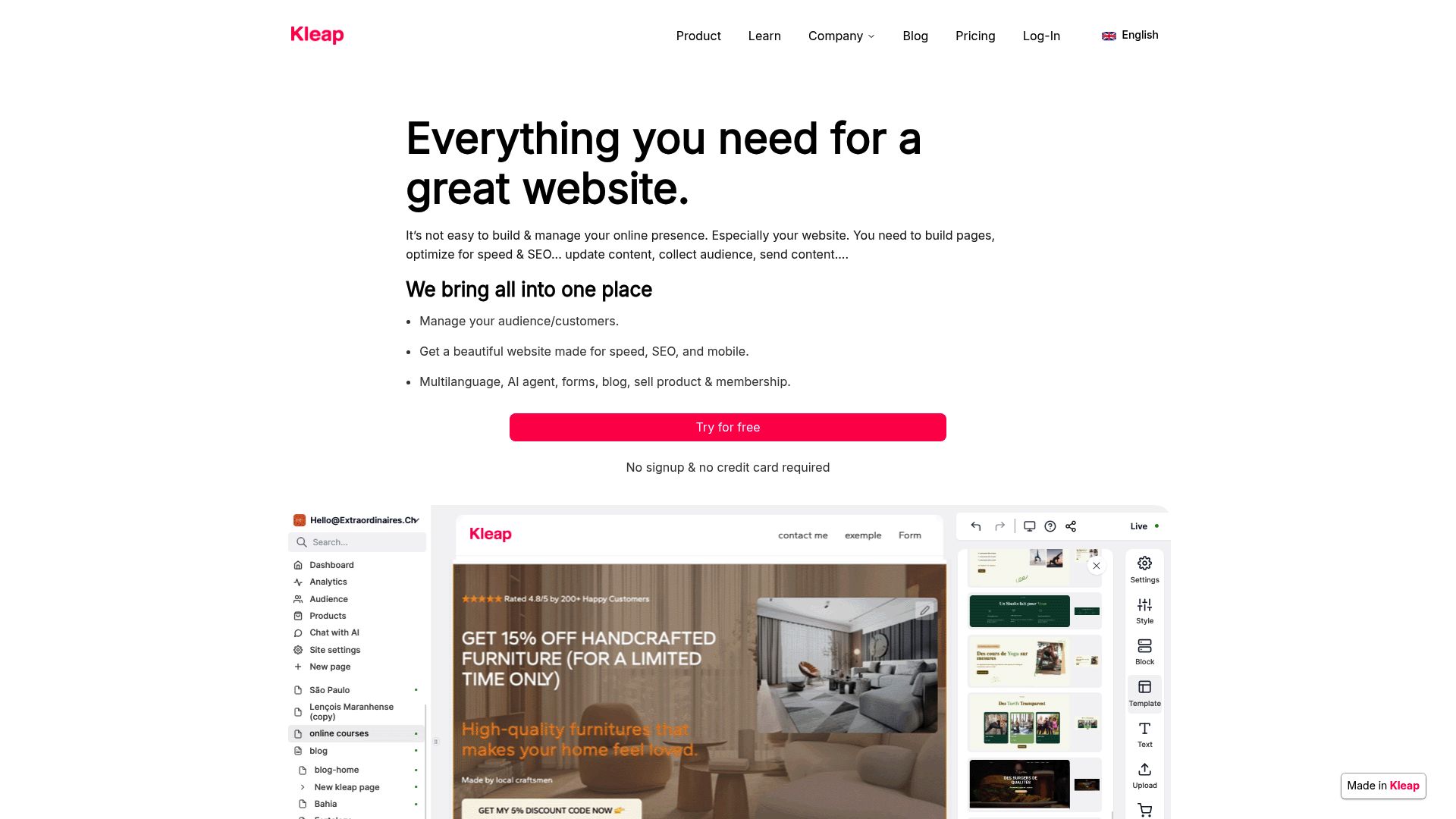
📸 kleap.co
Many AI-generated website builder platforms rely heavily on pre-designed templates.
According to B12, this can lead to a "cookie-cutter" appearance. The algorithms function based on pattern recognition.
They look at what already exists and replicate it. This means AI-designed sites often lack originality.
If you are a freelancer or a creative entrepreneur, your brand is your biggest asset.
Everbee notes that if you need to stand out in a crowded market, the general aesthetic provided by many AI solutions may not cut it. You disappear into the noise.
The layouts become repetitive.
The designs lack the distinct personality that makes a brand memorable. Pagecloud suggests that for businesses hinging on distinctiveness, these structured design options feel incredibly constricting.
You want to look like a market leader, not a generic template.
The Nightmare of Limited Customization
So, the AI builds the site. You look at it.
It is acceptable, but you may want to change the header, move the button to the left, or alter the way the gallery flows. That's usually where the honeymoon period ends. The biggest letdown with many AI website design builders is that they just don't understand what you're trying to do.
A major disadvantage of many AI website design builder tools is that they do not always align with your vision. The team at B12 says it well: if you're a stickler for details or have a certain style in mind, the rigid customization options can feel like hitting a brick wall.
Not having control is a huge problem. It's frustrating to deal with inflexible systems.
Pagecloud even points out that trying to tweak one tiny detail isn't always a walk in the park. Some platforms essentially "lock" you into the generated version.
To make significant changes, you may have to manually rebuild sections. This defeats the entire purpose of using automation in the first place.
This is why at Kleap, we focus on the concept of "And." AI and Control.
Pure generation without editing power is just a trap.
Missing Local Context and the "Human" Touch
Have you ever read a website that sounded like it was written by a robot?
It probably was.
What is AI website generation good for?
Speed. What is it bad at?
Nuance.
AI-generated content often lacks crucial business context.
Hemisphere DM notes that your website's content might use industry jargon your customers don't actually use. Or worse, it misses local references that build connection.
If you are a bakery in Brooklyn, mentioning "local sourcing" isn't enough; mentioning specific relationships with nearby farms or community events drives sales. AI doesn't know you sponsored the Little League team last week.
Furthermore, there is the copywriting issue. The folks at Pagecloud also mention that while AI copywriting is fast, the result often sounds robotic and completely off-brand.
Without editing, it fails to connect emotionally with your audience. It sounds overly polished.
Generic. It lacks the grit and voice of a real founder.
This requires you to go back in and rewrite the text anyway, creating more work for you.
Scalability: Hitting the Ceiling
When you start, you just want a site that works. But what happens when you grow?
This is the silent killer of the basic AI-generated website builder.
These tools are perfect for getting a simple site up quickly, but they fall short when you enter complex digital territories. B12 warns that if you want to integrate sophisticated e-commerce functions, personalized subscription models, or dynamic pricing, you will run into walls. The pre-packaged features are intended for broad use, not specific, complex growth strategies.
According to a review by Crocoblock, complex functionality often requires additional plugins or custom development that simple AI builders just don't support. You might find yourself six months in, realizing the platform can't support your new product line.
This leads to migration headaches. Mismatches between your needs and the tool's capabilities could force you to shift to a completely different platform. As B12 notes, this might require rebuilding your site from scratch.
That is a massive waste of time and resources better spent on attempting to acquire customers.
How to Use AI Correctly (The Hybrid Approach)
We've painted a pretty grim picture, but don't get us wrong. AI is revolutionary.
The problem isn't the technology; it's how people rely on it.
The fundamental issue is that automation cannot replace human judgment. An AI builder generates based on patterns it has seen before, not based on your unique business circumstances.
It doesn't understand your competitive landscape or your long-term vision.
However, the solution isn't to go back to hand-coding HTML. The solution is to prioritize tools that offer AI initialization with human refinement.
You need an AI-generated website builder that acts as an assistant, not the boss. You should look for platforms that:
- Generate the structure: Let AI handle the boring setup of margins, padding, and basic layout.
- Allow deep customization: Ensure you can change colors, fonts, and layouts instantly without coding.
- Put mobile first: You'd be surprised how many AI tools create sites that look broken on a phone.
- Integrate, don't get stuck: Your website needs to work well with the payment gateways and marketing tools you're already using.
The real magic happens when you mix AI's speed with your own control. As the team at UseMotion puts it, without that control, you're just getting a generic site that might look okay at first but won't actually help you grow your business.

Practical Takeaways for Freelancers and SMBs
If you are looking to build a site today, here is your checklist to avoid the "AI trap":
- Audit the Output: Don't accept the first draft. Rewrite the headlines to match your actual voice.
- Check Mobile Responsiveness: AI often messes up mobile views. Check it on your phone immediately.
- Inject Local SEO: Manually add your city, neighborhood, and local keywords that the AI missed.
- Choose Flexibility: Use a builder like Kleap that allows you to edit the generated content freely.
This brings us back to why the team built Kleap. We wanted the speed of the AI-generated website builder for that first spark of creation, but we refused to sacrifice the professional quality and customization that business owners actually need to sell their services.
You get the site up in minutes, but it is your site, not a robot's guess.
Conclusion
The allure of the "one-click website" is strong.
But for a business to truly succeed online, it needs more than just existence. It needs strategy, personality, and the ability to grow.
Purely AI-generated sites are often just digital placeholders.
They lack the strategic depth to convert visitors and the flexibility to scale with you. By understanding these limitations, you can use AI for what it is good at (speed and structure) while reserving the strategic and creative decisions for yourself.
Don't settle for a cookie-cutter brochure. Use AI as a springboard, not a crutch.
Ready to build a website that actually works for your business? Try Kleap today.
Get the speed of AI with the control of a professional platform.
FAQ: AI Website Builders
1. What is an AI generated website builder?
An AI-generated website builder is a tool that automatically creates a website for you after you answer a few simple questions about your business. It uses AI to pick out a template, write some initial copy, and even find images, so you don't have to touch a single line of code.
2. Can I customize a website built by AI?
That really depends on the platform.
Some AI builders pretty much lock you into the template they generate, which makes changing anything a real pain.
Hybrid platforms (like Kleap) generate the initial site using AI but give you full editing tools to customize the design and content afterward.
3. Is an AI website bad for SEO?
Not inherently, but often yes. Purely AI-generated content can be generic and lack the specific keywords and structure needed to rank well.
You almost always need to manually optimize the copy, headers, and meta descriptions to achieve good SEO results.
4. Will my AI website look like everyone else's?
If you don't take the time to customize it, then yeah, probably. A lot of these AI tools are working from the same playbook of design patterns.
If you want to stand out, you've got to bring your own flavor—your photos, your brand colors, and your unique voice—to the structure that the AI gives you.