AI Website Design Builder The Truth for Entrepreneurs

You are staring at a blinking cursor or a blank whiteboard.
You know you need a website. Your business technically doesn't exist until it has a URL.
But the path forward feels murky.
Do you spend thousands hiring a professional agency?
Or do you try to wrestle with a DIY platform yourself?
This is the dilemma every entrepreneur faces.
Lately, a third option has entered the chat: the AI website design builder. It promises the best of both worlds.
Speed. Efficiency. Professional looks without the professional price tag.
But is it too good to be true?
Can an algorithm really replicate the intuition of a human creative?
We are going to dig deep into this. We need to see if an AI website design builder is just a fancy toy or a legitimate business asset.
It’s not about bashing designers or overhyping robots. It is about finding the right tool for where your business is today.

The Surge of the AI Website Design Builder
The technology landscape has shifted. It wasn't long ago that building a website meant dealing with messy code or dragging pixelated boxes around a clunky screen for hours.
You had to know about padding, margins, and hex codes.
Now, artificial intelligence has changed the baseline. An AI website design builder doesn't just give you tools; it does the heavy lifting for you.
You input your business name, your industry, and maybe a few keywords about your vibe.
The system analyzes thousands of successful design patterns.
It looks at what works for your specific niche. In seconds, it generates a fully functional layout.
This isn't magic; it is efficient data processing.
But does efficiency equal quality?
We are seeing a massive adoption of these tools among freelancers and small business owners. The appeal is obvious.
You bypass the blank page paralysis. You get a starting point that looks polished right out of the gate.
Understanding the limitations is just as important as celebrating the speed. Let's break down exactly what the research says about this digital evolution.
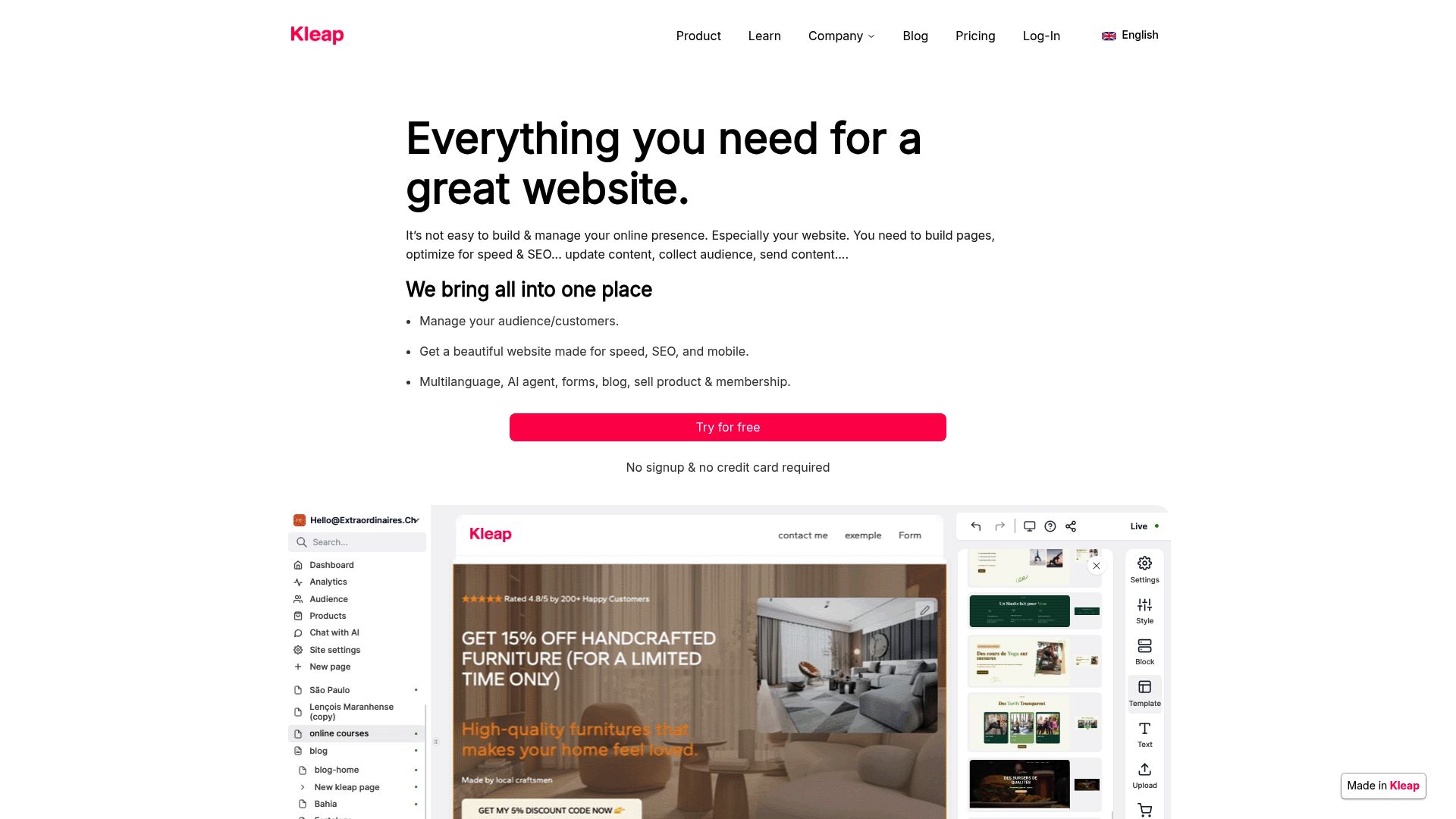
Try it — build your site while you read
Describe what you want and get a live, publishable site in seconds. Free to start, no code.
Join 200,000+ makers building real websites with Kleap.
Speed and Affordability: The Entrepreneur's Edge
Let's be real about the biggest hurdles in business: time and money. When you are bootstrapping a startup or launching a freelance career, cash flow is tight. You cannot always justify a five-figure expense for a digital brochure.
Research highlights that AI website design builder tools win hands down in this category. According to Seahawk Media, AI builders are capable of delivering websites in just minutes or hours.
This is ideal for rapid deployment when you simply need a digital presence quickly.
Compare that to the traditional route. Hiring a designer involves distinct phases.
Briefing. Wireframing.
Mockups.
Revisions.
Development, QA testing. The process creates a stunning result, but it often takes weeks or even months.
If you are launching a coffee shop next Friday, you do not have months.
You need a menu and a map online right now.
Cost is the other massive factor. Most AI solutions operate on a subscription model that costs less per month than a few lattes.
In contrast, professional design is a service industry. You are paying for expert hours, software licenses, and overhead.
For many, the math is simple.
The Freedom of DIY
There is also a psychological benefit here: control. Using an AI tool puts you in the driver's seat.
You don't have to wait for an email reply from a developer to change a headline.
You can test ideas instantly. Want to see if a blue button converts better than a red one? Just ask the AI to swap the palette.
This agility allows businesses to pivot significantly faster than those tethered to rigid agency contracts.

Resat Kuleli and Unsplash
Customization vs. Strategy: Where AI Hits the Wall
Now we have to look at the other side of the coin. Speed is great; however, if the destination is wrong, you are just getting lost faster.
The primary criticism of the AI website design builder is the 'cookie-cutter' effect. These tools work with templates and make automated choices. The AI is definitely smart, but it's essentially playing in a sandbox filled with pre-approved designs.
What does that mean for you?
It can lead to some pretty generic results. Your site might look clean and professional, sure, but it could also be a dead ringer for your competitor's site if you both used the same tool.
And standing out is everything in branding, right?
That’s where pro designers come in; they offer total customization.
They’re able to shape the entire design, layout, and functionality to match your unique brand and nail your business goals.
It's not just about making things look good; it's about visually solving your business problems.
A human designer gets the subtle stuff. They know your brand's 'playful' vibe means rounded corners and pastels, but maybe with a slightly rebellious twist that an AI just wouldn't catch.
AI has a tough time with brand storytelling and creating that gut-level emotional connection.
These emotional hooks are crucial for building customer trust. An algorithm knows where to place a Call to Action (CTA) based on heatmaps. A human knows how to phrase that CTA to resonate with a tired mother looking for a solution at 2 AM.
The Technical Ceiling
There is also the issue of complex functionality. If you need a standard portfolio or a simple store, an AI website design builder is fantastic.
But what if you need a custom client portal that integrates with a legacy database?
Custom features and advanced integrations are usually out of reach for most AI builders. This is well within a professional designer's skill set. They can write custom code to bridge gaps that drag-and-drop editors cannot cross.
We often tell our users at Kleap that identifying your functional needs early is vital. If you need a spaceship, don't buy a bicycle. However, if you just need to get to the grocery store, the bicycle is actually the better choice.
How to Design a Professional Website Without Coding
The democratization of design is the most exciting trend in our industry. You used to need to know HTML, CSS, and JavaScript just to put text on a screen.
That barrier to entry kept a lot of great ideas offline.
Today, learning how to design a professional website without coding is less about syntax and more about vision. The AI handles the syntax. Your job changes from "builder" to "creative director."
Modern AI builders use natural language processing. You type, "I want a section about our history with a timeline," and the code is generated in the background. You never see a bracket or a semicolon.
This shift allows you to focus on the content. What are you actually saying? Who are you saying it to?
The technical hurdle is removed, putting the focus back on marketing and communication.
However, "no-code" doesn't mean "no-skill." You still need to develop an eye for what looks good.
Even the best AI can produce a cluttered page if the user insists on adding too much text.
We always recommend keeping it simple.
Let the AI generate the structure, and try not to fight the design principles it applies. It bases its layout on the Golden Ratio and established grid systems. Trust the machine on the layout, but trust your gut on the message.

AI Content Generation for Websites
A website isn't just boxes and images. It is words.
Text. Copy.
This is often the biggest bottleneck in launching a site. You have the layout, but you are stuck writing the "About Us" page.
This is where AI content generation for websites becomes a superpower. Integrated AI tools can write your headlines, your product descriptions, and even your blog posts.
Imagine you are a florist. You tell the builder, "Write a welcoming headline for a wedding florist in Austin, Texas."
The AI might spit out: "Elegant Blooms for Your Austin Love Story."
That is arguably better than what a stressed business owner might come up with after a long day. It is SEO-optimized: geographically relevant, and emotionally resonant.
However, a human editor is still necessary. The unique tone of voice needs checking. AI can sometimes sound a bit robotic or overly enthusiastic.
You'll notice it loves words like "delve," "unlock," and "elevate." So, here's my advice: let the AI knock out that first draft for you.
It cures writer's block instantly. Then, go through and sprinkle in your personality.
Change "We provide excellent service" to "We treat every bouquet like it's for our own mom."
That mix of AI efficiency and human soul is the sweet spot.
It is how you scale content creation without sounding like a generic corporation.
Flexibility and Scalability Comparison
Starting small is smart, but what happens when you blow up?
That growth brings its own technical headaches, and this is where the inflexibility of some platforms can really start to hurt.
People often call AI-generated sites rigid, and for good reason. Trying to make changes beyond simple text and image edits can get tricky if you don't know your way around code.
For example, if the AI put your site together on a specific grid, trying to mess with that layout could totally wreck how it looks on a phone.
A web designer, though?
They build sites that are meant to adapt and grow from the get-go.
They're always thinking about the future. They'll build what might look like a complex back-end, but it’s designed that way to allow for growth, anticipating you might want to add something like a members-only section six months down the road.
I was reading some insights from CyberSprout, and they highlighted an important aspect: pros ensure that your site remains aligned with your business goals and doesn't break as you grow.
Think of it this way: they're laying a foundation that can support a skyscraper, while an AI builder is helping you construct a really, really nice cottage.
It is important to ask yourself: what is the five-year plan?
If you plan to stay a boutique consultancy, the AI website design builder will likely serve you forever. If you plan to become the next Amazon, you will eventually need a custom build.
But here is the thing: that is okay.
You don't need the Amazon infrastructure on day one. In fact, building it too early is a waste of capital.
Use the agile tool to start, and upgrade when your revenue justifies the expense.
📸 Kleap.co
Industry Verdicts and Expert Insights
We aren't the only ones talking about this. The entire tech world is debating the role of AI in creativity.
The consensus is shifting from 'replacement' to 'augmentation.'
Most experts agree that AI builders are not close to fully replacing web designers. They are best seen as tools for efficiency and rapid prototyping.
They are not substitutes for deep creativity and holistic strategy.
Future trends point toward collaboration. Designers are increasingly using AI to speed up their workflows.
They use generators to create wireframes or color palettes, then apply their expert layer on top.
According to W Academy, while DIY with AI is possible, most business owners eventually benefit from professional input. This might just be a consultation or a brand audit rather than a full build.
This hybrid approach is interesting. You might build your site with Kleap to go live quickly.
Once you are generating revenue, you hire a freelancer to tweak the CSS or refine the copy.
You aren't throwing the site away; you are polishing it.
Summary Table: AI Builder vs. Professional Designer
Sometimes you just need the facts laid out side by side. Here is how the two options stack up against each other based on current research.
This table makes the trade-off clear. You trade deep customization and human strategy for incredible speed and low cost. For many of you reading this, that is a trade you are happy to make right now.
When Should You Use an AI Builder?
Let's get practical. Who is the AI website design builder actually for? It is not for everyone; however, for specific segments, it is a game changer.
If you are a freelancer needing a portfolio, use AI. Your work speaks for itself; the site just needs to be a clean container for it. Spending $5,000 on a portfolio site is usually overkill.
If you are a local business, such as a restaurant, salon, or consultant, use AI. You need a homepage, services list, about section, and contact form.
AI excels at these standard structures.
This technology is perfect for what we call 'informational websites.' If the transaction doesn't happen on the site (or if it's a simple booking), AI is robust enough to handle it.
It is also the perfect tool for MVPs (Minimum Viable Products). If you have a business idea, don't spend six months building the perfect site. Build a 'good enough' site in one day, launch ads, and see if anyone clicks.
Speed of execution is more valuable than pixel perfection in the early stages.
When do you need a professional?
We would be lying if we said AI is the answer to everything. There are times when you absolutely should hire a human expert.
If you are building a complex SaaS platform, you need developers. The interface might be designed by AI, but the functionality needs human engineering.
If your brand strategy relies entirely on a unique, never-before-seen visual experience, you need a creative director. Take high-end fashion brands; they often pick a wild, artistic design over something that is super easy to use.
An AI is almost always going to choose usability.
If your site is a core part of your business bringing in millions, your appetite for risk changes completely.
At that point, you need a team on call to manage security, uptime, and ongoing tweaks. The stakes are just too high for a DIY platform.
It’s a bit like fixing up your house: you can definitely paint your own walls (that’s your AI builder).
You might even tile your own bathroom. But if you are tearing down load-bearing walls to build an extension, you hire a contractor.
The bottom line
Does an AI website design builder replace a designer?
Technically, no.
It doesn't replicate the human brain's ability to strategize, empathize, and innovate.
But functionally?
For the vast majority of small businesses, entrepreneurs, and freelancers, the answer is increasingly "yes."
It replaces the need for a designer in the early and middle stages of a business lifecycle.
It removes the gatekeepers that used to make professional web design a luxury item.
The landscape has changed.
You no longer have to choose between a website that looks like a high school project and bankruptcy. Tools like Kleap allow you to generate a stunning, mobile-optimized site while you finish your morning coffee.
The technology is here to assist you, not to limit you. Embrace the speed. Save your budget for marketing.
Get your idea out into the world.
If your business grows so big that the AI can no longer contain it, that is a pretty good problem to have.
FAQ
Can I switch from an AI builder to a custom design later?
Absolutely.
Many businesses start with an AI builder to validate their market and generate initial revenue. Once they outgrow the platform, they hire developers to migrate the content to a custom solution.
Think of the AI site as your launch pad.
Will my AI website rank on Google?
Yes, AI website design builder platforms usually generate clean code that search engines can read easily.
However, ranking depends heavily on the content you add.
You still need to do keyword research and write valuable text for your audience.
Is the content generated by AI copyright-free?
Generally, yes.
Content generated by AI for your website belongs to you, but laws are evolving.
It is always smart to customize the text to ensure it is unique to your brand and avoids any potential duplication issues across the web.
Do AI builders create mobile-friendly sites?
Most modern AI builders are mobile-first. They design for the smartphone screen effectively because they know that is where the majority of traffic comes from today. You usually don't have to do extra work to make it responsive.