Bookipi AI Website Builder Review Is It Good?

Starting a business is messy.
You have a million things to do, from chasing clients to managing finances. Somewhere in that chaos, you know that you need a website. It is the digital storefront that proves you exist.
Building one usually feels like a massive headache you simply don't have time for. That is exactly where the current wave of AI tools comes in.
You might be managing your invoices and hearing about the bookipi AI website builder. It promises to take the pain away by generating a site for you in seconds.
But is it actually any good?
Or is it just another shiny distraction that can't handle the heavy lifting when you need to run your business?
We are going to dig deep into this tool. We will look at what it does well, where it falls short, and ultimately help you decide if it is the right foundation for your digital presence.
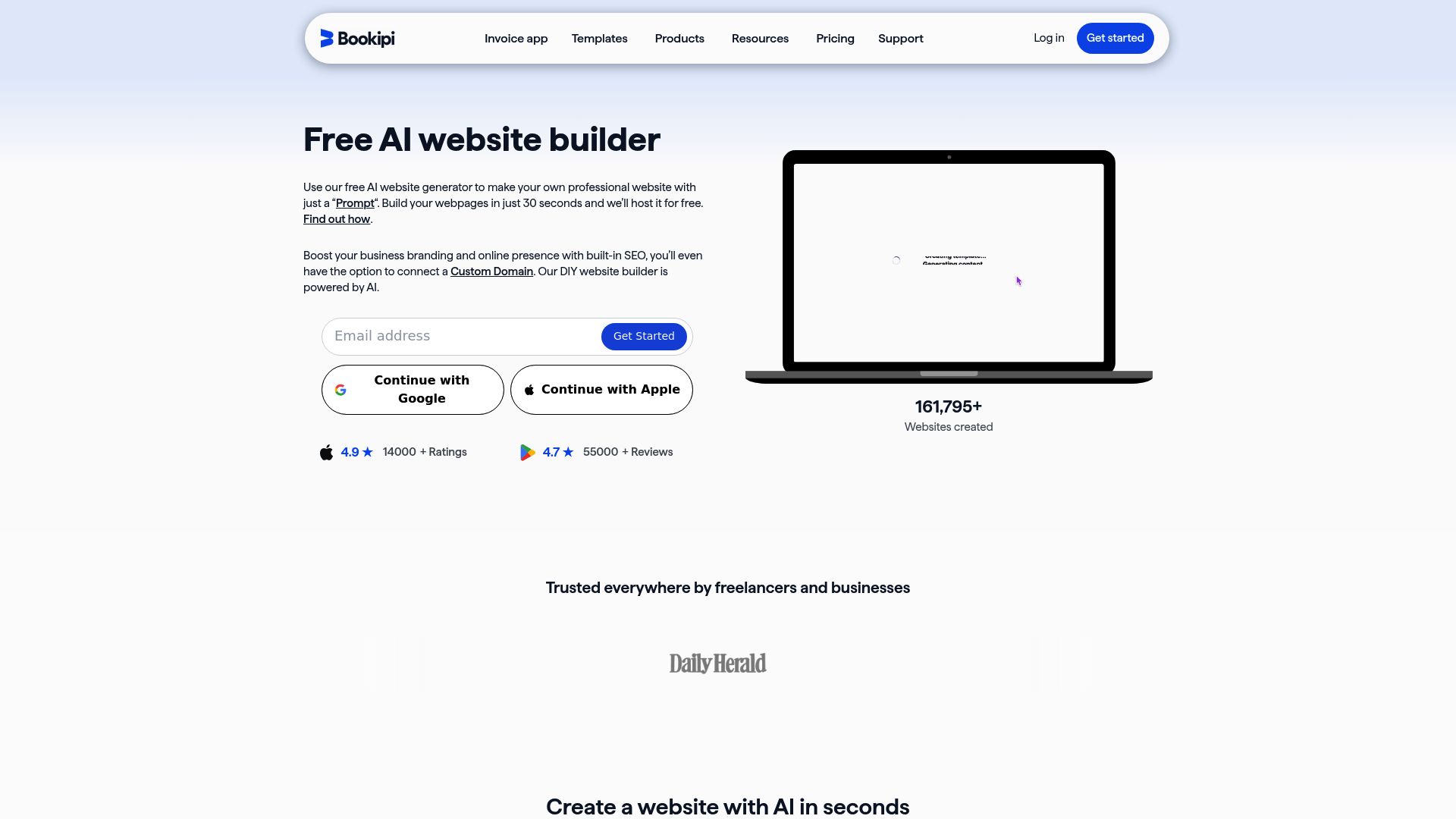
📸 bookipi.com/p>
It is important to understand that not all website builders are created equal. Some are built for power (some for design freedom, and some, like Bookipi) are built for pure speed and integration with financial tools. If you are looking for an affordable website builder for startups, the allure of a free, integrated tool is strong.
However, your website is often the first impression a customer gets of your brand. A weak website can actually cost you money by turning people away. We need to look past the marketing; we must see if the bookipi AI website builder can truly support a growing business or if you are better off with a specialized platform like Kleap.
In this review, we will cover everything, from the interface to the output quality, and most importantly, the limitations that usually are not mentioned until after you have signed up. Let’s get started.
Our verdict
- To understand the website builder, we must first examine the parent company.
- Speed is the name of the game here.
- Let's give credit where credit is due.
- Now we have to get real.
What Exactly Is the Bookipi AI Website Builder?
To understand the website builder, we first have to look at the parent company. Bookipi's main claim to fame is its solid invoicing and expense tracking app.
They have made a name for themselves by helping freelancers and small business owners get paid faster. That's baked into their DNA.
The AI website builder is a newer initiative, designed to keep their existing users from wandering off.
The whole idea is pretty straightforward. Since Bookipi already has some of your business information (such as its name, what you do, and where you are located), it uses that data to feed its AI and create a website for you. The goal isn't to be the next WordPress or Webflow.
They are not trying to compete with giants like WordPress or Webflow. Their goal is much simpler: to give freelancers a quick URL they can place on an invoice.
Understanding this is important because it explains everything that's great and not-so-great about the platform.
Think of it less as a full-blown website builder and more like a bonus feature for their finance software. If you're already using Bookipi for everything, this probably sounds amazing.
It brings all your tools under one roof.
But here is the catch: a tool built by finance experts might prioritize function over form, or utility over marketing flexibility.
As we move through this review, keep that in mind.
We are analyzing this through the lens of business growth, not just accounting convenience.

Try it — build your site while you read
Describe what you want and get a live, publishable site in seconds. Free to start, no code.
Join 200,000+ makers building real websites with Kleap.
How the Setup Process Works
Speed is the name of the game here.
When we tried the Bookipi AI website builder, we were shocked by how quickly the setup was. You are not dragging and dropping elements onto a blank canvas for hours.
Instead, you have a very brief conversation with an AI.
You just pop in your business name and industry, and then the AI asks for a quick rundown of what you do. This is where you need to be specific.
If you just say, "I bake cakes," you will get a generic bakery site. For example, if you say something like, "I bake custom gluten-free wedding cakes in Austin," the AI will do its best to customize the words and pictures for that niche.
I discovered on WowSlider that the tool uses these prompts to automatically create your headlines, descriptions, and even the layout. You don't have to write a single line of code.
For any business owner who breaks into a cold sweat just thinking about HTML or CSS, that’s a huge relief. They promise you can have a full layout ready in less than a minute.
Once the AI churns out the first draft, you are taken to a simplified editor.
Here, you can see what the algorithm has decided your brand looks like. It selects images, writes the copy, and sets up a contact form.
It feels a bit like magic the first time you see it happen.
However, reliance on AI generation means you are at the mercy of the algorithm's creativity. Sometimes the text is spot on.
Other times, it can feel a bit robotic or generic. You will almost certainly need to go in and polish the copy to sound like a human actually works there.
The setup is fast, yes, but the refinement phase is where you will spend your time.
Key Strengths of Bookipi's Solution
Let's give credit where credit is due. There are specific scenarios where the Bookipi AI website builder shines.
If you fit a certain profile, these features might be exactly what you are looking for.
1. Incredible Ease of Use
We cannot overstate how simple the interface is. Most traditional website builders suffer from "feature bloat," where you are overwhelmed by menus, plugins, and setting panels.
Bookipi strips all that away. It is designed for the non-technical user.
You can generate a basic business website in under a minute, as highlighted by TechRadar.
That accessibility is a major win for accessibility in the tech space.
2. Integration with Business Tools
This is the platform's superpower. If you are using Bookipi to send invoices, having your website capable of taking inquiries that lead directly into your client management flow is efficient.
It reduces the "app toggling" fatigue that many entrepreneurs suffer from. You are not trying to sticky-tape a third-party website builder to your accounting software; they are already roommates.
3. Cost-Effective Entry Point
Budget is always a concern for new ventures.
Bookipi offers a free plan that allows you to build and launch your business. For a business that has zero revenue yet, this is attractive. It lets you test the waters.
You can get an online link without putting down a credit card.
In our industry, finding a truly free starting point that yields a functional result is becoming rarer.
4. Basic SEO and Analytics
The platform includes a Google Analytics 4 connection and basic SEO settings. You can tweak meta titles and descriptions. While this isn't an advanced suite of marketing tools, it covers the absolute essentials.
You are not launching completely blind; you can at least track who is visiting your page, provided you know how to set up the Google side of things.

The Major Limitations You Need to Know
Now we have to get real. While the strengths are nice, the limitations of the bookipi AI website builder are significant. These are the factors that usually cause growing businesses to migrate away from the platform after six months.
It is better to know these hurdles now than to stumble over them later.
The Domain Name Dealbreaker
This is arguably the biggest issue for any serious business. As of 2025, the platform does not support native custom domain connections on its standard setup efficiently.
You're usually stuck with a subdomain (like yourbusiness.bookipi.com), which, as TechRadar points out, is a pretty big drawback.
So why does this matter?
It all comes down to trust. Just imagine handing a business card to a potential big-ticket client.
Does johns-consulting.bookipi.com scream 'established expert'?
Nope. It screams 'hobby'. A custom domain (like johnsconsulting.com) is pretty much non-negotiable if you want to be taken seriously.
Sure, there might be some workarounds or ways to connect it through other services, but not having a simple, built-in way to add your own domain is a huge headache.
Limited Customization and Design Freedom
The AI gives you a layout, and you can tweak it to a point.
You can swap images and rewrite text. But if you want to move a button three pixels to the left or completely overhaul the structure of a landing page to optimize for conversions, you are going to hit a wall.
B12 notes that the flexibility is lacking if you need more than the basics. You are trading creative control for speed.
For some, that is a fair trade. For a brand that wants to stand out, it is a cage.
Lack of Advanced Features
Do you want to add a blog to drive traffic?
You can't really do that effectively. Do you want a complex e-commerce store with product variants and inventory management?
It is not built for that. Do you need to inject custom JavaScript to run a specific tracking pixel or a unique animation?
Not happening. The feature set is locked down to keep things simple.
This prevents you from breaking the site, but it also prevents you from growing it.

Comparing Bookipi to Kleap: A Strategic Look
When you are shopping for a no-code website builder comparison, you need to look at the long-term trajectory of your business.
Bookipi is excellent if you view your website as a digital business card attached to an invoice. But what if you view your website as a sales machine?
This is where a platform like Kleap differentiates itself. Kleap is also an AI-powered builder, so you get that same speed-to-launch benefit. You don't need to code, and you can have a site up in minutes.
However, Kleap was built with a mobile-first, conversion-focused philosophy from day one.
With Kleap, you aren't just putting information on a screen.
You are building a funnel. The designs are optimized for how people actually browse today on their phones, scrolling quickly. Kleap understands that a pretty site is useless if it doesn't turn visitors into customers.
Furthermore, the rigidity we see in Bookipi isn't present in the same way.
Kleap allows for that professional polish, including custom domains and deeper integration with marketing tools, not just accounting ones.
It positions your brand as a leader, not just a participant.
Think of it this way: Bookipi helps you manage the business you have (invoicing). Kleap helps you get the business you want (marketing and conversion).
Who Should Actually Use Bookipi?
Despite the limitations, the bookipi AI website builder is the perfect solution for a specific group of people. We believe in using the right tool for the job, and sometimes, a simple tool is the right one.
If you are a freelancer (perhaps a graphic designer or a copywriter) and you already use Bookipi to manage your finances, this builder is a great add-on.
It allows you to verify your existence to clients without costing you extra money or time.
It is also suitable for 'Side Hustlers.' If you are testing a business idea and are not sure if it will work, do not spend weeks building a custom site. Use Bookipi to create a landing page, see if anyone bites, and send them an invoice.
It is the ultimate 'Minimum Viable Product' website tool.
However, if you are a local business trying to rank on Google Maps, a startup seeking angel investment, or a boutique shop wanting to sell products online, this tool will likely frustrate you within the first week.
Why 'Affordable' Can Sometimes Be Expensive
We often see searches for an affordable website builder for startups.
It makes sense. Cash flow is tight. Bookipi's free entry point ticks this box perfectly.
But we need to redefine what 'affordable' means in a business context.
There is the monetary cost (subscription fees), and then there is the opportunity cost. A free website that fails to convert visitors into leads is actually very expensive.
It costs you revenue every single day. If your website looks amateurish because you cannot connect a proper domain, or if it takes too long to load because the code isn't optimized, you are losing potential clients.
Sometimes, paying a small monthly fee for a platform with real SEO tools, great mobile design, and features that actually convert visitors can pay for itself with just one new client a month. So when you're looking at tools like Bookipi, you have to ask yourself: 'Is this really saving me money, or is it costing me future customers?'

Comparing No-Code Builders: Where Does Bookipi Fit In?
The world of no-code tools is definitely crowded. You've got the huge names like Wix and Squarespace, the more complex platforms for designers like Webflow, and this whole new wave of AI builders.
So where does the Bookipi AI builder land on this map?
It's squarely in the 'Utility' corner.
Wix and Squarespace are in the 'Creative & General-Purpose' corner; they do a bit of everything but can get overwhelming and pricey.
Then you have Webflow, which is definitely in the 'Pro Designer' corner.
It's incredibly powerful but comes with a seriously steep learning curve.
Kleap and Bookipi sit in the 'AI Efficiency' corner. But even here, they diverge.
Bookipi leans towards administrative utility.
Kleap leans towards growth and marketing utility.
If you need to create a digital brochure quickly, Bookipi works. If you need a digital salesperson, you look towards platforms designed for conversion.
| Feature | Bookipi AI Builder | Standard Builders (Wix/Sqsp) | Conversion AI Builders (Kleap) |
|---|---|---|---|
| Speed to Launch | Extremely Fast (< 1 min) | Slow (Hours/Days) | Extremely Fast (< 1 min) |
| Coding Required | None | None | None |
| Custom Domain | Difficult / Not Native | Yes (Paid) | Yes |
| Focus | Invoicing Integration | Design Flexibility | Mobile Conversion & Sales |
| Cost | Free / Low Cost | Mid to High Cost | Competitive |
The Importance of Content Quality in AI Builders
One aspect that often gets overlooked in reviews is the quality of the content generated. Under the hood, the Bookipi AI website builder uses Large Language Models (LLMs) to write the text for your site. If you look at Bookipi's own marketing materials, they say this helps fill your site with relevant keywords right from the start.
However, AI content is a starting block, not a finish line. Search engines like Google are getting smarter at detecting low-effort, purely AI-generated content.
While Bookipi gives you the text, it is the user's responsibility to inject personality.
It's good that the platform lets you edit the text. But since the design templates are pretty rigid, you might find it's a real struggle to fit your unique, human story into the robotic text boxes they provide.
Platforms that really think about content hierarchy, such as how a visitor's eye moves from the headline down to the 'buy now' button, almost always perform better.
It's one of those subtle things where platforms built for design usually have a clear edge over those built just for utility.
Mobile Optimization: A Critical Factor
We live in a mobile-first world.
If your website looks great on a desktop but breaks on an iPhone, you are invisible to the majority of your market.
Bookipi's templates are generally responsive.
They stack correctly on smaller screens.
However, 'responsive' and 'optimized' are two different things.
Responsive just means nothing is broken. Optimized means the experience is delightful on a thumb-scroll. Because Bookipi's builder is basic, you have limited control over the specific mobile experience.
You cannot easily hide an element on mobile that clutters the screen.
This is a sharp contrast to Kleap, which is built specifically to look and feel like a high-end app on mobile devices. If your audience is finding you through Instagram or TikTok, where they are already on their phones, the mobile experience is the only one that matters.

Expert Opinions on the Platform
We are not the only ones analyzing this tool. It helps to look at the consensus across the tech industry.
TechRadar, a giant in tech reviews, finds the tool easy and fast for basics but explicitly does not recommend it for building professional, feature-rich, or highly branded business sites yet. That is a polite way of saying 'keep it simple.'
Similarly, review aggregators and directories like B12 agree that while the simplicity is a strong starting point, the lack of depth is a real hindrance for anyone looking to scale.
The consistent theme across all expert reviews is that Bookipi helps you start, but it doesn't necessarily help you grow.
Bookipi itself positions the product carefully.
They market it as an integrated add-on for busy small business owners. They aren't claiming to eliminate professional web designers. They are trying to save their invoicing users a few hours of time.
Strategies for Using Bookipi Effectively
If you decide that the bookipi AI website builder is the right choice for you right now, there are ways to make the most of it. Don't just click "generate" and walk away.
You need to put in a little bit of work to overcome the limitations.
First, spend time on your imagery. Since you cannot change the layout much, high-quality custom photos (not stock photos) are the best way to differentiate your site.
Show your actual face, your actual product, or your actual office.
Second, use the integration.
If the tool's strength is invoicing, leverage that. Make it incredibly easy for someone to hire you and pay you.
Making the Transition: When to Upgrade
A common path we see is the "graduation" strategy.
A freelancer starts with a free or low-cost tool like Bookipi to get their first three clients. It works.
It's low risk.
But once those three clients turn into thirty, the limitations start to chafe.
The lack of a custom domain starts to feel embarrassing. The inability to add a scheduling widget becomes a scheduling nightmare. This is the moment of transition.
Moving a website from a proprietary builder like Bookipi to another platform usually means rebuilding from scratch. You cannot just "export" the code.
This is why some entrepreneurs prefer to start on a platform that can scale with them, like Kleap, even if it's their Day 1. It saves the headache of a migration six months down the road.
Actionable Advice for Small Business Owners
So, you are sitting there with a laptop and a business idea. What should you do?
Here is our straightforward advice.
If you have zero budget and simply need to prove you exist for a bank application or a vendor registration, use the bookipi AI website builder. It is fast, free, and checks the box.
If you are building a brand that relies on consumer trust, aesthetic appeal, or organic search traffic (SEO), you should look at more robust AI solutions.
Look for a builder that offers:
- Native custom domain support (yourname.com).
- Mobile-first design architecture.
- Advanced SEO customization options.
- Flexibility to add marketing integrations.
Your website is digital real estate. You want to build your house on land that you can develop, not in a rented room where you aren't allowed to hang pictures on the wall.
Conclusion
The Bookipi AI website builder's arrival is definitely a win for the industry because it makes getting online easier for everyone. It's another step toward making technology something anyone can use, not just folks who know how to code. For people already deep inside the Bookipi finance world, it’s a super convenient and logical add-on to what they're already doing.
But here's the thing: convenient doesn't always mean effective.
With its limits on custom domains, rigid designs, and the simple fact that it doesn't scale well, it becomes a tough sell for any ambitious entrepreneur. This is especially true for those who really want to stand out in a crowded digital market.
If your goal is simply to send an invoice with a link attached, Bookipi is sufficient. But if your goal is to captivate an audience, drive conversions, and build a digital asset that grows with you, you might find yourself outgrowing the tool faster than you expect. In the world of website builders, you often get what you pay for, not just in dollars, but in capabilities.
Ready to build a website that actually drives business growth?
Explore Kleap and see the difference a conversion-focused AI builder can make for your brand.
FAQ
Is the Bookipi AI Website Builder really free?
Yes, Bookipi offers a free plan that allows you to build and publish a basic website. But just know that getting advanced features, removing their branding, or trying to use a custom domain will likely mean needing a paid plan, and even then, domain options are limited.
Can I use my own domain name with Bookipi?
As of early 2025, easily connecting your own custom domain is one of its biggest limitations. Most of the time, you'll have to use a Bookipi subdomain, which really isn't the best look if you're trying to build a professional brand.
How does Bookipi compare to Kleap?
Think of Bookipi as a simple add-on for its invoicing customers, built just to give them a basic web presence. Kleap, on the other hand, is a dedicated AI website builder built from the ground up for mobile sales, marketing, and growing with your business, all while using your own custom domain.
Do I need coding skills to use Bookipi?
Nope.