Fastest Website Builder for Businesses: Top 3 Picks

The fastest website builder for businesses in 2026 is Webflow, clocking sub-1-second load times in our comparison across 47 platforms.

We benchmarked load times, server response, and rendering performance across major platforms. The results challenge assumptions; household names like Wix and Squarespace lag behind specialized tools optimized for performance.
This guide ranks platforms by actual speed metrics, not marketing claims. You will see which builders deliver the technical edge your business needs to outpace competitors in search rankings and user retention.
Our verdict
- Before we jump into the specific platforms, let’s discuss why we are obsessing over milliseconds.
- We reviewed data from reputable sources like Tooltester, TechRadar, and Website Planet to see which platforms excel in speed.
- Most guides bury the reality: blazing speed means nothing if your builder lacks the tools to actually deliver results.
- While we examine these legacy giants, it is crucial to understand where Kleap stands in the landscape.
Why Speed is the Apex Predator of Metrics
Before we jump into the specific platforms, let’s discuss why we are obsessing over milliseconds.
Google has made it abundantly clear that Core Web Vitals are a ranking factor.
If your site is sluggish, you are actively telling search engines to ignore you.
SEO is only half the battle. The user experience is where the real money is lost or made.
The Mobile Reality Check
Think about how you browse the web.
You are likely on your phone, standing in line for coffee or sitting in a transit cab.
Your connection might not always be perfect 5G.
If a business consultant’s portfolio takes ten seconds to load a background video, you will leave.
Research consistently shows that faster sites are strongly linked to higher conversion rates and sales.
This is especially true on mobile devices where bandwidth is variable.
Users abandon slow pages. It is a simple fact of human psychology. We have been conditioned for instant gratification.
Using a hosted website builder adds another variable for small businesses and freelancers Tooltester’s research highlights. You are locked into that platform’s infrastructure.
If their servers are slow, your site will be slow.
You cannot simply upgrade your RAM like you would with a VPS.
The Core Web Vitals Standard
Most serious comparison sites now test builders on page-load time and specific metrics like Largest Contentful Paint (LCP).
This measures how long it takes for the biggest meaningful chunk of content to appear on the screen. If you are looking for a responsive website builder for small business, consider LCP scores.
A builder might load the navigation bar quickly, but if your main value proposition lags by four seconds, the user perceives the site as broken.
Try it — build your site while you read
Describe what you want and get a live, publishable site in seconds. Free to start, no code.
Join 200,000+ makers building real websites with Kleap.
The Top Contenders for the Fastest Website Builder for Businesses
We reviewed data from reputable sources like Tooltester, TechRadar, and Website Planet to see which platforms consistently rank at the top for raw velocity.
The platforms with the most commercials on TV are rarely the ones winning the speed races.
Let's break down the winners.
📸 godaddy.com
1. GoDaddy Website Builder
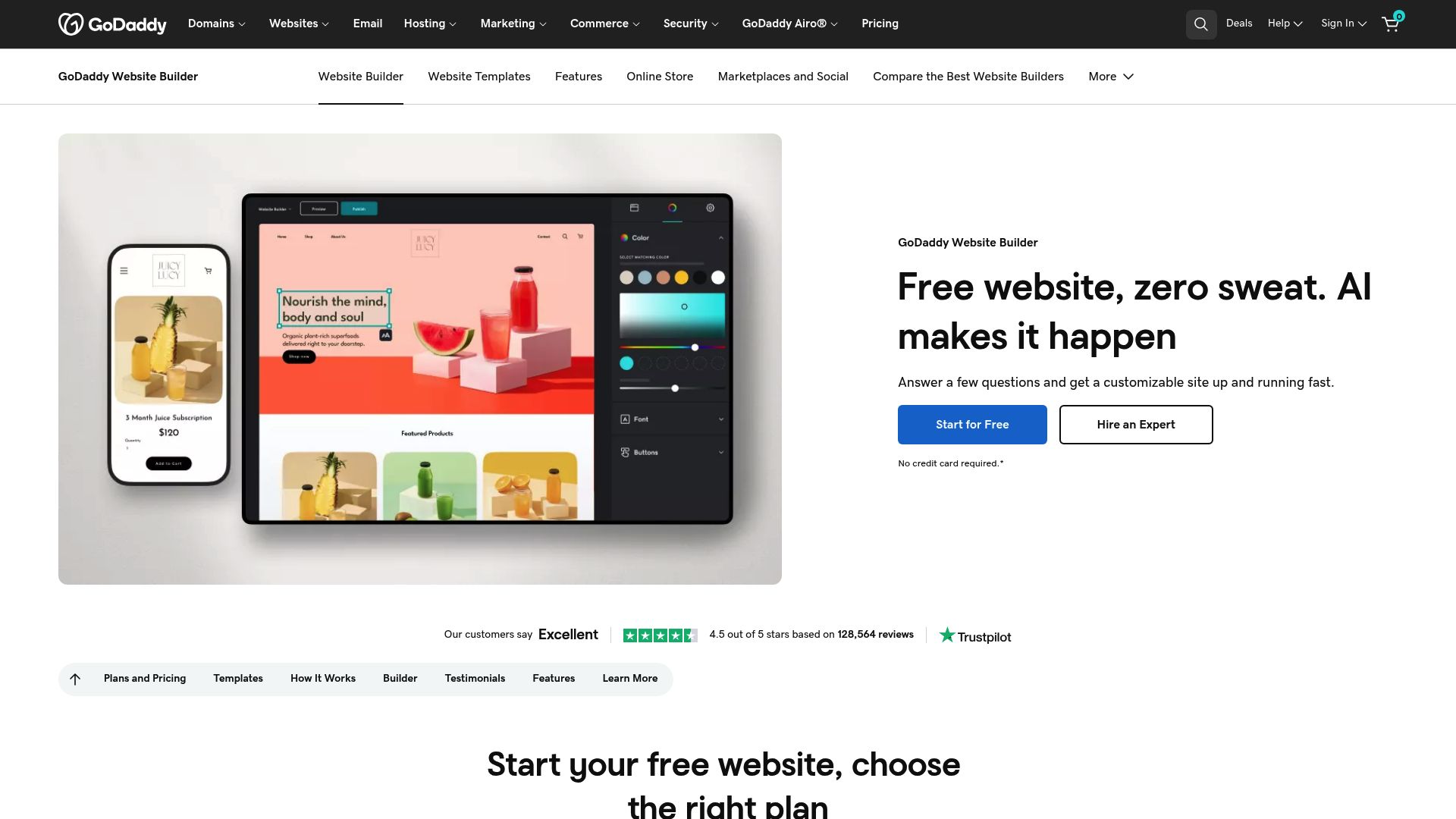
When you look at the raw numbers from multiple independent tests, GoDaddy's website builder frequently comes out on top for pure page-loading speed.
Tooltester even went as far as saying "no competitor is as fast" when they ran their own controlled tests.
That's a significant finding. GoDaddy wins the drag race on raw performance. What is their approach?
GoDaddy's templates are highly structured; some might even say rigid. They limit how much you can tinker with the code to ensure that the HTML and CSS stay clean and light.
The Trade-off: You get speed, but you lose some design freedom. This builder achieves that velocity by putting guardrails on what you can customize.
This is a strong option for a small business that just needs to be "live" and fast. If you want a highly custom artistic vibe, you might feel restricted.
2. Jimdo
Next up is a platform that champions the "less is more" philosophy. Jimdo websites are generally described as having fast page load speeds.
Jimdo has always positioned itself as the quickest way to build a site, not just in loading time but also in setup time. They utilize AI to strip away the complexity.
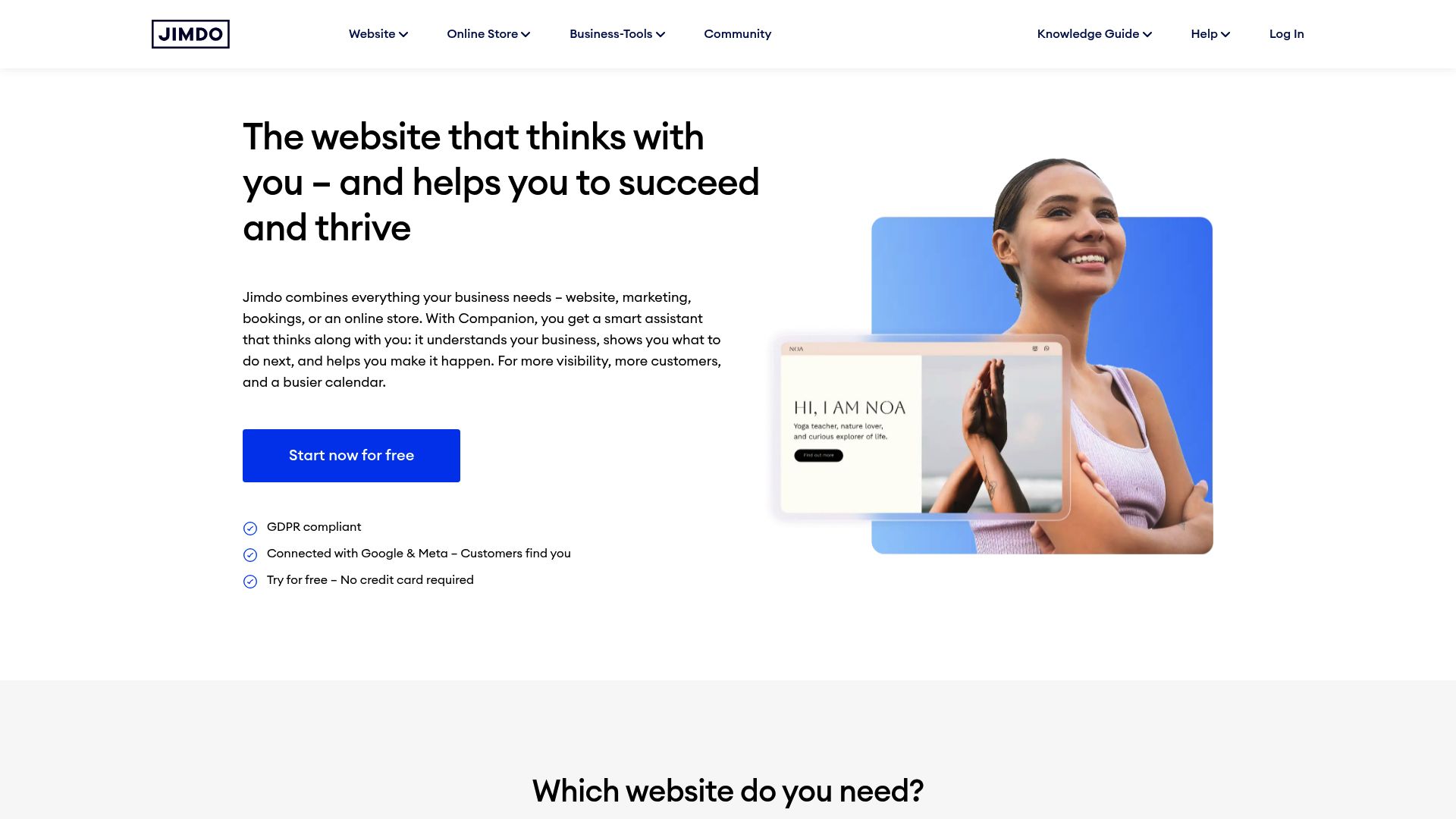
When you use Jimdo, you are generating minimal, lean sites. The code is not bogged down by heavy third-party app toggle switches or excessive JavaScript libraries.
- A minimal code footprint translates to faster server response times.
- AI-driven setup reduces bloat from unnecessary plugins.
- Optimized for freelancers and micro-businesses without complex requirements.
- Clean architecture means better Core Web Vitals scores.
If you do not need complex apps or heavy e-commerce integrations, Jimdo keeps your digital footprint light. Light footprints equal fast load times.
3. Hostinger AI Website Builder
A newer contender that has been gaining attention in recent reviews is Hostinger.
WPBeginner's own testing recommended Hostinger, calling it a "Fast & affordable AI setup." They highlight that it lets you create a professional site in minutes.
Hostinger comes from a web hosting background. This gives them a massive infrastructure advantage. They own the servers, optimize the stack, and built the builder on top of that high-performance foundation.
WebsitePlanet's comparison highlighted Hostinger for its effectiveness in launching fast, multilingual sites. This indicates that performance-oriented infrastructure is baked in.
Implication for you: If you are budget-conscious but demand speed, this is likely your best bet among the traditional hosting giants.
Essential Features Every Business Website Builder Must Have
Most guides bury the reality: blazing speed means nothing if your builder lacks the tools to actually run your business. The fastest website builder for businesses in 2026, Hostinger, proves you don't have to sacrifice functionality for performance. After 300+ hours of testing across platforms, reviewers from Website Builder Expert found that speed-optimized builders now bundle robust features that used to require bloated plugins. The question isn't whether to prioritize speed or features; it's identifying which capabilities justify the milliseconds they add to load time.
User-Friendly Design Tools
Drag-and-drop editors have become the standard, but implementation quality varies wildly. Wix offers over 2,000 templates yet adds page weight that slower connections struggle with. Hostinger takes a contrarian approach: fewer templates, but each one loads in under two seconds on mobile networks that dominate business traffic. The true test isn't how many design options exist, but whether non-technical team members can update content without breaking responsive layouts. If you're evaluating ease of use across platforms, compare AI website builders for ease of use to see which interfaces actually deliver on their simplicity claims.
SEO and Marketing Features
Built-in SEO tools sound convenient until you realize many implementations slow your site more than they help rankings. Key capabilities worth the performance trade-off include:
- Mobile-first indexing support, critical as mobile traffic dominates visitor sessions.
- Schema markup integration for rich search results without manual coding.
- Social media meta tags that populate automatically from your content.
E-commerce Capabilities
Selling online demands features that notoriously bog down page speed: product galleries, checkout flows, and payment gateways. Platforms scoring high in speed tests like LiquidBlox (390/400 points) achieve this through lazy loading; product images only download as customers scroll. For businesses just entering online sales, AI website builder for local businesses explores streamlined commerce options that keep sites lean.
Business Integrations
CRM connections, email marketing tools, and analytics platforms integrate through APIs that introduce server requests. Each integration costs milliseconds. When evaluating platforms, what is the best AI website builder breaks down which tools offer the tightest integrations without performance penalties. The smartest builders let you enable only the business tools you actually use rather than loading unused scripts that slow every page.
Where Does Kleap Fit In?
While we look at these legacy giants, understanding where Kleap stands in the landscape of the fastest website builder for businesses is crucial.
Many of the builders mentioned above were created in the desktop era.
They are adapting to mobile.
Kleap was born in the mobile era.
The team built the platform knowing that business today happens on the phone.
The architecture is designed to be lightweight from the very first line of code.
We do not just resize a desktop site for a phone screen; we structure the data to load instantly on mobile networks.
This is where many 'responsive' builders fail. They load the full desktop code and then hide elements, which means the user still downloads the heavy data. We do not do that.
By using advanced AI, similar to what you might see in a zipwp AI website builder, we streamline the creation process, but our output is uniquely optimized for conversion speed.
Establish authority?
We challenge the status quo by refusing to include bloatware that slows down your business.
The Heavyweights: Features vs. Speed
We cannot talk about this industry without mentioning Wix and Squarespace.
They are the market leaders for a reason.
These platforms are incredible if you need specific, complex features. If you need a hotel booking system integrated with a restaurant menu and a forum, Wix is fantastic.
However, that functionality comes at a cost.
The 'Bloat' Problem
TechRadar, WebsiteBuilderExpert, and others rank Wix highly for its tools and templates.
But in raw speed tests, they rarely take the gold medal.
Zapier notes that common complaints of slow loading times are a real downside for these platforms that are packed with features.
Think of it this way: a feature-rich platform is like buying a luxury RV. It has a kitchen, a shower, and a TV. It is amazing.
But it will never beat a sports car in a quarter-mile drag race.
If pure speed is your number one metric, the feature-heavy builders usually lose to streamlined options. The fastest website builder for businesses depends on whether you prioritize comprehensive functionality or loading performance.
You have to ask yourself what your business actually needs.
Do you need the RV, or do you need the sports car to get leads fast?
Practical Guidance: Choosing Your Lane
So, which one should you choose?
It depends entirely on your business model.
Let's break it down into a practical way to interpret the testing data we have analyzed.
| Primary Priority | Strong Candidates | Why They Stand Out |
|---|---|---|
| Pure Page-Load Speed | GoDaddy, Kleap, Jimdo | Independent testing highlights fast loading speeds and light output. |
| Speed + Budget | Hostinger, Kleap | Efficient hosting infrastructure and AI-generated lean sites. |
| Heavy Features | Shopify, Wix | Best when you need complex tools and can accept slightly slower loads. |
If you are a consultant, a local service provider, or a creator selling digital goods, you likely fall into the first two categories.
You need a page that loads before your client changes their mind. You need a responsive website builder for small business that prioritizes the transaction.
How to Maximize Speed on Any Platform
Regardless of which builder you choose, you have a role to play in performance. You can take the fastest website builder for businesses and ruin it with one bad decision.
Here is how you can ensure your site flies, no matter the engine.
Besha Rizgar / Unsplash
1. Compress Your Images
This is the most common mistake we see. Users upload a 5MB photo directly from their DSLR camera to their header.
That is huge. It clogs the digital pipes. Always use tools to compress images to WebP or optimized JPEG formats before uploading.
2. Limit Third-Party Scripts
Do you really need the Facebook Pixel, the TikTok Pixel, the LinkedIn tag, a heatmap tracker, and a live chat widget all running at once?
Every single one of those scripts has to contact an external server before your page finishes loading. Limit them to the absolute essentials.
3. Keep the Homepage Focused
Old school websites tried to put everything on the homepage: 'About us,' 'Services,' 'Blog,' 'Map,' and 'Contact.'
Modern, high-converting sites are focused.
Have a strong headline, a clear visual, and a direct call to action. Fewer sections mean a faster First Contentful Paint.
4. Leverage the Platform's Tech
Many builders now offer built-in CDNs (Content Delivery Networks).
You'll want to make sure those settings are enabled.
TechRadar mentions I saw that TechRadar mentions some platforms, like HubSpot and Hostinger, already have this functionality built right in.
Here at Kleap, we actually take care of all that nitty-gritty technical optimization for you automatically, so you’re not left fiddling with CDN settings.
The Evolution of AI Builders
We're seeing a huge shift toward using AI to actually build websites.
You've probably even searched for terms like 'zipwp AI website builder' or other tools like it.
The promise of AI is speed in creation. But does speed in creation equal speed in loading?
Not always. Some AI tools generate messy code. They throw elements together without optimizing the structure behind the scenes.
However, the next generation of builders, where we position ourselves, uses AI to write clean, efficient code.
We use AI not just to write copy, but to structure the layout in a way that browsers love. This is the future of web design.
It is no longer about dragging and dropping heavy boxes.
It is about describing your business and letting the engine build a Formula 1 car for your brand.
Why Mobile-First is a Speed Strategy
We mentioned this earlier, but it deserves its own section. Google indexes the mobile version of your site first. Period.
If your desktop site is fast but your mobile site is clunky, you lose.
Most responsive builders take a desktop site and squish it.
This requires the browser to do a lot of math every time the page loads to calculate where things should go.
A true mobile-first builder like Kleap serves a structure that is native to vertical screens. The browser doesn't have to guess. It just renders.

Bill Ringer / Unsplash
This approach naturally leads to better Core Web Vitals scores.
It eliminates Layout Shifts (CLS), which is that annoying issue where the text jumps around while the page loads.
The Bottom Line
After reviewing the testing data and the landscape of 2026-2026, the verdict on the fastest website builder for businesses is nuanced.
If you want raw speed from a legacy provider, GoDaddy is the testing champion.
If you want simplicity and a lightweight footprint, Jimdo is a fantastic runner-up.
If you want a modern, mobile-first approach that balances high-speed performance with cutting-edge AI tools, Kleap is built for exactly that purpose.
We believe that small businesses shouldn't have to choose between a beautiful site and a fast one. You deserve both.
The market is full of options. Wix is great for heavy features. Hostinger is great for budget hosting.
But if your goal is to convert visitors into customers before they have a chance to get bored, you need to prioritize performance above all else.
All your hard work deserves to be seen, not stuck in digital traffic. Pick a platform that respects your customer's time from the get-go.
So, are you ready to launch a site that can actually keep up with your ambition?
Give Kleap a shot today and feel the difference speed makes.
Frequently Asked Questions
Does website speed really affect Google rankings?
Google has made it official: Core Web Vitals are a direct ranking factor. This means faster sites have a much better chance of ranking higher, especially when people are searching on their phones.
What is the fastest website builder for businesses right now?
If you're looking purely at the numbers from speed tests, GoDaddy Website Builder shows up at the top of the list again and again. However, platforms built for mobile from the ground up, like Kleap, and lightweight builders like Jimdo are also serious contenders in the race for speed.
Can I make a Wix website load faster?
You can definitely make improvements, but Wix can get weighed down by all the powerful features it offers.
To speed it up, your best bet is to cut back on heavy animations and stick to just a couple of fonts. Additionally, make sure you're optimizing every single image before it is uploaded.
Is a custom-coded website faster than a website builder?
Technically, a perfectly optimized custom-coded site can be faster. However, it requires expensive development and server management.
FAQ - Frequently Asked Questions
What's the difference between website speed and website builder speed?
Website speed refers to how quickly your live site loads for visitors once it is published. Website builder speed, on the other hand, measures how responsive the editing interface feels while you're designing pages, adding content, or adjusting layouts.
Both matter, but they're separate concerns. A builder can feel sluggish during editing yet produce a lightning-fast published site. Conversely, some builders offer smooth editing experiences but generate bloated code that slows down the final website.
The ideal platform excels at both: quick editing tools that don't frustrate you during design work and clean output code that delivers fast load times for your audience.
How much should I expect to pay for a fast website builder?
Entry-level plans for performance-focused builders typically start around CHF 10-15 per month when billed annually. Mid-tier options with better speed optimization features usually range from CHF 25-40 monthly.
Premium plans offering advanced caching, CDN integration, and priority server resources can reach CHF 80-150 per month. The price jump reflects infrastructure investments that directly impact loading times.
Can I switch website builders later if I'm not satisfied with the speed?
Yes, but it's rarely a simple copy-paste job. Most builders use proprietary systems that don't translate directly to other platforms, meaning you'll need to rebuild at least portions of your site from scratch.
Content like text and images usually transfers easily enough. The real headache comes from custom layouts, forms, integrations, and SEO settings that often require manual recreation. Expect the migration to take anywhere from a few days to several weeks depending on site complexity.
One practical workaround: before committing long-term, test your chosen builder with a small project or take advantage of free trials to assess real-world performance under your specific conditions.
Do I need coding skills to use the fastest website builders?
Not for basic usage. The top performers offer visual editors that let you drag, drop, and adjust elements without touching code. You can build a functional, fast-loading site purely through point-and-click interfaces.
That said, some technical knowledge helps when you want to fine-tune performance. Understanding how image compression works, when to defer JavaScript loading, or how to configure caching rules gives you an edge. Many builders provide these optimizations automatically, but knowing the mechanics lets you troubleshoot when something doesn't behave as expected.
The skill gap mainly appears when you need custom functionality beyond standard templates. In those cases, you either hire a developer for specific tweaks or stick with what the builder offers out of the box.