2 Secrets Website Builder Using AI For More Sales

You know that feeling when you launch a website, sit back, and wait for the sales to roll in, but nothing happens?
It is frustrating. You built a beautiful home for your business, but the lights are on and nobody is home.
It seems like everyone is struggling with this lately.
Here creates the problem.
Most people think the job is done once the design looks pretty. But in the digital world we live in today, pretty doesn't always pay the bills.
This is where the technology has shifted dramatically.
We aren't just talking about drag-and-drop tools anymore. We are talking about a website builder using AI that acts more like a digital sales manager than a digital paintbrush.
The secret isn't in the colors or the fonts. It lies in the data. An AI-powered builder doesn't just guess what works; it creates sales pathways based on what has actually worked for thousands of other businesses.
Key takeaways
- Let's be honest about how websites used to be built.
- You might be wondering how this actually works under the hood.
- This is a question we hear constantly.
- You can have the best converter in the world, but it is useless without traffic.
- It helps to look at the data side, by, side.
Why a Website Builder Using AI Changes the Game
Let's be honest about how websites used to be built. You would hire a designer: wait six weeks, pay a fortune, and end up with a static brochure. If you wanted to change a headline to test a production description, you had to call the developer.
It was slow.
It was painful.
A website builder using AI completely removes that friction. But sticking to the basics of speed is missing the bigger picture.
The real game-changer is intelligence.
Think about it this way. When you use a tool like Kleap or similar innovative platforms, you leverage machine learning that understands user intent. The AI knows where eyes land on a page.
It knows which button colors trigger urgency.
We are seeing a shift from "static design" to "dynamic conversion." According to recent observations in the tech space, the key isn't just attractive design. It lies in leveraging AI's ability to optimize every element of your site for conversions, from layout to personalized experiences.
For small businesses and freelancers, this is massive.
You don't need a degree in marketing psychology anymore. The software handles the heavy lifting of figuring out why a visitor isn't clicking "Buy Now."
Try it — build your site while you read
Describe what you want and get a live, publishable site in seconds. Free to start, no code.
Join 200,000+ makers building real websites with Kleap.
Data-Driven Optimization: The Sales Engine
You might be wondering how this actually works under the hood. It is not magic.
It is math.
AI analyzes hundreds, sometimes thousands, of user interactions. It identifies which headlines stop the scroll and which Call to Actions (CTAs) get ignored.
It is like having a focus group running on your website 24/7.
Behavioral analytics are integrated directly into the building process.
Research suggests that leveraging these insights for automatic refinement of site elements can significantly enhance engagement. Imagine your website realizing that your sign-up form is too low on the page and suggesting you move it up.
That is the power of a website builder using AI. It removes the guesswork.
If you are manually A/B testing every headline, you are wasting time you could spend on your product. AI tools can run these simulations and suggest the winner. It effectively bridges the gap between a site that looks good and a site that sells.
Can I Build an Ecommerce Website with AI?
This is a question we hear constantly. The short answer is yes, and you absolutely should.
Managing an online store involves a million moving parts. Inventory, descriptions, SEO, image optimization. Doing this manually is a recipe for burnout.
Think about it, a specialized website builder using AI doesn't just churn out grammatically correct product descriptions; it writes copy that actually *sells*.
And here's the real kicker for eCommerce: personalization is everything now.
It's what actually drives revenue.
The AI actually creates different content for each visitor.
So, if someone's been browsing running shoes, shouldn't your homepage show off your athletic gear when they come back?
Of course it should.
These platforms can personalize messaging based on the user's buying stage.
This has been shown to significantly increase conversion rates. It turns a cold store interface into a helpful shopping assistant.
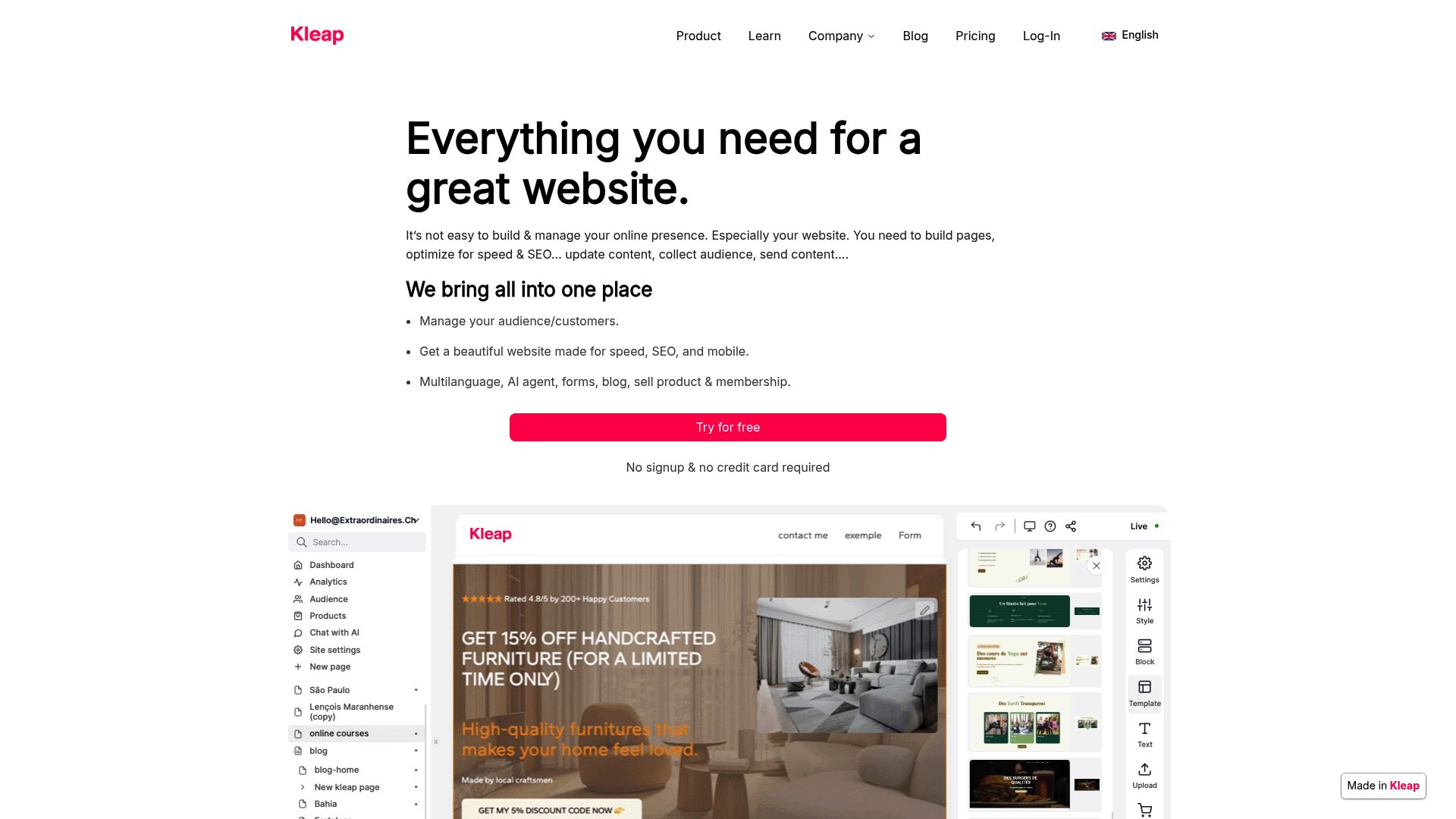
📸 kleap.co
Small Business Website Builder with SEO: The Traffic Magnet
You can have the best converter in the world, but it is useless without traffic. This is where the "build it and they will come" mentality fails hard.
We used to hire SEO agencies to fix our meta tags and structure. Now, a robust small business website builder with seo capabilities creates this foundation automatically.
It understands the semantic structure Google loves.
Marketing automation is often baked right clearly into these AI tools. We are talking about automated SEO prompts: personalized email drip campaigns, and smart pop-ups. It helps drive targeted traffic and nurture leads over time, all from a unified dashboard.
Instead of juggling a plugin for SEO, a tool for emails, and a tool for landing pages, the AI unifies this. It ensures your H1 tags match your high-volume keywords without you needing to know what an H1 tag is.
Comparison: Features That Drive Revenue
It helps to look at the data side-by-side. Not all builders are created equal when it comes to actually making money.
| Feature | How It Drives Sales |
|---|---|
| AI-driven design suggestions | Makes sure your pages are built from the ground up for a great user experience and, more importantly, for making sales. |
| Automated A/B testing | It's always testing different layouts and buttons to figure out what actually gets people to click. |
| Personalized recommendations | Shows visitors the products they’re most likely to love, which is a great way to bump up the cart size. |
| Conversion-focused copy | Writes headlines and descriptions that are designed to sell, not just to describe. |
| Integrated lead capture | Smart forms and booking tools that actually get you more leads and inquiries are built right in. |
| SEO integration | Drives qualified traffic directly to your sales funnels. |
While many platforms offer these features, the key is integration. You want a system where the SEO feeds the traffic, the AI design captures the interest, and the automated copy closes the deal.
Navigating the Competitor Landscape
There are plenty of players in this field.
It is important to know who does what so you can choose the right tool for your growth.
The Heavyweights
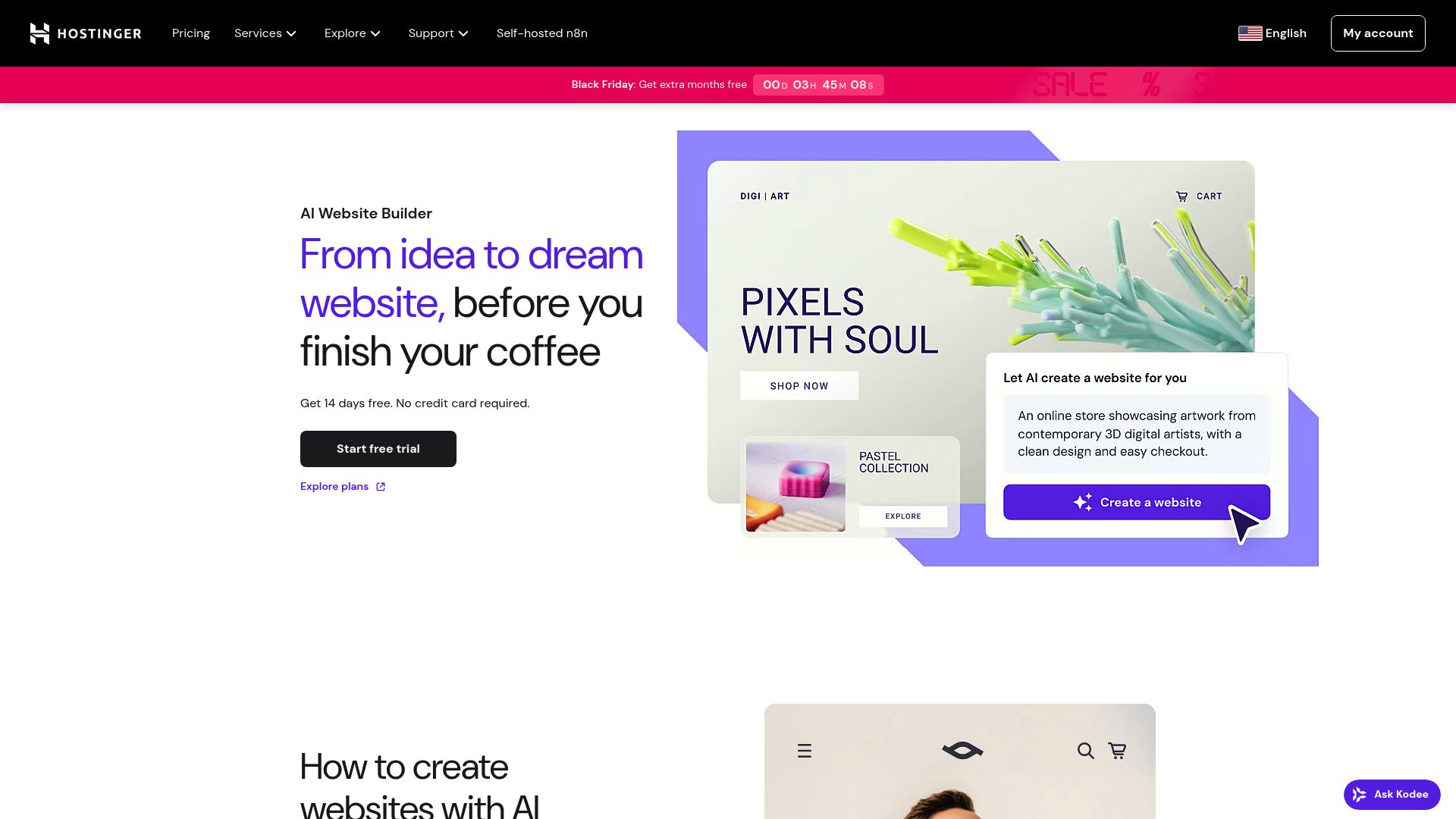
Companies like decent market leaders offering massive ecosystems. Hostinger offers an AI generator along with built-in eCommerce tools that have gained significant popularity.
They are great if you need a traditional hosting setup with some AI sprinkled on top.
Wix has also entered the chat with robust marketing automation. They offer deep customization but can sometimes feel overwhelming for a freelancer who just wants to sell.
The Agile Solution: Kleap
Then you have platforms like Kleap.
We view things differently. For small businesses and entrepreneurs, speed is the currency that matters most.
You don't have weeks to learn a complex editor.
Kleap positions itself as the mobile-first, rapid deployment solution. While others focus on desktop-heavy editors, we focus on where your customers are. Their phones.
A website builder using AI should make your life easier, not give you more menus to navigate.
Best Practices for Entrepreneurs Using AI
Owning the tool is only half the battle. How you use it determines your success.
Keep your forms minimal.
Fewer fields almost always convert more visitors into leads.
The AI might suggest this, but you need to approve it.
Don't forget social proof.
Add testimonials and trust badges.
Experts in conversion design emphasize that these elements reinforce credibility and reduce buyer hesitation. Let the AI format these reviews for maximum impact.
Another tip is to leverage the analytics. If the AI suggests changing a layout because of a high exit rate, listen to it.
We often get attached to our designs, but data doesn't lie.

Real-World Results: The ROI of AI
You might be thinking this sounds expensive or complicated.
It is actually the opposite. Businesses leveraging these tools report huge time savings.
But the real story is the sales bump.
Companies report a measurable increase in traffic and user engagement.
It directly impacts Return on Investment (ROI). By identifying lead generation inefficiencies and automating repetitive marketing tasks, you will need fewer resources for growth.
It allows you to stay lean while scaling up.
The "Secret" Takeaway
So, what is the real secret?
It is not just using AI for easier design.
The secret is giving AI the ongoing job of optimizing your customer journey.
It is about moving from discovery to engagement, and finally to conversion.
When you let AI handle the data-driven design changes, your website stops being a static brochure.
It becomes a living, breathing sales machine. It adapts as your audience grows.
It learns as your products change.
For freelancers and entrepreneurs, this is the ultimate leverage. You get the capabilities of a large marketing team packed into a single platform.
If you are ready to stop struggling with code and start focusing on sales, it is time to embrace the future. Your competitors likely already are.
Running a business is hard enough.
Building a website shouldn't be. Try Kleap today and let AI turn your visitors into customers.

FAQ
1. Can I really build a professional website with AI without coding?
Absolutely. A website builder using AI like Kleap does all the heavy lifting and writes the code for you.
You just answer a few questions about your business, and boom, the platform creates a beautiful, working, mobile-friendly site for you in minutes.
2. How does AI help with SEO?
Basically, the AI figures out what keywords people are searching for and then builds your site's structure, metadata, and headings to match what search engines like to see. It's a huge help for ranking higher, even if you don't know the first thing about SEO.
3. Is an AI website builder good for eCommerce?
Yes, definitely. It does more than just list products: it helps you write convincing descriptions, keep track of inventory, and even tailor the shopping experience for each visitor to help you make more sales.
4. Will my website look like a generic template?
Not at all. The best AI builders generate one-of-a-kind layouts that fit your specific brand and content. You still get tons of freedom to customize, making sure your site really stands out from the crowd.