AI Website Builder with Ecommerce Functionality 5 Best Options That Actually Deliver in 2026

The AI Website Builder with Ecommerce Functionality: The 5 Best Options in 2026 are Wix, Squarespace, Shopify, Hostinger, and Jimdo. Each combines AI-driven design with built-in selling tools.
Setup time varies widely; some platforms can get a store live in under an hour, while others require more configuration for advanced features.
Match the platform to your sales volume first, then evaluate AI features, not the other way around.
The right choice cuts months of development work and avoids costly platform migrations later.
Most entrepreneurs don't fail at selling online; they fail at picking the wrong tool, spending weeks rebuilding what should have taken days.
The market for AI website builders with ecommerce functionality has exploded. The 5 Best Options for AI Website Builders with Ecommerce Functionality covered here were selected after evaluating design intelligence, payment integration depth, inventory management, and real scalability. This evaluation considered more than just marketing claims.
For freelancers, agency owners, and founders who need a store that actually converts, not just looks good in a demo, one metric separates the contenders from the pretenders: what happens after the AI builds their site.
The platform you choose today will either grow with your revenue or quietly become the ceiling on it.
Table of contents
2. Kleap, the All-in-One AI Builder Built for Fast Ecommerce Launches
3. Shopify Magic, Wix ADI, and Squarespace Blueprint, AI Meets Established Platforms
4. BigCommerce with AI Integrations, when Scale Is the Priority
5. What AI Ecommerce Builders Won't Tell You Before You Sign Up
6. Side-by-Side Verdict, which AI Ecommerce Builder Should You Choose?
8. The AI Website Builder with Ecommerce Functionality 5 Best Options Verdict Is Clear
How We Picked These 5 AI Ecommerce Website Builders
Not every builder that slaps 'AI' on its homepage deserves the label. To cut through the noise, we evaluated each platform against four hard criteria: whether AI drives the core build experience, not just a chatbot tacked on afterward; how deep the native ecommerce stack runs; whether pricing is transparent with no hidden transaction fees; and how fast a non-technical founder can go from idea to a live store.
These aren't soft considerations; they're the exact pressure points where most platforms quietly fail.

Photo by Roger Cai on Unsplash
The 4 criteria that mattered most
AI-native vs. AI-bolted-on: Does the AI generate the full site structure or just suggest a headline?
Ecommerce depth: Product management, checkout, shipping, and payment processing are all native and not plugin-dependent.
Pricing transparency: Transaction fees, plan ceilings, and real monthly costs at launch scale are clearly outlined.
Speed to live: This is measured against Kleap's claimed 15-minute store launch benchmark.
Who this comparison is built for
This ranking targets founders, freelancers, and small business owners who need a functional store quickly and without a development budget or a dedicated tech team. If you're running a high-volume catalog operation scaling toward enterprise, Shopify's deeper commerce ecosystem may serve you better.
For everyone else prioritizing speed, cost control, and genuine AI-driven building, these five options represent the clearest choices in the current market.
Try it — build your site while you read
Describe what you want and get a live, publishable site in seconds. Free to start, no code.
Join 200,000+ makers building real websites with Kleap.
Kleap, the All-in-One AI Builder Built for Fast Ecommerce Launches
Most AI store builders hand you a template and call it "AI." Kleap works differently: you describe your store in plain English. For founders who need a live store this week, that gap is the whole argument.
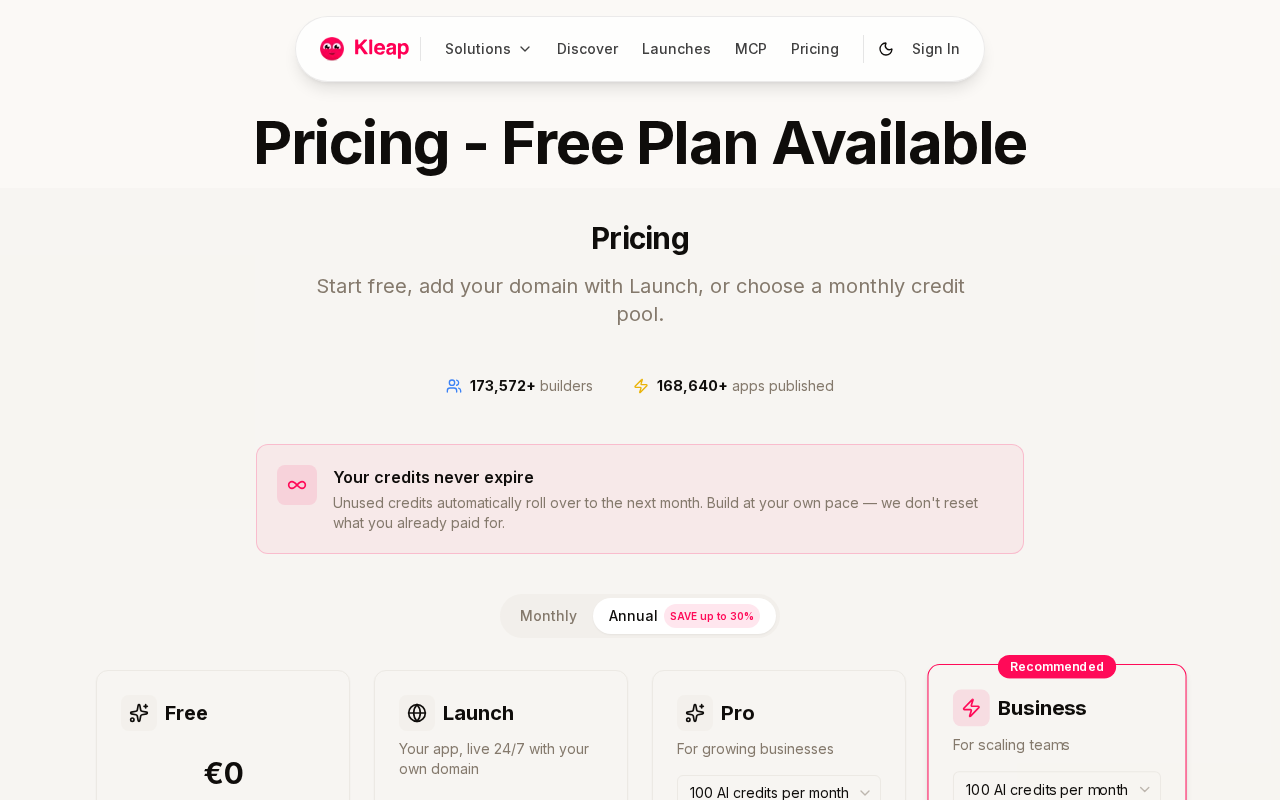
Kleap pricing page
What makes Kleap's ecommerce engine stand out?
The architecture is genuinely all-in-one. Kleap bundles hosting, custom domains, forms, and checkout into a single platform. There is no need for a third-party hosting account, a separate domain registrar, or a plugin stack to maintain.
Its ecommerce engine supports physical products, digital goods, subscriptions, and memberships out of the box, with Stripe connectivity handling payments.
Think of it as the difference between renting a market stall and owning the building.
Natural-language generation is the real differentiator. While Wix and Squarespace still rely on template selection before AI assists, Kleap starts from a prompt.
That means the layout, product structure, and store logic are generated together rather than retrofitted onto a generic design. For an AI ecommerce website builder free tier, that's an unusually complete starting point.
Kleap pricing and who it suits best
Kleap's pricing tiers are structured for different growth stages:
Free, build and test with no upfront commitment
Launch, $9/month (or $99/year), entry-level publishing
Pro, $25/month, full feature access for growing stores
Business, $50/month, suited for higher-volume operations
Enterprise, custom pricing for teams with complex needs.
The free-to-start model removes the biggest barrier for early-stage founders: you can validate the concept before spending a dollar. Pro at $29/month sits well below Shopify's $29/month entry point while covering hosting, domain, and ecommerce in one bill.
If you want to explore options before committing, the free AI website builder with custom domain path is worth testing first. Kleap suits founders and SMEs who prioritize launch speed over deep commerce customization.
Shopify Magic, Wix ADI, and Squarespace Blueprint: AI Meets Established Platforms
Three platforms dominate most "best ecommerce builder" lists for good reason: Shopify, Wix, and Squarespace have years of proven infrastructure behind them. The caveat?
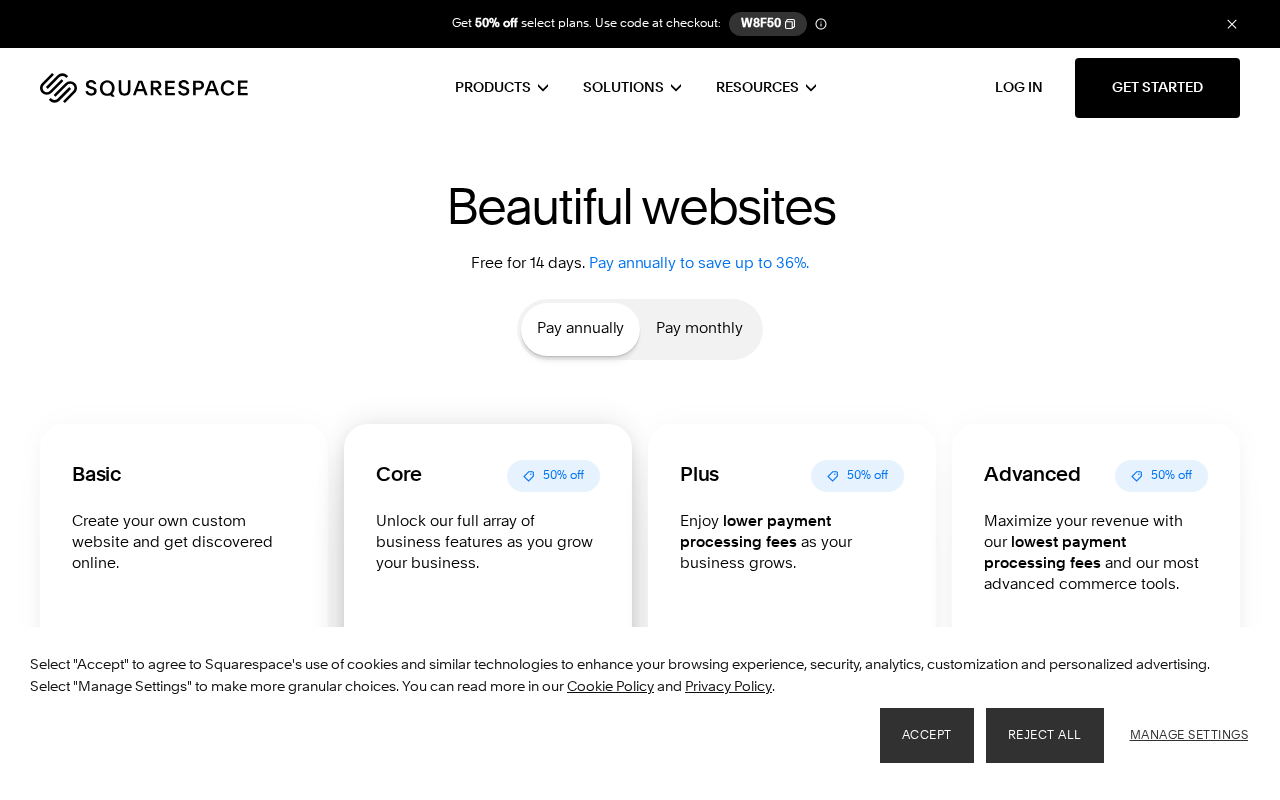
Squarespace pricing page
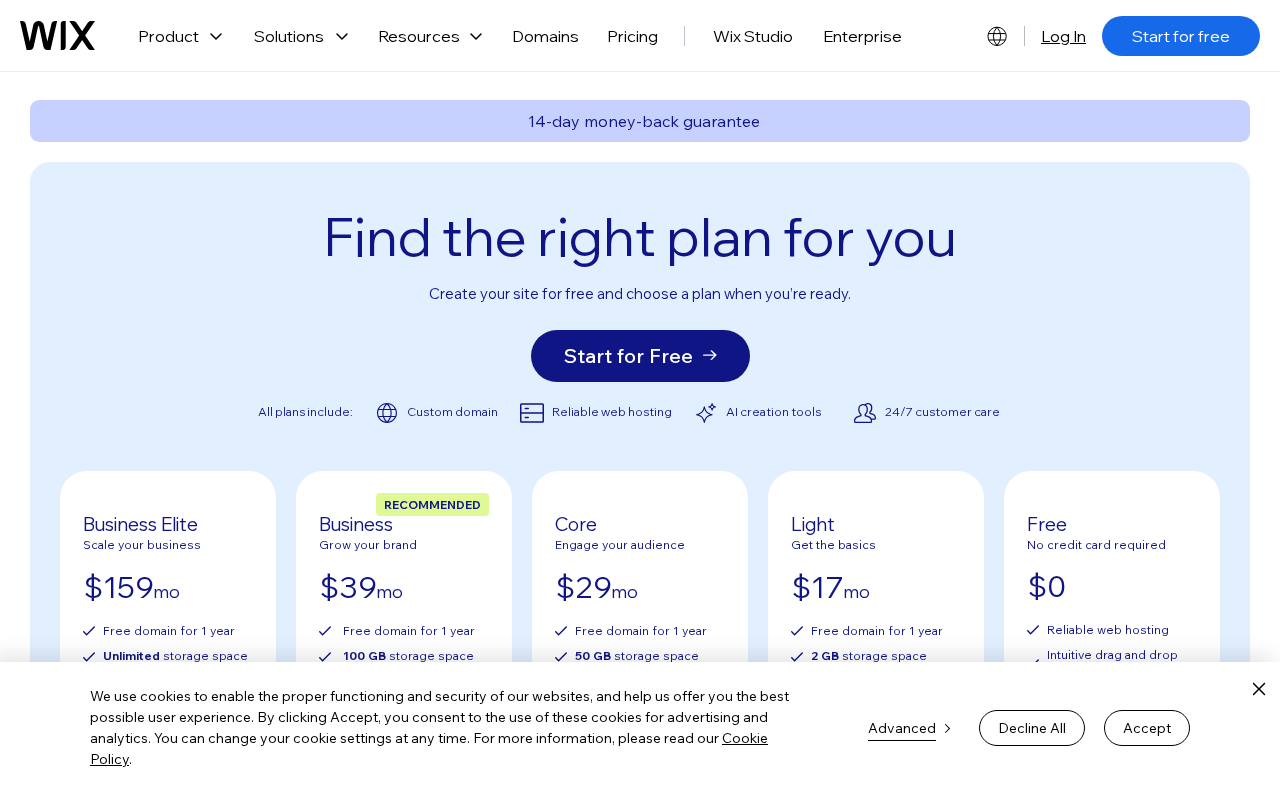
Wix pricing page
Their AI features are largely layered on top of existing systems, not baked into the core engine. For sellers evaluating any best website builder AI free option, that distinction changes the entire decision.

Shopify pricing page
Shopify: AI features layered onto mature ecommerce infrastructure
Shopify is the clearest recommendation for high-volume sellers, with plans starting at $29/month. Its AI tools, Shopify Magic and Sidekick, assist with product descriptions and copy drafting. However, they do not generate full storefronts from a natural-language prompt.
Think of it as a skilled assistant in a large warehouse: incredibly useful once the shelves are already built, but less helpful if you need the warehouse constructed first. Transaction fees on lower-tier plans add real costs at scale because every percentage point compounds quickly across thousands of monthly orders.
Where Shopify genuinely leads is in ecosystem depth: a massive third-party app store, solid fulfillment integrations, and reliability under catalog-heavy operations that smaller builders simply cannot match. For a growing brand with complex inventory and multi-channel needs, that infrastructure is worth the higher entry price.
Wix ADI and Squarespace Blueprint for design-first sellers
Wix ADI generates layouts from prompts and handles ecommerce basics well, with pricing landing around $27/month in current comparisons. Its AI depth for ecommerce-specific flows, product management, and checkout optimization is shallower than Shopify's commerce stack, however.
Wix earns its place for design-led small businesses and beginners who prioritize visual flexibility over enterprise-grade selling tools.
Squarespace Blueprint AI, starting around $16/month for commerce plans, delivers arguably the strongest design output of the three. The trade-off is focus: Squarespace remains better suited to service businesses and content-first brands than to sellers managing large, dynamic product catalogs.
Its ecommerce basics are solid; its ecommerce ceiling is lower.
Sellers who need proven scalability and a broad third-party app ecosystem will find these three platforms hard to beat. Those who need the fastest AI-to-live-store workflow, however, may want to explore newer alternatives.
Curious how the community actually ranks these tools? The best AI website builder free reddit discussions surface some genuinely useful practitioner insights.
Shopify: Best for scaling stores, complex fulfillment, large catalogs, $29/month
Wix: Best for beginners and design-led SMBs, around $17/month
Squarespace: Best for brand-first or service businesses, around $16/month
Kleap tip: If you are evaluating Shopify or Wix but feel held back by setup time, use Kleap's natural-language prompt to generate your full storefront first, then assess whether the added ecosystem of legacy platforms justifies the cost and configuration overhead for your specific catalog size.
BigCommerce with AI Integrations, when Scale Is the Priority
At scale, that matters enormously.
A store processing thousands of dollars monthly on Shopify's base plan loses a percentage of every sale to platform fees on top of payment processor costs. BigCommerce charges nothing extra because the architecture is built for volume from the ground up rather than retrofitted for it.
Where BigCommerce's AI tooling actually adds value
Unlike Kleap's native AI generation or Shopify Magic's built-in copy tools, BigCommerce delivers AI capabilities through third-party integrations and partner apps. That's not a weakness for the right buyer.
Growth-stage teams with developer resources can wire in specialized AI tools for product recommendations, dynamic pricing, and inventory forecasting with precision that no single built-in AI assistant matches. The headless commerce and API-first architecture make this genuinely flexible, not just theoretically so. It is an approach aligned with the MACH framework (microservices, API-first, cloud-native, headless).
The trade-offs, complexity, cost, and learning curve
The starting price sits at $39/month, confirmed in 2026 reviews, which already exceeds every AI-native builder in this comparison. Add developer time, app subscriptions, and integration overhead, and the real cost climbs quickly.
This is not a platform you launch in 15 minutes. It rewards teams that need maximum ecommerce infrastructure and can invest the setup time to use it properly.
BigCommerce fits a specific profile: scaling businesses with in-house development resources, complex catalogs, and multi-channel ambitions. For founders who want speed and simplicity, exploring a best AI website builder free option like Kleap is the smarter starting point.
AI approach: Third-party integrations, not native generation
Starting price: $39/month
Avoid if: Speed-to-launch and low overhead are your priorities
What AI Ecommerce Builders Won't Tell You Before You Sign Up
The fine print matters more than the demo reel. Before committing to any AI website builder with ecommerce functionality, there are four truths the marketing pages consistently bury, and each one can quietly double your tested monthly cost or cap your store's growth before you hit your stride.

The hidden costs that inflate your monthly bill
"AI-powered" is a marketing label applied with striking looseness. Some platforms use AI to generate full layouts from a natural-language prompt.
Others use it exclusively to draft product descriptions.
Verify which features you're actually getting before signing up.
Transaction fees compound faster than most founders expect.
That's a material difference, not a rounding error.
What the demos don't show
Hidden add-ons are the second trap. Advertised base prices rarely include premium themes, third-party app subscriptions, or custom domain costs.
One 2026 cost analysis found that a 30-product store could run anywhere from $240 to over $3,800 over two years depending on the platform and add-ons selected. The gap between 'starting at' and 'what you'll actually pay' is wide.
Verify whether AI generates layouts or just copy before committing.
Calculate the total cost including apps, domains, and themes, not just the base plan.
Test AI generation with your real product data, not the platform's pick demo content.
Check what 'priority support' actually means on your specific tier.
Demo outputs almost always use polished, pre-loaded content. The AI looks impressive until you paste in your actual product catalog.
Test with real data, raw descriptions, real images, and actual SKUs before you judge the output quality.
Side-by-Side Verdict: Which AI Ecommerce Builder Should You Choose?
The right pick depends entirely on where you are in your business journey. Five platforms consistently dominate current comparisons of AI website builders with ecommerce functionality, and each wins for a different buyer profile.
The criteria that matter most are AI depth, transaction fees, pricing range, and whether the platform grows with you or fights you at scale.
Builder | Free to build? | Custom domain | Free-tier limit | Best for |
|---|---|---|---|---|
Kleap AI builds your store in minutes | Yes | $8.25/mo billed yearly | Fast ecommerce launches | |
Shopify Robust ecommerce infrastructure | No | $29/mo | No free plan (trial only) | High-volume sellers |
Wix Visual flexibility for sellers | Yes | $17/mo | Wix ads + subdomain | Design-led businesses |
Squarespace Strong design output | No | $16/mo | No free plan (trial only) | Content-first brands |
Hostinger Affordable hosting solutions | No | $2.99/mo | No free plan (trial only) | Budget-friendly ecommerce |
Jimdo Easy setup for beginners | Yes | $11/mo | subdomain + Jimdo ads, 5 pages | Simple online stores |
Our final recommendation by business type:
Founders and freelancers: Kleap, free to start, no financial risk, live in minutes.
Scaling brands with developer resources: Shopify or BigCommerce.
Design-first SMBs: Wix for flexibility, Squarespace for polish.
One 2026 cost comparison found that a 30-product store over two years costs $29/mo or more on Shopify once transaction fees and apps stack up.
Kleap tip: Start on the free tier, build your full store with natural-language prompts, and only upgrade to Pro (from $25/month) once your first sales validate the concept. Zero upfront cost means zero excuse not to launch today.
Frequently Asked Questions
What is the difference between an AI website builder and a traditional website builder for ecommerce?
Traditional builders hand you a blank canvas and expect you to assemble everything: templates, plugins, payment gateways, and product pages. An AI builder like Kleap starts from your description and generates the entire store structure, design, and functionality in one pass.
The practical gap is speed and decision fatigue. With a traditional builder, you make hundreds of micro-decisions.
With an AI builder, you describe what you want. The AI handles the rest, including layout logic, mobile responsiveness, and form integration.
Can I sell digital products and subscriptions with an AI-built ecommerce store?
Yes. An AI-built store isn't limited to physical goods.
Kleap's ecommerce capabilities support digital product delivery and subscription-based models. This means you can sell ebooks, courses, software licenses, or recurring memberships from the same platform.
What matters is how the platform handles checkout flows and access control after purchase. Kleap's full-stack approach means these aren't bolt-on features requiring third-party plugins; they're built into the platform architecture from the start.
Which AI ecommerce website builder charges the lowest transaction fees?
Transaction fee structures vary significantly across platforms, and the headline percentage rarely tells the full story. Some builders charge zero platform-level transaction fees but lock you into their native payment processor, which carries its own processing rates.
Kleap's pricing starts free, with Pro from $25/month and Business from $50/month. For the most current fee structure specific to your plan and payment processor, check directly with Kleap through their site. This is the one detail that changes most frequently across the industry.
Do I need coding skills to launch an ecommerce store with an AI website builder?
No. That's the core promise of AI builders: natural language replaces code. You describe your store, your products, your brand, and the AI generates a fully functional, hosted ecommerce platform without a single line written by you.
That said, Kleap does give you complete code ownership if you want to go deeper. So if you have a developer on your team who wants to extend or customize beyond what the AI generates, that door stays open.
You're never locked into a no-code ceiling.
How long does it take to build and launch an ecommerce store using an AI builder?
Realistically, a basic store can go live in under an hour. I've seen teams with a clear product catalog and brand brief launch a fully functional storefront in a single afternoon using AI-powered builders.
The variable that slows people down isn't the tool; it's content readiness. Product descriptions, images, and pricing decisions take longer than the build itself.
Have those assets ready before you start, and the AI handles everything else at a pace that genuinely surprises first-time users.
The AI Website Builder with Ecommerce Functionality: 5 Best Options Verdict Is Clear
Speed, zero transaction fees, and genuine AI depth are the only three metrics that separate a platform worth your time from one that just looks impressive in a demo.
Shopify Magic, Wix ADI, and Squarespace Blueprint each bring real strengths. However, they also bring legacy pricing structures and transaction fees that quietly erode margins as you scale. Kleap eliminates that friction from day one.
If you're launching an ecommerce store in 2026 and want AI that handles design, copy, and functionality in a single build, start with Kleap's free tier. Ship your store and upgrade only when revenue demands it.
Ready to go from idea to live store without writing a single line of code? Start building with Kleap for free directly on their site, no credit card required.
Your store doesn't need more planning; it needs a launch date.