Beacons Technology, how Proximity Marketing Transforms Customer Engagement

Beacons are small Bluetooth devices that transmit signals to nearby smartphones, enabling location-based customer interactions within a range of 10 to 100 meters.
- Deploy beacons to trigger personalized mobile notifications when customers enter your physical space
- Track foot traffic patterns and customer behavior without requiring app downloads or invasive tracking
- Integrate with existing CRM systems to bridge the gap between digital marketing and in-store experiences
Walk into a store, and your phone buzzes with a discount code for the exact product you browsed online yesterday. Magic?
No.
Beacons technology makes this easy connection possible, and it's reshaping how businesses interact with customers in physical spaces. Whether you run a retail shop, manage event venues, or operate a multi-location enterprise, proximity marketing creates touchpoints that feel personal without feeling invasive.
You'll explore beacon fundamentals and why this technology matters beyond retail hype. We'll break down the mechanics (spoiler: it's simpler than you think), examine real-world applications transforming museums, airports, and healthcare facilities, and address the privacy concerns competitors conveniently ignore.
Strategic implementation tactics follow, plus ROI optimization techniques that separate successful deployments from expensive experiments. Common questions about battery life, range limitations, and integration challenges round out the discussion.
The insight here? Beacons aren't about pushing more ads.
They're about creating contextually relevant experiences that customers actually appreciate (and that's the part most marketing platforms miss).
Key takeaways
- Walk into a retail store and your phone lights up with a personalized discount.
- Think of beacons as miniature radio stations that whisper to nearby smartphones.
- Beacons have evolved far beyond simple marketing tools.
- Most beacon vendors pitch a frictionless future.
- Most companies jump into beacon deployment without any real strategy behind it.
What Are Beacons and Why Should Your Business Care?
Walk into a retail store and your phone lights up with a personalized discount. That's beacon technology at work.
These small, low-energy Bluetooth transmitters communicate with nearby mobile devices, creating invisible zones that detect when customers enter specific areas. Unlike traditional marketing that broadcasts to everyone, beacons pinpoint individuals within meters, triggering customized messages based on their exact location.
For businesses, this transforms physical spaces into intelligent environments that respond to customer presence in real time.
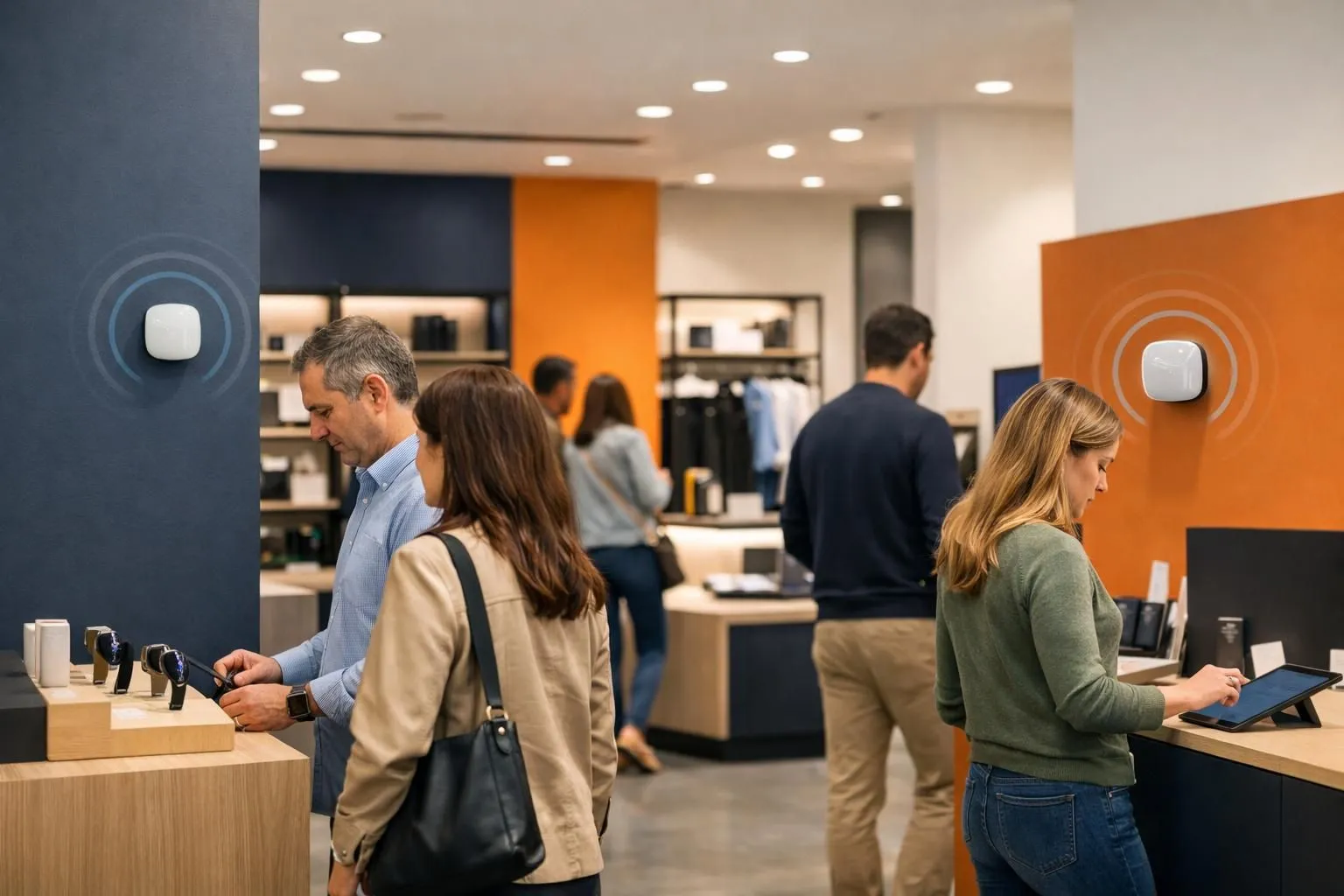
In practice, the technology has evolved considerably since early location tracking systems. Today's beacons deliver sophisticated proximity marketing that adapts to user behavior.
A clothing retailer might send style recommendations when shoppers linger near dresses, while museums trigger audio guides as visitors approach exhibits. This shift from basic positioning to contextual intelligence creates genuine value rather than intrusive spam.
Cost remains remarkably low compared to traditional advertising infrastructure. Deployment often requires minimal hardware investment and straightforward software integration.
The Technical Foundation of Beacon Technology
Beacons send out unique identifiers that mobile apps can pick up and process. When your phone catches this signal, the app kicks off specific actions like showing content, tracking data, or turning on features.
The system relies on three components:
- Physical beacons broadcasting signals at regular intervals
- Mobile apps equipped to receive and process these transmissions
- Backend platforms analyzing interaction patterns and managing content delivery
From Bluetooth to Business Intelligence
Why does this matter for business owners? Foot traffic data shows which store areas draw attention, how long people browse, and what paths they take through your space.
You can boost conversions by sending offers right when customers are ready to buy. In practice, personalized touches build loyalty by recognizing what people want without extra staff time.
Businesses using beacons get ahead with insights they couldn't access before. Turning physical stores into trackable marketing channels that work like online platforms.
Try it — build your site while you read
Describe what you want and get a live, publishable site in seconds. Free to start, no code.
Join 200,000+ makers building real websites with Kleap.
How Beacons Actually Work, the Technical Magic Explained Simply
Think of beacons as miniature radio stations that whisper to nearby smartphones. They broadcast a unique identifier using Bluetooth Low Energy (BLE), a protocol designed for maximum battery efficiency.
Unlike traditional Bluetooth that drains power quickly, BLE allows a single coin-cell battery to last up to two years. The device continuously transmits its signature every few hundred milliseconds, creating an invisible bubble of connectivity around itself.
No pairing required. No complicated setup.
Just constant, energy-efficient broadcasting.
Bluetooth Low Energy in Action
Each beacon contains three crucial identifiers that work like a digital address system. The UUID (Universally Unique Identifier) marks your organization, the major number designates a specific location like your Chicago store, and the minor number pinpoints exact zones within that space.
When a customer with your app walks within range, typically between 20 and 300 feet depending on configuration, their phone detects this broadcast. The beauty lies in customization: adjust transmission power to shrink or expand your coverage area based on whether you're targeting a specific shelf or an entire warehouse floor.
The Signal Dance, From Detection to Action
Here's where it gets interesting for business applications. The three-step process happens almost instantly:
- Beacon broadcasts its unique identifier package
- User's smartphone app detects the signal and measures proximity
- App triggers predetermined action, notification, content display, or data collection
Privacy remains paramount in 2026. Users must explicitly grant location permissions and install your app before any interaction occurs.
Beacons themselves cannot track individuals or collect personal data. They simply announce their presence, much like how exploring best free ai website builder 2025 options requires your active engagement.
The smartphone does the listening, not the beacon.
7 Game-Changing Applications Transforming Industries in 2026
Beacons have evolved far beyond simple marketing tools. Today, these compact devices power sophisticated systems across sectors as diverse as healthcare, transportation, and real estate.
While many associate them exclusively with retail promotions, their true potential lies in solving complex operational challenges that businesses face daily. The versatility stems from their core capability: precise indoor positioning combined with contextual data delivery.
Retail environments represent the most mature implementation space, yet innovation continues. Stores now deploy beacons for in-store navigation systems that guide shoppers to specific products, dramatically reducing the "I can't find it" frustration that drives 23% of customers to competitors.
Smart shelves detect when someone lingers near a product, triggering detailed specifications or comparison data to their phone. Cart abandonment drops when beacons send timely reminders about items left behind, sometimes paired with modest incentives.
However, the real win comes from understanding traffic patterns, which aisles get ignored, which displays attract attention, allowing merchandisers to optimize layouts based on actual behavior rather than intuition.
From Window Shopping to Personalized Experiences: Retail Revolution
Museums and cultural venues now use beacon-enabled audio guides that trigger content automatically when visitors approach exhibits. You don't need to punch numbers into clunky devices anymore.
the Smithsonian Institution tracks visitor flow with these systems to spot bottlenecks and underused galleries. Event organizers use beacons to help people network better since attendees get alerts when someone nearby shares their interests.
Conference platforms track session attendance and give organizers detailed analytics about which topics draw crowds versus which rooms stay empty despite strong registration numbers.
Healthcare, Events, and Smart Cities: Beyond Commerce
Healthcare facilities tackle a real problem: equipment that goes missing constantly. Hospitals put beacons on wheelchairs, IV pumps, and portable monitors, dropping search time from 20 minutes to under two. Patient wayfinding systems help visitors navigate massive medical complexes, which cuts stress for families who are already anxious.
Staff notification systems alert nurses when patients in certain rooms need help, speeding up response times without endless intercom announcements. Transportation hubs now use beacons for accessibility services too. Visually impaired travelers get audio directions through airports, and public transit systems send real-time departure updates plus platform changes.
hospitality venues offer contactless check-in and room controls that adjust lighting and temperature based on what guests prefer. Real estate agents track property showing attendance automatically, ditching manual sign-in sheets while collecting data about which features prospects examine longest. Building an ai no code website builder integration for these beacon systems has gotten surprisingly easy.
Kleap tip: When you're evaluating beacon applications for your business. Focus on solving one specific operational pain point instead of trying detailed deployment. Pilot programs that target measurable problems, like cutting customer service inquiries or boosting asset utilization.
Demonstrate ROI faster and build organizational confidence for broader implementation.
What Other Marketing Technology Providers Won't Tell You
Most beacon vendors pitch a frictionless future. Reality hits harder.
Your users need a compatible app already installed on their devices before any proximity marketing happens. That single requirement eliminates roughly 80% of foot traffic in most retail environments.
The technology works brilliantly in theory, but practical deployment reveals obstacles that sales presentations conveniently skip.
Physical hardware demands ongoing attention. Batteries die every 18-24 months depending on broadcast frequency.
Someone must climb ladders, access ceiling mounts, and swap out power sources across dozens or hundreds of locations. That's recurring labor cost nobody mentions during initial budget discussions.
Field service contracts add up quickly when you're managing infrastructure at scale.
The Hidden Infrastructure Requirements Nobody Mentions
Permission fatigue destroys campaigns before they even launch. IOS and Android both force users to approve Bluetooth access, location services, and push notifications.
Each prompt creates a potential exit point. Data from Bluetooth Low Energy implementations proves conversion rates tank when users see three separate permission requests.
your marketing team builds great content, but technical barriers prevent delivery.
Data integration creates additional problems. Linking beacon interaction data to your CRM and analytics platforms demands developer time.
Off-the-shelf solutions claim plug-and-play setup, but custom mapping always ends up required. Attribution becomes complicated when customers browse in-store, leave, and convert online several days later.
Why Most Beacon Campaigns Fail in the First 90 Days
Content creation becomes the bottleneck. Technology deployment happens in weeks.
Building a library of contextually relevant messages for different locations, times, and customer segments? That takes months.
One generic "Welcome to our store" notification won't drive ROI. Success demands ongoing creative production that most organizations underestimate when budgeting for beacon projects.
Strategic Implementation: Maximizing ROI From Your Beacon Investment
Most companies jump into beacon deployment without any real strategy behind it. They drop devices around their location, push out an app.
and can't figure out why nobody uses it after the first couple weeks. Here's the truth: smart implementation makes the difference between beacon campaigns that work and costly tech projects that just sit there collecting dust.
You need careful planning, exact execution, and constant tweaking based on actual user behavior data.
The 4-Phase Deployment Framework That Works
Start small. Phase one involves a controlled pilot program testing technology reliability and message resonance with a limited audience segment.
Choose one high-traffic area and three beacon units maximum. This contained approach reveals technical glitches and customer response patterns without risking your entire budget.
According to proximity marketing research, pilot programs reduce full-scale deployment failures significantly.
Phase two maps your customer journey meticulously. Identify moments when shoppers need information, face decision paralysis, or demonstrate purchase intent.
Place beacons at these critical junctures, not randomly throughout your space. An entrance beacon might deliver welcome offers while fitting room placement triggers personalized product recommendations.
Phase three integrates beacon data with existing marketing automation platforms and CRM systems through APIs and SDKs. This connection transforms isolated interactions into cohesive customer profiles.
Phase four implements continuous optimization through A/B testing different messages, timing intervals, and content formats based on behavioral analytics.
Tracking Success Beyond Vanity Numbers
Notification opens don't tell you much about real performance. You need to track metrics that matter for your business goals.
- Dwell time increases in targeted zones
- Conversion lift compared to control groups
- Engagement rate with delivered content
- Customer lifetime value impact over quarters
- Repeat visit frequency changes
plan your budget carefully across the entire tech stack you'll need. Hardware typically costs a reasonable amount per unit, but building the app, creating engaging content, and managing campaigns need ongoing investment.
Platforms with easy SDK integration cut down technical work significantly, so you can focus resources on strategy instead of dealing with code.
Frequently Asked Questions About Beacons Technology
Do beacons work without a dedicated app? Not really. Beacons broadcast Bluetooth signals all the time, but users need an app on their phone to receive them.
The app listens for nearby beacons and triggers specific actions like push notifications or location tracking. Some operating systems can detect beacons through built-in features, but that's pretty limited. You need a custom app to create meaningful interactions with customers.
This requirement creates both a technical hurdle and a real opportunity for businesses. Companies can build engaging mobile experiences that strengthen their physical locations and drive better customer engagement.
Technical and Privacy Concerns Answered
Privacy concerns pop up frequently when people talk about beacon technology. Unlike GPS tracking, beacons can't identify or track individuals without their explicit consent.
They just broadcast an identifier signal to nearby devices. Your app picks up this signal only if users downloaded it and approved Bluetooth permissions.
beacons don't collect any personal data on their own. Battery life depends on the model and settings you choose.
Most beacons run for one to three years on a single coin cell battery when they transmit every second. Maintenance means replacing batteries occasionally and updating firmware when needed. Both iOS and Android support beacon protocols, though Apple uses iBeacon while Google uses Eddystone instead.
Cost and Implementation Considerations
Small businesses often ask if they can afford this technology. Basic beacon hardware runs about 15-40 dollars per unit, so pilot programs stay within reach.
Enterprises rolling out hundreds of beacons across multiple sites need to budget several thousand dollars for hardware plus ongoing app development and analytics platforms. beacons beat geofencing for indoor accuracy but need physical installation.
They cost less than GPS for indoor spaces where satellite signals don't work.
Kleap tip: Start with a small beacon setup in your busiest area to test customer response before expanding to other locations. Keeping upfront costs low while collecting real performance data.
FAQ - Frequently Asked Questions
Do beacons work without a mobile app installed?
No. Beacons broadcast signals, but they need an app to interpret and act on those signals.
Think of it like a radio transmitter. Someone needs a receiver tuned to the right frequency.
Without the app (the receiver), the beacon's broadcast goes unheard. This requirement protects user privacy, since customers must actively download your app and grant permissions before any interaction happens.
Are beacons a privacy concern for customers?
Only if implemented poorly. Beacons themselves don't collect personal data, they simply broadcast an identifier.
The app on the customer's phone decides what to do with that signal. Transparency matters here.
Tell customers what you're tracking and why. Most concerns disappear when businesses explain they're using beacons to improve the shopping experience, not to spy.
The app requires explicit location permissions, so users stay in control.
How long do beacon batteries typically last?
Most commercial beacons last between 1 and 3 years on average. High-end models can push past 5 years with proper settings.
Battery life depends on transmission power and how often the beacon broadcasts. a beacon that pings every 100 milliseconds drains much faster than one transmitting each second.
Lower power settings help your battery last longer but cut down the range. You're looking at a clear trade-off between longevity and coverage distance.
What's the difference between beacons and geofencing?
Beacons work indoors and can target down to just a few meters of precision.
Geofencing uses GPS and handles much larger outdoor areas instead. It triggers when someone crosses a defined geographic boundary, like within 500 meters of your store. GPS drains battery fast because it's constantly checking location in the background.
beacons run on Bluetooth Low Energy and use way less power overall. Inside retail spaces, beacons give you much better accuracy for customer tracking. You can send notifications when someone walks past a specific product display, not just entering.
Many businesses use both methods together. Geofencing handles outdoor proximity marketing, while beacons manage detailed indoor engagement.
How much does it cost to implement beacons for a small business?
Budget swings all over the place depending on your setup and goals. Hardware costs range from a few hundred to several thousand dollars.
Basic beacons run about $20-40 each, and a small retail store typically needs 3-5 units. You'll also need app development unless your platform already supports beacons built-in.
template solutions cost less, while custom builds get pricey fast. Monthly platform fees add recurring expenses if you're using a subscription service.
The real money often goes to strategy and content creation though. You need strong offers that make people respond to those beacon notifications.
Can beacons track customers without their permission?
Not in any meaningful way. The beacon itself can't track anyone, it just broadcasts a signal.
Your app needs explicit permission to access Bluetooth and location services. Even then, the app only knows a beacon is nearby when the user has installed your app and granted those permissions.
This two-step requirement (app installation plus permissions) protects privacy. Some retailers worried about "creepy" tracking have found that transparency solves most concerns.
Explain what you're tracking and why, and customers usually accept it as part of a better shopping experience.
Ready to Build Your Beacon-Powered Experience?
Beacons aren't futuristic tech anymore. They're working right now in stores, museums, airports, and events, delivering personalized experiences that customers want.
The technical complexity? That's the barrier most businesses face when exploring proximity marketing.
Here's your concrete next step: map out one customer touchpoint where real-time, location-based interaction would add genuine value. A retail checkout?
Event registration? Product discovery?
Start there.
Building beacon-enabled applications used to require months of development work and specialized technical teams. Kleap changes that equation entirely.
Our AI-powered platform lets you create sophisticated, beacon-integrated experiences without writing code or managing infrastructure. You focus on the customer journey.
We handle the technical complexity.
Visit kleap.co to see how businesses are launching proximity marketing campaigns in days, not months. Or reach out directly, our team will walk you through exactly how beacons can work for your specific use case.
The proximity revolution is here. Your customers are already carrying the technology in their pockets.