Advice on selling websites to local businesses is easy to find.
Read the full introHide the intro
This page is what happened when we played the first half of it for real on a live product: two Google Maps searches for local businesses, a check of their own websites, a demo for the one with no site at all, and the pitch that was written for it. It follows that order, with the clock, the counts and the places where the result surprised us. We contacted nobody, so there are no reply rates and no income figures here: anything about prices comes from Clutch's published surveys and pricing guide, and anything about the law comes from the FTC.
In this guide+
- Do local businesses still need someone to build their website?
- Step 1: Which niche and city should you start with?
- Step 2: How do you find businesses with no website or a bad one?
- Step 3: Why build the demo before you contact anyone, and how?
- Step 4: What should the outreach message say, and what does the law require?
- Step 5: What do you say on the phone, and what do you send after?
- Step 6: How much should you charge, and what goes in the proposal?
- Step 7: How do you put it live and hand it over?
- What did we not test?
- How do you get your first web design client from here?
- Questions
Do local businesses still need someone to build their website?
Yes, though the pool is shrinking. The best numbers we could find come from Clutch's surveys of small businesses, from 2017 to 2025. They asked the businesses themselves, so read them as the shape of the market and not as a count of your town. A search for your own city, in the next step, gives you current leads.
Clutch surveys of small businesses, 2017 to 2025
| Survey | Asked | What it found |
|---|---|---|
| 2017 | 355 owners and managers | Nearly one-third ran the business without a website; 31% used social media profiles instead of a dedicated site |
| 2018 | 351 | 36% had no website; among those with one, 48% spent between $500 and $10,000 and 28% spent less than $500 |
| 2019 | 529 small businesses | 40% had no website, 60% had one |
| 2025 (press release, 21 Aug 2025) | small businesses (sample size not stated) | 83% had a website, up from 64% in 2018; 17% remained offline, over a third of them saying a website is not relevant to them. 45% of the websites were developed by outsourced partners and 8% by their owners |
2017
- Asked
- 355 owners and managers
- What it found
- Nearly one-third ran the business without a website; 31% used social media profiles instead of a dedicated site
2018
- Asked
- 351
- What it found
- 36% had no website; among those with one, 48% spent between $500 and $10,000 and 28% spent less than $500
2019
- Asked
- 529 small businesses
- What it found
- 40% had no website, 60% had one
2025 (press release, 21 Aug 2025)
- Asked
- small businesses (sample size not stated)
- What it found
- 83% had a website, up from 64% in 2018; 17% remained offline, over a third of them saying a website is not relevant to them. 45% of the websites were developed by outsourced partners and 8% by their owners
Three things follow for you. Most local businesses now have a site (83% in Clutch's 2025 release), so the weak and outdated ones, not only the missing ones, are your market: five of the 22 businesses in our second search were flagged weak. The businesses that remain offline are a smaller, real pool (17%). And 45% of sites were built by outsourced partners, which is the slot you are selling into.
Step 1: Which niche and city should you start with?
We expected the trades to be the easy start, so search 1 asked for plumbers, roofers, HVAC companies and landscapers in Spokane, Washington. Search 2 asked for barbershops, house cleaning services and handymen in Coeur d'Alene, Idaho. The two searches did not look alike.
What the two searches found (the Website column of Kleap's leads table)
| Search | Leads | No website | Weak website | Site did not load | Not flagged |
|---|---|---|---|---|---|
| Spokane, Washington: plumbers, roofers, HVAC companies and landscapers | 18 | 0 | 0 | 1 | 17 |
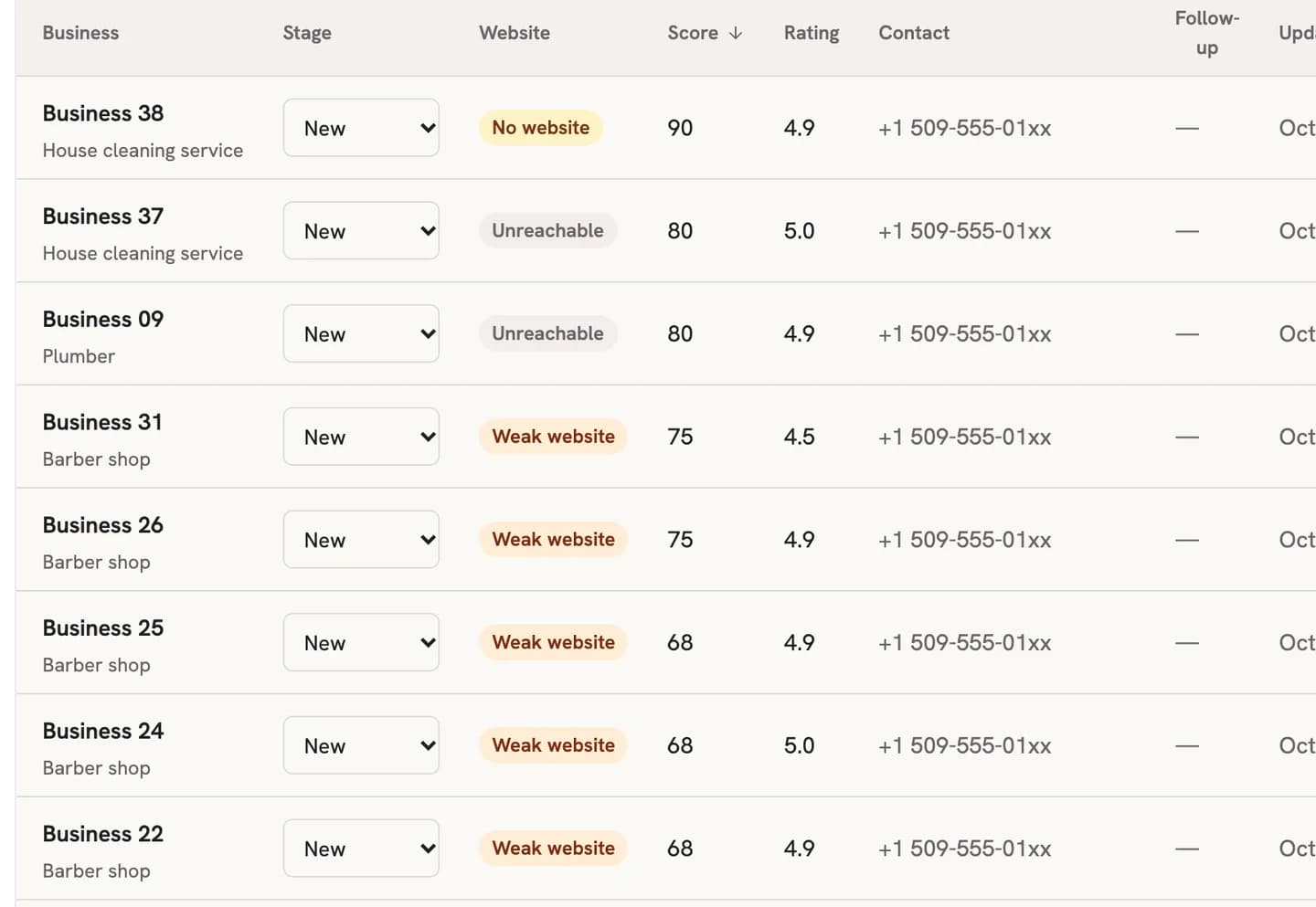
| Coeur d'Alene, Idaho: barbershops, house cleaning services and handymen | 22 | 1 | 5 | 1 | 15 |
Spokane, Washington: plumbers, roofers, HVAC companies and landscapers
- Leads
- 18
- No website
- 0
- Weak website
- 0
- Site did not load
- 1
- Not flagged
- 17
Coeur d'Alene, Idaho: barbershops, house cleaning services and handymen
- Leads
- 22
- No website
- 1
- Weak website
- 5
- Site did not load
- 1
- Not flagged
- 15
Search 1 returned 18 businesses and every one listed a website on Google Maps; for one of them the site would not load for Kleap's checker. Search 2 returned 22 and 7 of them were flagged: one with no website at all, 5 weak and 1 that would not load. Search 1 gave plumbers and roofing contractors; no HVAC company or landscaper came back. Search 2 gave barber shop, house cleaning service, hair salon; no handyman came back. We did not test why. Our reading, not a measured fact: a Maps search lists well-ranked businesses first, and well-ranked trades have usually already paid for a site.
Start with owner-run businesses where looks matter: the barbershop and house cleaning search had 7 flagged sites in 22; the plumber and roofer search had 1 in 18. That is two cities and one run each, so test your own.
Search one city at a time and read the table before you widen: ours took about twelve minutes each, so a second city costs little.
Mix a few trades in one request: both of ours did, and Kleap handled each as one search.
Expect most leads to be fine: only 8 in 40 were flagged, so ask for a few more than you need.
Step 2: How do you find businesses with no website or a bad one?
We used Kleap's leads search, which reads Google Maps in a cloud browser and checks the business's own website. We made a site of our own first, because it is the page you point a prospect to: a one-page site for a made-up freelance web design business was live in 8 min 37 s from one prompt.
Open any Kleap project and ask for the search in chat. We typed the request below, naming trades and a city.
Wait about twelve minutes. Search 1 took 12 min 6 s and search 2 took 12 min 43 s. A card in the chat shows the lead count and an Open leads button.
Open the leads table. It is sorted by score, highest first, and the score put the flagged sites on top: 90 for the business with no website, 80 for sites that would not load, 75 and 68 for weak ones, and 20 for the others.
Narrow it down. The table has a website filter, a Has an e-mail checkbox and a Follow-up due checkbox.
Review each flagged site yourself. Open it in your own browser and keep the ones you could honestly improve.
Find me local businesses in Spokane, Washington that need a website: plumbers, roofers, HVAC companies and landscapers with no website at all, or a bad one. Save them as my leads with phone, address, Google rating, website status and a short pitch for each.Contact details are the part people expect to be hard. Kleap looks for an e-mail address written on each business's own website and records only addresses it finds there, never guessed ones: 13 of the 40 leads had one. The others are reached by phone, and the table lists a phone number for every lead we got.
Step 3: Why build the demo before you contact anyone, and how?
A demo changes what you send. Instead of asking whether you can build them a website, you send them the website. We did not test whether owners answer more often this way, so treat it as an approach and not a result. We did test how fast it is to build.
Pick the lead you would be proud to improve. Ours was a house cleaning service in search 2 with no website at all and a 4.9 Google rating.
Ask for the demo in chat. We wrote: “Build a demo website for the house cleaning business in my leads that has no website ([its name]). Use only the facts you have about it.”
Let it build in its own project. Kleap creates a separate new project, not a page of your own site, from what the lead record holds: name, trade, address, phone, Google rating and the state of the current website.
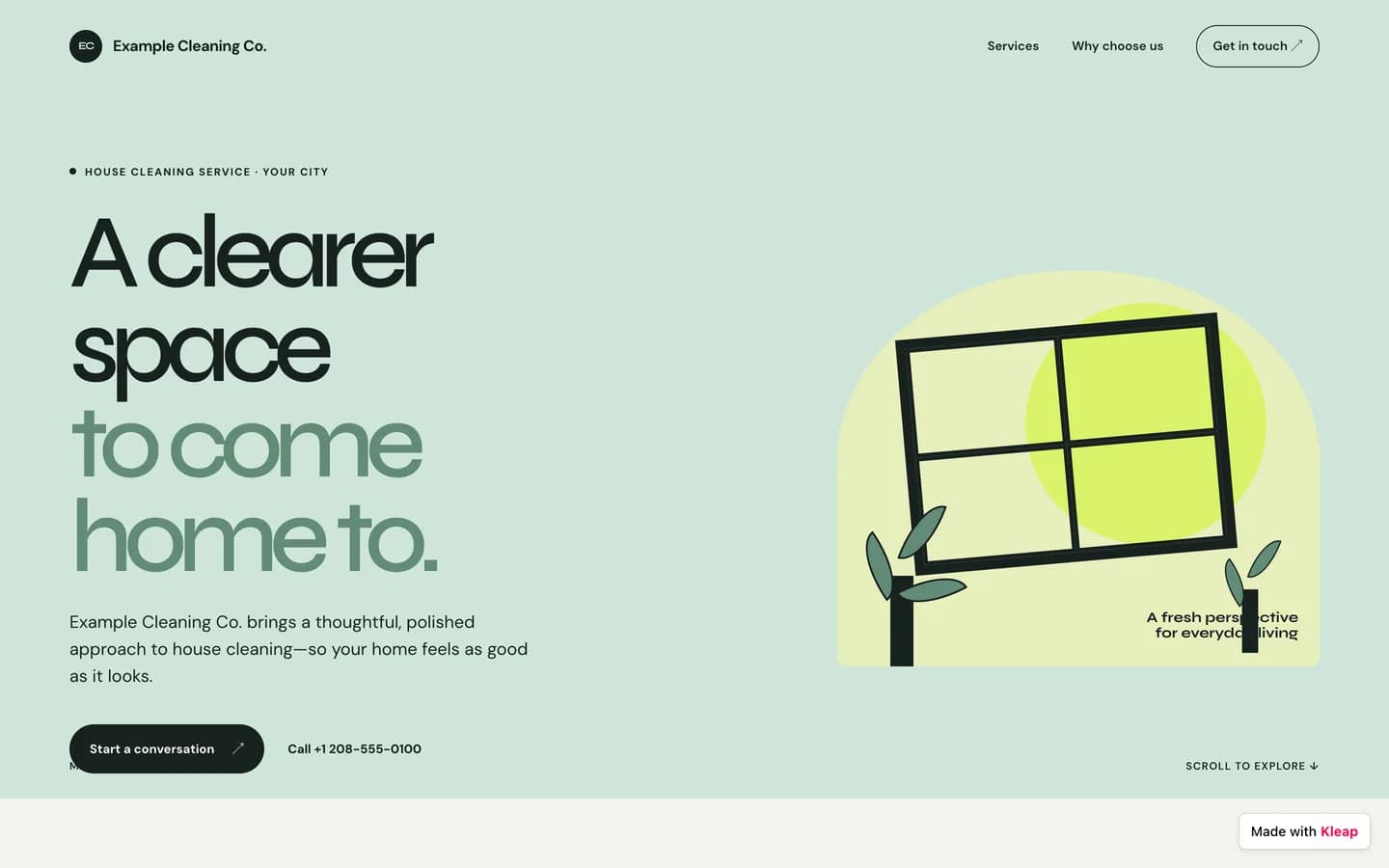
Open it. Kleap marked the demo published 3 min 26 s after we asked, and the kleap.io address answered when we opened it.
What to check before the demo goes anywhere
The services are generic. The page lists six cleaning options, each saying “Pricing: request a quote”. That is deliberate: Kleap is told to use only the facts it has and to keep anything else generic or marked as a placeholder. Replace them with the owner's real services before you rely on it.
The page shows no reviews, years in business, hours or team names. That is what you want when a stranger might read it, because Kleap was told to use only the facts it had.
There are no photos of the business. The hero is an illustration. Ask the owner for real photos.
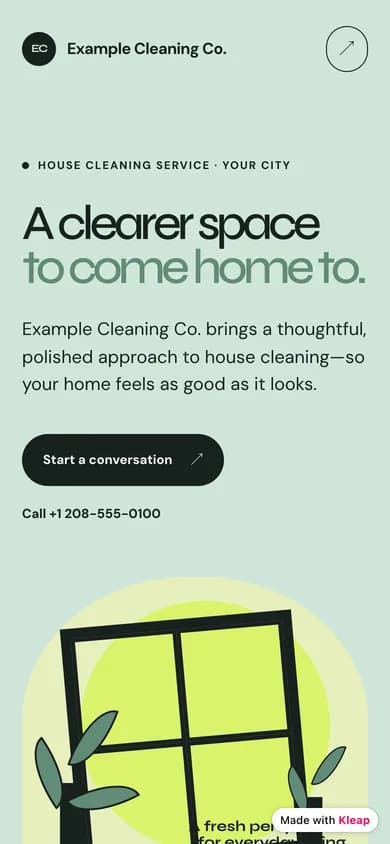
Look at the whole page. In ours, a caption inside the hero illustration was partly covered by a plant. Ask Kleap in chat to fix anything like that; you will only notice it by looking.
Step 4: What should the outreach message say, and what does the law require?
Kleap wrote a short pitch for each flagged lead and for none of the others: 8 of 40 leads (one in search 1, for the site that would not load, and 7 in search 2). This is the one it wrote for the business with no website, with the business name and the sender replaced. We did not send it.
Hi [business name], I came across your Google Maps listing and noticed that no website is listed on your profile. We’re a small local web agency and could put together a quick, free mock-up to show what a simple website for your business might look like. Would you be open to seeing one? Best, [your business name]
One true observation. That the listing shows no website is something the owner can check at once. Kleap's pitches for the weak sites each named a checkable point: not served over HTTPS, no page title, an old copyright year, a social page instead of a site.
Add the demo. The pitch offers a mock-up. Once the demo exists, say so and give the link.
One question at the end. “Would you be open to seeing one?” is easy to answer yes or no.
Say who you are. Replace “a small local web agency” with your real name and business.
The law, in the FTC's words
In the United States the CAN-SPAM Act sets rules for commercial email, and the Federal Trade Commission's guide states: “The law makes no exception for business-to-business email.” These are the headings of its main requirements.
Each separate email in violation can be penalised by up to $53,088, per the FTC's page. We are not lawyers, check the rules where you and the business are, and you can always phone: leads without an e-mail address are phone leads. Send from your own mailbox, to people you chose one at a time.
Step 5: What do you say on the phone, and what do you send after?
Every lead we got had a phone number and only some had an e-mail address, so the first contact is often a call. This is the routine we would follow; we did not try it on anyone, so it is a plan and not a result.
Prepare three things before you dial. The website status Kleap shows for the lead (none, weak or did not load), one concrete thing you saw on their current page, and the demo opened on your own phone.
Say who you are, what you saw and what you made, in about thirty seconds. Then ask one question and stop talking.
Send the demo by e-mail only if they say yes, with the elements the FTC lists: your real name and business, a subject line that says what it is, a line that it is an advertisement, your postal address and an opt-out.
Follow up once, a few days later, and then stop. A second message with the same link is enough.
Hi, is this [owner's first name]? I'm [your name], I'm a local web designer in [your city]. I was looking for a [trade] in [city] and your Google listing has no website on it, so I put together a demo of what one could look like. Can I e-mail you the link? If it's not for you, no problem.Subject: A demo website for [business name]
Hi [first name], thanks for taking my call. Here is the demo: [link]. It uses only what is on your Google listing, so the services are placeholders until you tell me yours. This is a promotional message from [your business], [your postal address]. If you would rather not hear from me again, reply "stop" and I will not write again.
[your name]What owners will say, and how to answer
| The owner says | Answer with |
|---|---|
| “I get all my work by word of mouth.” | Their own Google listing: ask what a stranger sees when they search the business name, and show the demo next to it. |
| “I have a Facebook page.” | Ask what they would want a visitor to find that a social page does not give them, and show where it sits in the demo: an address, a contact form. Kleap flags a social page standing in for a site as a weak site. |
| “How much is it?” | A fixed price for the site and a separate, smaller recurring fee for changes, both written down (see step 6). Never a vague “it depends”. |
| “I'm busy, just send me something.” | Yes: the demo link, nothing else. Promise one follow-up and keep the promise. |
| “I already have a website.” | Open theirs and the demo side by side on your phone and name the one checkable problem Kleap found: no HTTPS, no page title, an old copyright year, or not adapted to phones. |
“I get all my work by word of mouth.”
- Answer with
- Their own Google listing: ask what a stranger sees when they search the business name, and show the demo next to it.
“I have a Facebook page.”
- Answer with
- Ask what they would want a visitor to find that a social page does not give them, and show where it sits in the demo: an address, a contact form. Kleap flags a social page standing in for a site as a weak site.
“How much is it?”
- Answer with
- A fixed price for the site and a separate, smaller recurring fee for changes, both written down (see step 6). Never a vague “it depends”.
“I'm busy, just send me something.”
- Answer with
- Yes: the demo link, nothing else. Promise one follow-up and keep the promise.
“I already have a website.”
- Answer with
- Open theirs and the demo side by side on your phone and name the one checkable problem Kleap found: no HTTPS, no page title, an old copyright year, or not adapted to phones.
Step 6: How much should you charge, and what goes in the proposal?
Nothing in our trial can tell you what to charge, and the sources we found report what businesses spent and what agencies charge, not what you should charge. They give you the range the owner already has in mind.
Published price anchors
| Source | What it says |
|---|---|
| Clutch, Web Design Company Pricing Guide 2026 (updated 21 Sep 2026) | “Most web design projects reviewed on Clutch usually cost less than $10,000.” Agencies shortlisted on Clutch charge around $100 to $149 an hour; website-builder specialists are listed at $25 to $49 an hour. It gives no separate figure for small sites |
| Clutch, small business survey, 2018 (351 US owners) | Among small businesses with a website, 28% had spent less than $500 and 48% between $500 and $10,000 |
Clutch, Web Design Company Pricing Guide 2026 (updated 21 Sep 2026)
- What it says
- “Most web design projects reviewed on Clutch usually cost less than $10,000.” Agencies shortlisted on Clutch charge around $100 to $149 an hour; website-builder specialists are listed at $25 to $49 an hour. It gives no separate figure for small sites
Clutch, small business survey, 2018 (351 US owners)
- What it says
- Among small businesses with a website, 28% had spent less than $500 and 48% between $500 and $10,000
Read together, an owner who has paid for a site before has most likely paid under $10,000, and many paid far less. The agency figures are agencies', not freelancers', and the survey is from 2018. Our suggestion, which we did not test: quote one fixed price for the site and a separate recurring fee for hosting and changes, and put each in writing.
What the proposal should say
What the site is: the pages, the contact form and where its messages go.
Who supplies what: the owner gives real services, photos and opening hours; you write and build the rest.
The domain: it is registered in the owner's name, not yours.
Changes: how many rounds of changes the price covers, and what the monthly fee covers after launch.
Payment: when each payment is due, and what happens if the owner goes quiet.
Step 7: How do you put it live and hand it over?
Go through the demo with the owner and change it in words. Real services, real photos, real opening hours: each is a chat message to the project.
Publish from the Publish button. Our made-up business's own site went from first prompt to a live address in 8 min 37 s.
Connect the owner's own domain. The editor offers an Add a domain button at publishing time, and there is more on connecting a domain.
Look at the live page on a phone and send a test message through the contact form before you tell the owner it is done.
Agree the monthly care in one sentence: which changes you make when asked (hours, photos, a new service) and how fast.
What did we not test?
Any message to a business. We sent nothing, so there are no reply rates, no close rates and no income figures. Ask any page that claims them to show its trial.
More than two cities and 40 leads. The flag counts could look different in your town and trade.
Whether the weak-site flags are right. They are automatic and we did not review each one by eye.
What an owner thinks of a demo. We built one and did not show it to anyone.
The phone script, the e-mail and the proposal. They are a plan built from the trial's data and the FTC's checklist; nobody has received them.
Payment and contracts. The Clutch pages and the FTC page are the only sources for prices and email rules here.
How do you get your first web design client from here?
This is the routine our trial points to, not a measured result. Run one search for a niche in your own town, read the table from the top, open the flagged sites and keep the handful you could honestly improve. Build a demo for each, check it, then contact those owners one at a time, by phone where you have no e-mail address and by lawful e-mail where you do. Follow up once. Quote from the survey bands and put the scope in writing. Then repeat in the next trade.