7 Crear Páginas Artificial Inteligencia Tools for Modern Web

AI website builders let you create trained sites through conversation in under 30 minutes, replacing weeks of traditional development with natural language prompts and instant design generation.
- Seven platforms now offer AI website creation capabilities, from free starter tools to enterprise-grade solutions with custom code export.
- Choose based on your technical comfort: pure conversation interfaces for beginners, hybrid prompt-and-edit systems for designers, or AI-assisted code editors for developers.
- Expect launch-ready sites in 15-45 minutes depending on complexity, with ongoing AI refinement replacing the traditional revision cycle.
You describe your business in three sentences. The AI generates a complete website.
Twenty minutes later, you're live.
However, that's not a demo scenario anymore; it's how AI website creation works in 2025. What used to require wireframes, design mockups, developer handoffs, and revision cycles now occurs in a single conversation with an AI that understands brand positioning as fluently as it writes code.
The shift matters because speed no longer forces you to sacrifice quality. Previous generations of website builders gave you templates that were rigid, recognizable, and limiting.
AI builders generate custom designs from scratch, tailored to your specific offer, audience, and aesthetic preferences. They then let you refine through natural language rather than wrestling with visual editors.
The real differentiator isn't the technology; it's knowing which tool matches your workflow, because the seven platforms covered here take radically different approaches to the same promise.
Our evaluation criteria for ranking AI website builders
While most comparison guides rank tools by popularity, we rank by what breaks first under real-world pressure.
After testing twelve platforms that promise to creer site web avec ia, we discovered that the gap between "generates a site in minutes" and "generates a site you can actually use" is massive. Wix claims its AI creates complete sites in minutes through chat, which means the first 180 seconds determine whether you spend the next three hours fixing broken layouts or launching immediately.
Speed and ease of first build
Since we measure time-to-publish, not time-to-draft, a builder that generates a homepage in 90 seconds but requires 45 minutes of manual fixes scores lower than one that takes 4 minutes upfront and ships ready.
Key tests: does the AI understand "e-commerce for handmade jewelry" versus generic "online store"? Does it pull real content structure or placeholder Lorem Ipsum?
Can a non-technical founder go live the same day?
Customization depth after AI generation
The hidden cost: platforms that lock you into AI-generated layouts. We review whether you can access underlying code, export designs, or integrate custom functionality post-generation.
Drag-and-drop flexibility matters less than whether the tool traps you in a template or gives you ownership to scale beyond the initial build.
Try it — build your site while you read
Describe what you want and get a live, publishable site in seconds. Free to start, no code.
Join 200,000+ makers building real websites with Kleap.
Why AI is reinventing website creation right now
The coding marathon is dead. What used to take three weeks of back-and-forth with developers now happens in the time it takes to describe your business in plain English.
AI website builders like Wix, Squarespace, and Figma have turned web creation into a conversation. You chat about your project, and the system generates a complete site with design, copy, images, and functional elements. Then you refine it visually without touching code. The shift isn't subtle: platforms that once required HTML fluency now operate entirely through natural language prompts.

From coding marathons to instant launches
The four-step workflow—describe, review draft, refine, publish—has become the industry standard. Although Wix's AI generates entire pages "just by chatting," Figma's natural-language builder creates adaptive, interactive sites without a single line of code.
The transformation hits hardest for entrepreneurs launching products, freelancers building portfolios, and small businesses needing e-commerce stores fast. The search term "crear paginas web con inteligencia artificial" reflects global demand for exactly this: instant web creation that eliminates the developer bottleneck and the 120-hour learning curve.
Kleap, one AI agent for websites and apps, from idea to live
While Wix and Squarespace tout "minutes to launch," Kleap collapses the entire stack into a single conversational agent. You describe your project in natural language: "build a portfolio for a freelance photographer with booking forms." The platform generates design, hosting, forms, and domain configuration without switching tools.
The catch? Most AI builders stop at templated layouts.
Thus, Kleap's agent creates unique, non-templated designs for each prompt. This eliminates the "I've seen this site before" problem that plagues standard no-code platforms. For teams launching MVPs or testing product-market fit, this approach reduces the typical 2-week build cycle to under an hour, including deployment.
How Kleap's natural language builder works
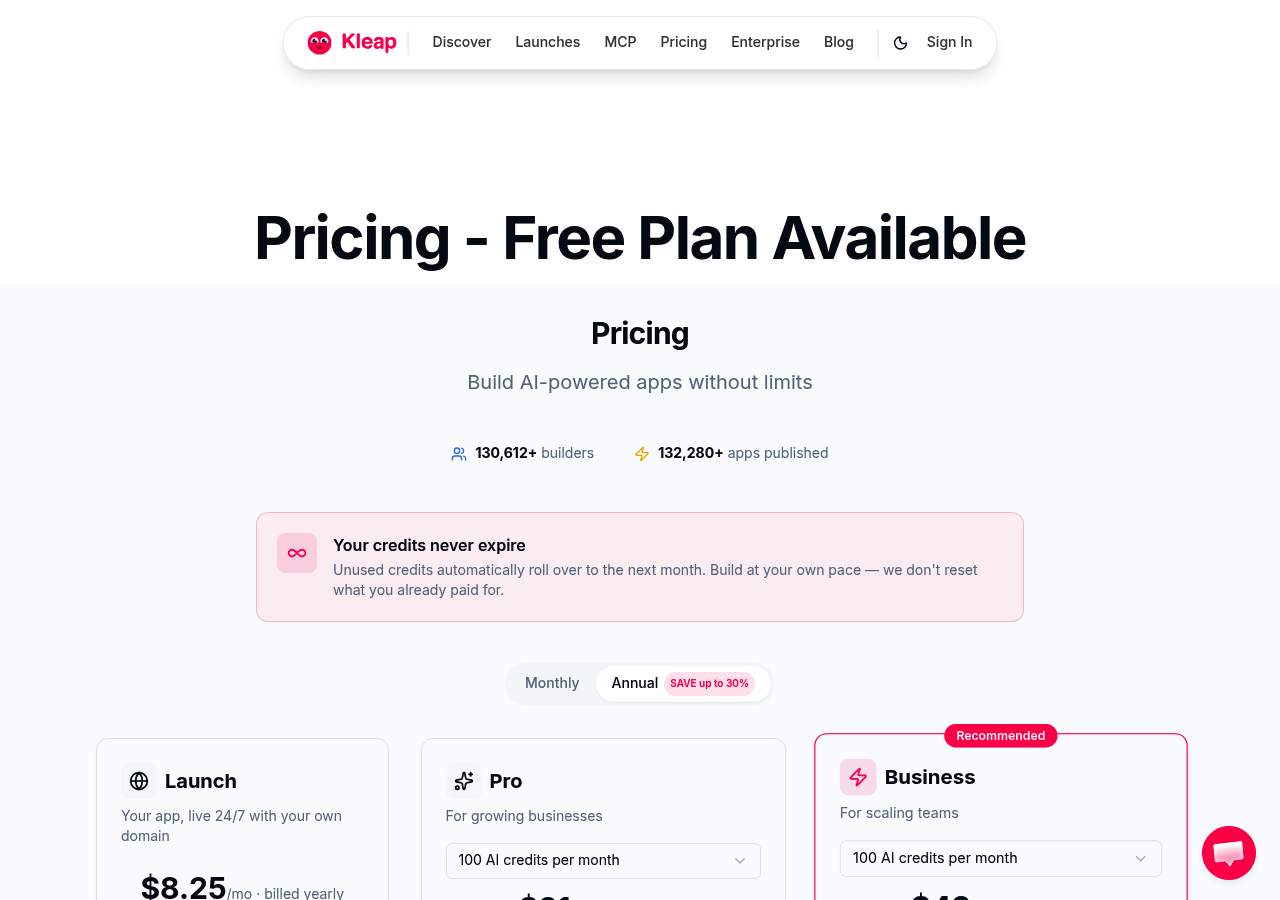
The workflow mirrors Figma's natural language generator but extends beyond static pages: describe your site, review the AI-generated structure, and refine content and styling in real time. Then publish with integrated hosting. Unlike competitors that generate a starting point and hand you off to a visual editor, Kleap maintains the conversational interface throughout. You iterate by chatting, not dragging blocks.
The platform handles blog setup, e-commerce storefronts, and custom forms within the same agent. This eliminates the plugin sprawl that trips up non-technical founders. Code ownership is yours: export the full stack if you outgrow the platform or need to migrate to a custom infrastructure later.
Pricing and who should choose Kleap
The free tier lets you prototype and test layouts indefinitely. Pro at $25/month releases custom domains and removes branding, the threshold where most serious projects start.
Business at $50/month adds priority support and advanced integrations for agencies managing multiple client sites. Meanwhile, Enterprise pricing is custom, targeting development teams that need white-label deployment and dedicated infrastructure.
Best fit: entrepreneurs who value speed over pixel-perfect control, freelancers launching client sites under tight deadlines, and agencies prototyping concepts before committing to full development. It is not ideal if your workflow requires granular CSS control or if you're building complex web applications with custom backend logic; the conversational interface trades precision for velocity.
For a broader comparison of AI-powered platforms, see our criador de site com inteligencia artificial guide.
Kleap tip: Start with the free tier to validate your concept. Upgrade to Pro only after you've confirmed product-market fit; the custom domain justifies the $25/month once you're ready to drive traffic, not before.
Wix AI, chat-driven website creation with enterprise apps built in
Wix proves that mature platforms dominate when AI meets infrastructure. While newcomers like AI website erstellen kostenlos tools promise speed, Wix AI delivers the complete stack. You can chat with the system, describe your business in plain language, and watch it generate design, copy, images, and pre-configured enterprise apps, booking systems, CRM, and marketing automation in under ten minutes.
The catch? You're not just getting a website.
You're inheriting Wix's decade of third-party integrations, SEO tooling, and hosting reliability that smaller AI builders can't match. On the other hand, this is website creation with artificial intelligence. It is for teams that need both velocity and operational depth.
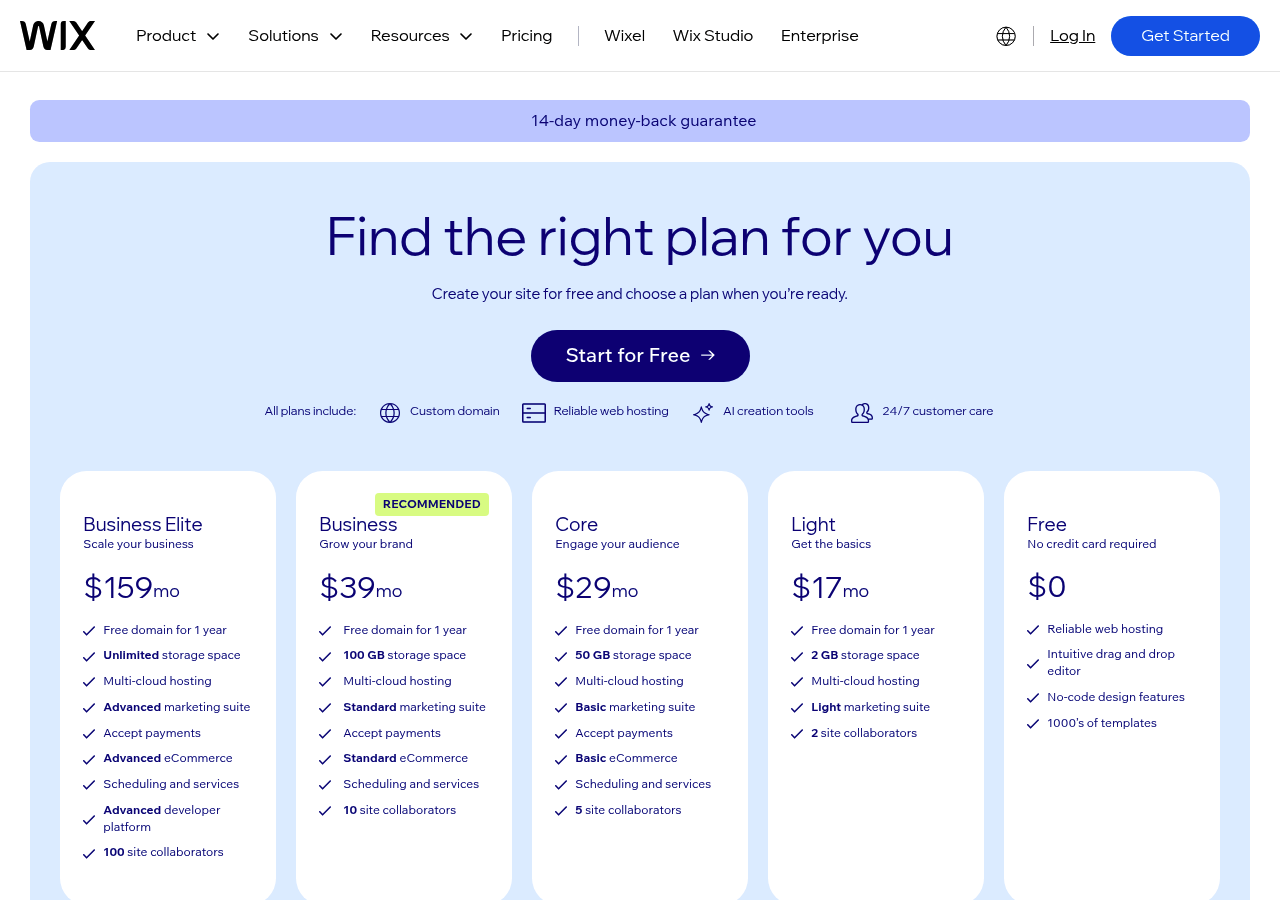
Pricing starts free, with premium plans from $16 monthly for basic sites and e-commerce from $27. It is best for small businesses that want integrated business logic without stitching five SaaS products together.
The trade-off: the interface overwhelms absolute beginners with too many features and too many menus. If you need a portfolio site in five minutes, look elsewhere.
If you're launching a service business with booking, payments, and client management, Wix AI handles the complexity that other builders ignore.
Figma AI, from design prototype to live site without code
Figma's entry into AI website generation signals a fundamental shift: design tools now deploy live sites, not just mockups. The platform puts natural language prompts to work to create adaptive, interactive pages with real data integration, no code required.
What separates it from traditional builders? Design precision.
Teams already working in Figma can now prototype Thursday morning and publish Thursday afternoon, eliminating the handoff friction that typically adds days to launch timelines. The workflow stays inside a single environment, preserving design intent from concept to production.

Nonetheless, pricing starts at $12 monthly for professional features, with a free tier covering basic projects. The catch?
There is a steeper learning curve for non-designers. Subsequently, Figma prioritizes collaborative design workflows over built-in SEO or e-commerce features that platforms like carrd emphasize.
Agencies and product teams gain real-time collaboration and powerful prototyping capabilities, but solo entrepreneurs seeking turnkey e-commerce may find the design-first approach demands more upfront investment in mastering the tool's interface and logic.
OpenAI Website Builder creates sites instantly with GPT-powered generation.
OpenAI's entry into website building flips the usual AI-builder script: instead of a form guiding the model, you describe what you need in plain language, and GPT generates structure, copy, layout, and functionality in one pass. The catch?
However, it is still experimental. While platforms like Wix and Kleap offer mature workflows with hosting and domain management baked in, OpenAI's approach targets developers and early adopters who want maximum prompt control and code ownership.
You get raw HTML, CSS, and JavaScript, no drag-and-drop editor, and no integrated CMS. Therefore, for teams already using GPT-4 or GPT-4o for content generation, this feels like a natural extension.
For everyone else, the learning curve is steep, and the missing infrastructure (hosting, forms, analytics) means you're building the rest yourself.

How OpenAI's model generates complete websites
GPT-powered generation works through iterative prompting: you describe the site's purpose, target audience, and key sections, then refine the output by asking for layout changes, color adjustments, or additional pages. Unlike a generador de sitios web con ia that constrains you to templates, OpenAI's model produces custom code from scratch.
The downside is that you're responsible for debugging, deployment, and ongoing maintenance.
Best use case: rapid prototyping for developers who want AI-assisted scaffolding, not a finished product.
Pricing and accessibility
OpenAI's website builder capabilities currently live within ChatGPT Plus (around $20/month) or API access, where costs scale with token usage. Although there's no standalone 'website builder' product yet, you're using the core GPT model and exporting code manually.
Compare that to Kleap's all-in-one approach: free to start, $25/month for Pro with hosting, domains, and forms included. OpenAI's model excels at generating initial code; Kleap handles the entire launch pipeline.
For non-technical users, the gap is decisive. For developers comfortable with command-line deployment, OpenAI offers unmatched prompt-level customization.
Kleap tip: If you're testing OpenAI's code generation, use it to draft the initial structure, then import the output into Kleap's editor for visual refinement and instant hosting. You get the best of both worlds without manual deployment.
Design.com, an AI-powered logo and website builder for brand consistency.
Most startups waste three weeks hunting for a designer, then another month waiting for website mockups. Since Design.com collapses that timeline to under sixty minutes by generating both logo and site from a single AI workflow, you describe your industry and style preferences, and the platform outputs brand assets and applies them across matching templates instantly.
The catch? While competitors like Wix or Figma focus on advanced site customization, Design.com prioritizes speed over depth: templates lean generic unless you invest hours tweaking layouts manually.
How Design.com Unifies Branding and Site Creation
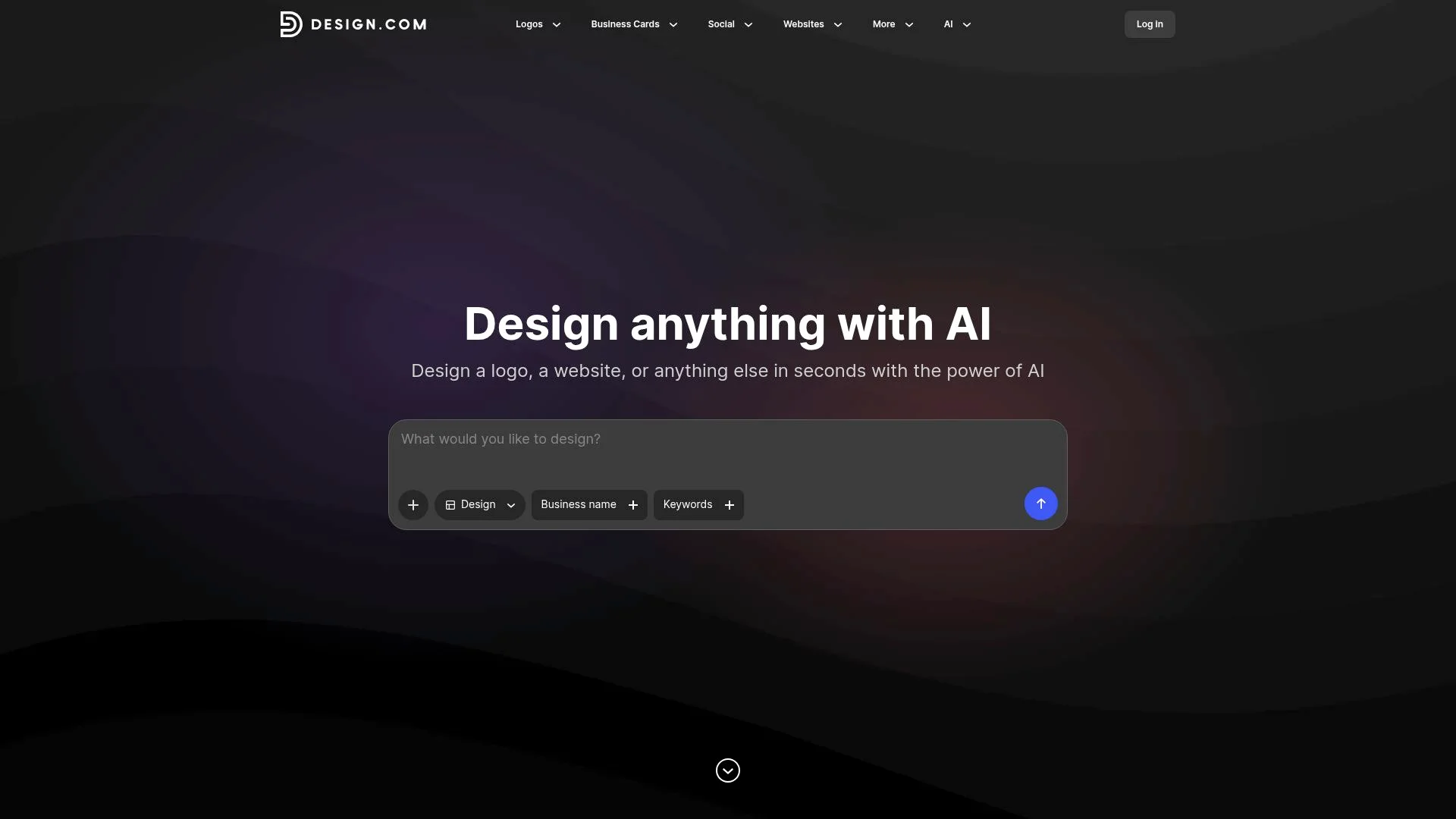
The AI asks three questions: business type, color palette, and font mood, then generates twenty logo variations in seconds. Pick one, and the system auto-populates website headers, business cards, and social media kits with that exact branding.
Unlike traditional design suites that require manual asset syncing, every element updates when you refine the logo. This workflow mirrors the four-step pattern common across AI builders: describe, review, refine, and publish, but Design.com adds a fifth layer by locking visual consistency across all deliverables before you touch the site editor.
Pricing and Best-Fit Customers
Logo packages start at twenty dollars for basic files and sixty-five for full branding kits; the website builder bundles into premium plans around fifteen dollars monthly. Best fit: bootstrapped founders launching from zero who need logo, site, and print materials designed before their first customer call.
Avoid if you already have brand guidelines; you'll fight the platform's insistence on regenerating assets to match its templates.
Framer AI: Design Freedom Meets AI Automation for Creative Professionals
Most AI builders generate functional sites. Framer AI generates sites that designers actually want to show in their portfolios.
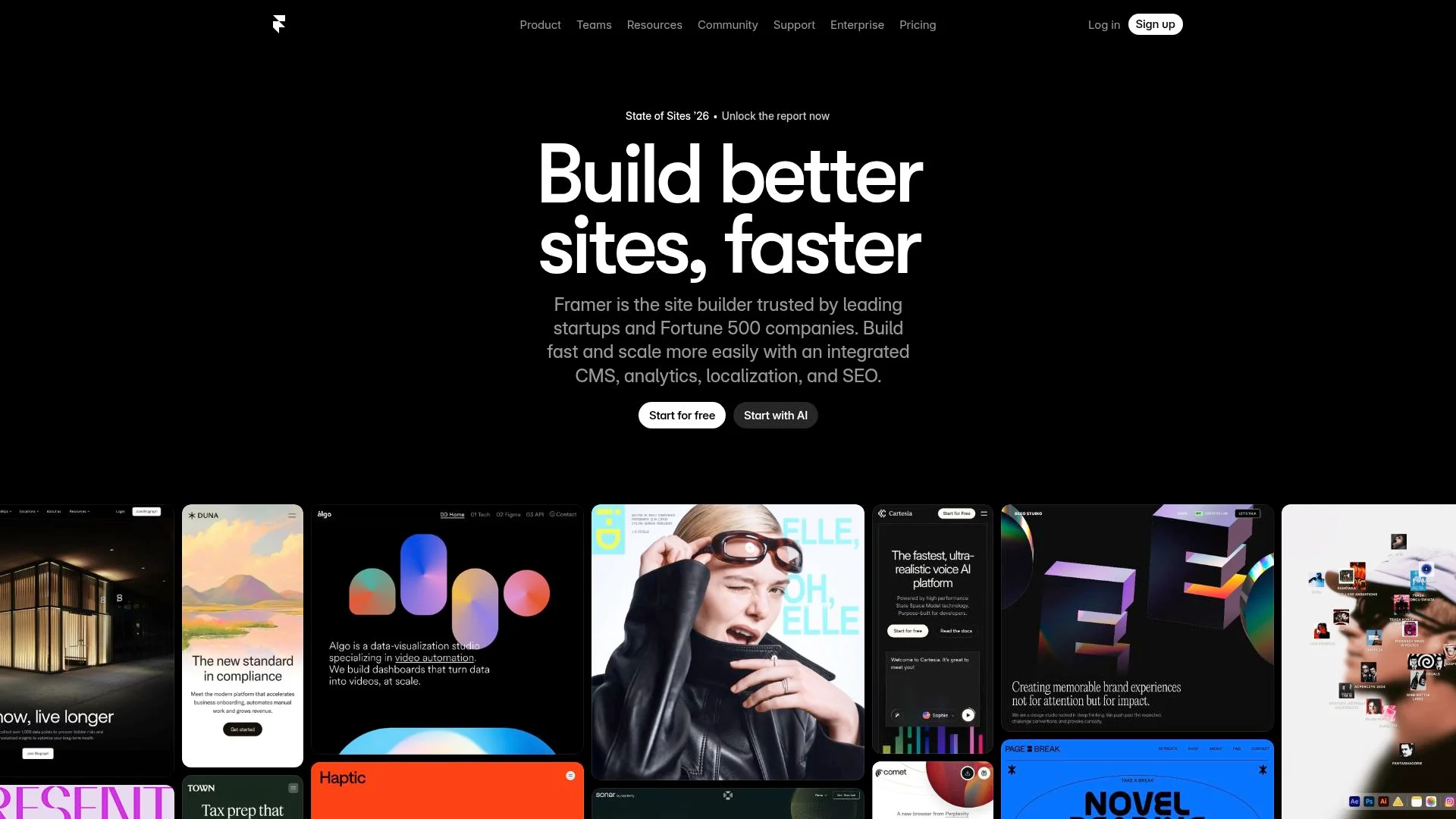
The difference? While platforms like Wix prioritize business apps and Figma stays in prototype mode, Framer bridges the gap between AI generation and production-grade design systems, generating interactive, responsive layouts from text prompts, then handing you an animation engine and CMS that would make a motion designer jealous.
The AI handles structure and initial content placement. You control every pixel, transition curve, and breakpoint afterward.
How Framer AI Generates Interactive, Pixel-Perfect Sites
Framer's generation flow mirrors the industry standard: describe your project, review the AI draft, and refine, but the output diverges sharply. Where competitors deliver static templates, Framer produces component-based designs with built-in scroll animations, hover states, and adaptive layouts.
Additionally, the AI reads your prompt, selects from professionally designed layout patterns, populates content, then unlocks Framer's full design toolkit: advanced animation controls, a visual CMS for dynamic content, and code export for teams that need ownership. This prototyping-to-production workflow eliminates the handoff gap that trips up agency teams.
Pricing and Who Thrives with Framer
The free tier covers small projects. Paid plans start at ten dollars monthly for custom domains and collaboration features.
Best fit? Designers and agencies who treat websites as creative work, not admin tasks.
The platform rewards design sensibility; users comfortable with animation timing and component architecture extract maximum value. Simplicity seekers will find the interface overwhelming.
For creative professionals who refuse to compromise on visual excellence when creating sites with AI automation, Framer delivers unmatched design flexibility without sacrificing speed.
Webflow AI: Professional Web Design Automation for Developers and Agencies
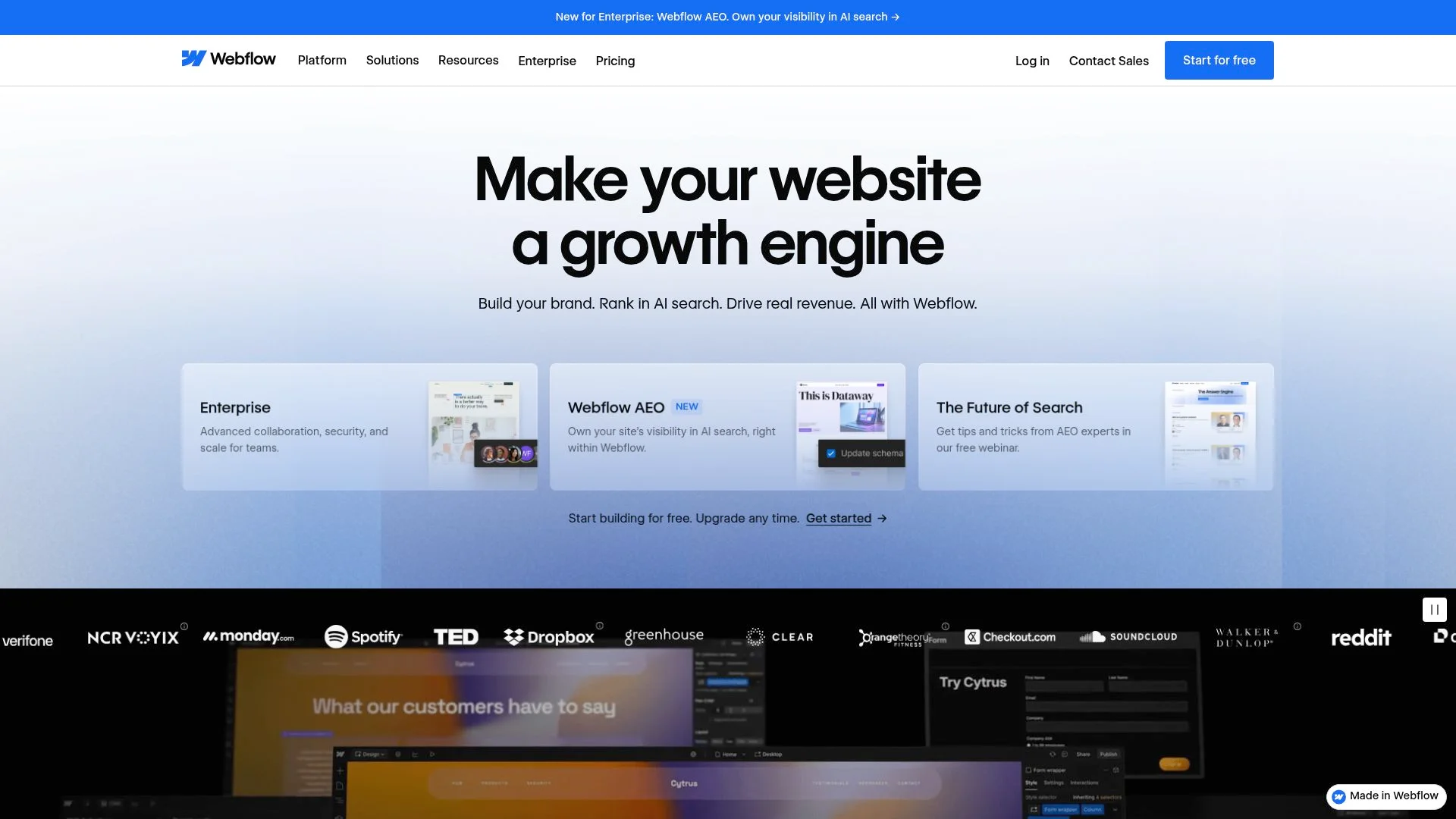
Most AI builders sacrifice control for speed. Webflow AI does the opposite: it generates production-ready layouts while handing you clean HTML, CSS, and JavaScript that you can edit pixel by pixel.
The difference shows up the moment a client requests custom functionality. While competitors lock you into templates, Webflow lets you export code, integrate APIs, and build CMS workflows that scale to thousands of pages. The catch?
You pay for that flexibility with a learning curve steeper than drag-and-drop competitors.
How Webflow AI combines code control with AI generation
The platform follows the industry-standard four-step workflow: describe your project, review the AI-generated brief, refine design and content, and publish, but adds a visual code editor underneath. Agencies managing client portfolios use this hybrid approach to launch faster while maintaining brand consistency across dozens of sites.
Pricing and ideal customer profiles
For example, plans start at $14 monthly for basic sites, climbing to $23 for CMS features and $29 for e-commerce. Enterprise teams needing custom solutions find the investment justified; freelancers building simple landing pages often do not.
What other AI website builders won't tell you
Free tiers sound appealing until you discover the catch: no custom domain, platform branding stamped across your footer, and SEO features locked behind the $25-per-month paywall. Above all, most platforms advertise 'all-in-one' capabilities but charge transaction fees on e-commerce sales, restrict premium templates, and bill separately for integrations that marketing materials suggest come included.
The real cost emerges three months in when you realize migration is nearly impossible; proprietary AI builders rarely export clean code, trapping your site inside their ecosystem.
When AI generation actually slows you down
AI-generated layouts deliver speed but sacrifice uniqueness. Without manual refinement, your site resembles the 10,000 other businesses that described their projects the same way.
Nonetheless, worse, AI often produces bloated code with accessibility gaps that tank performance scores and search rankings long-term. The platforms that emphasize rapid generation downplay the reality: the heaviest work starts after launch.
SEO optimization, content updates, and A/B testing—these conversion-critical tasks still demand human strategy, and AI offers minimal help once your site goes live.
Frequently asked questions about AI website builders
The most common question teams ask is: how long does generation actually take? Initial site creation happens in 1-5 minutes across most platforms, but the real work—refining copy, adjusting layouts, connecting domains—typically requires 30 minutes to 2 hours depending on complexity.
The catch? That's just the launch.
SEO optimization, content tweaks, and conversion testing happen after, not during, the AI generation phase.
Common concerns about AI-generated websites
Ownership trips up most buyers. While platforms grant content rights, code and infrastructure usually stay locked inside proprietary systems.
Only a handful, Kleap among them, offer full code ownership, which matters when you want to migrate or scale beyond the builder's limits. Editing post-generation is universal: every tool allows manual refinement, though methods vary from drag-and-drop to direct code access for developers.
Technical questions answered
SEO on AI sites works, but barely. Builders handle basic meta tags and semantic structure automatically, yet serious ranking requires manual keyword optimization, schema markup, and technical audits that the AI skips entirely.
Platform switching can be painful with closed ecosystems.
Migration becomes feasible only when you control the underlying code or export to standard formats, a feature most proprietary builders deliberately withhold.
Start Building Your AI-Powered Website Today
The shift to creating websites with artificial intelligence isn't coming; it's already here, and the gap between teams that have adopted AI builders and those still wrestling with traditional platforms widens every quarter.
Pick a tool from this list, start with the free tier, and ship your first page this week. The biggest mistake isn't choosing the 'wrong' platform; it's waiting another month to start.
Ready to build with Kleap? The platform gives you full code ownership, enterprise-grade security, and an AI agent that handles everything from design to deployment.
The free tier gets you started in minutes, Pro unlocks custom domains and advanced features at $25 per month, while Business adds priority support and advanced integrations at $50 per month.
Create your first AI-powered site now; no credit card is required to start, no coding knowledge is needed, and no lengthy setup process is blocking your launch.
Your idea deserves to go live today, not next quarter.