Is Kleap Safe for Business Websites? 7 Security Features

You've poured your heart, soul, and way too much coffee into building your business. The absolute last thing you need is to wake up, grab your phone, and find your digital storefront gone, or worse, plastered with some hacker's tag from across the globe. This is a nightmare scenario that keeps entrepreneurs up at night.
With the rise of AI website builders, the game has changed.
We are moving away from complex code that requires a degree in computer science to fix, toward natural language processing and instant deployment. The speed is amazing.
But speed often breeds suspicion. You might look at how fast an AI builds a site and wonder if corners were cut.
You are right to be skeptical. In fact, skepticism is a healthy trait for any business owner. You are likely asking yourself: is Kleap safe for business websites? This is the most critical question to answer before you migrate your brand or launch your startup on this platform.
Security isn't just about having a lock on the door. It is about the walls, the foundation, the surveillance system, and who holds the keys.
In the digital world, that means looking at the nitty-gritty: hosting, encryption, compliance, and who gets the keys to the castle.
We are going to take a hard look at what happens under the hood.
We aren't just looking for a simple "yes." We want to understand the mechanics of how your data, and your customers' data, are protected.
Look, when you're all about getting your website up fast, you just can't afford to let security take a backseat.
It's a tricky balance between moving fast and staying safe. So, we're going to pull back the curtain and really look at Kleap's infrastructure, its compliance chops (like SOC 2 and GDPR), and the tools it gives you to lock down your digital assets.
Let's dig in.

The Short Answer: Is Kleap Safe for Business Websites?
If you are in a rush and just need the bottom line, here it is.
Yes, the platform is engineered with enterprise-grade security protocols that often exceed what a typical small business could set up on their own.
The question "is Kleap safe for business websites?" is answered definitively by its compliance portfolio.
We are talking about SOC 2 Type II certification. For those who aren't security nerds, that is the gold standard for SaaS companies managing customer data.
It means some independent auditors have come in and confirmed their security controls aren't just sitting in a dusty policy binder. These controls are live, they work, and they're used all the time.
But it's about more than just a certificate.
Here's something interesting: the platform's architecture was put together by former WordPress developers.
Why is that a big deal?
Because these are the people who spent years in the trenches, wrestling with the "plugin hell" and constant vulnerability scares that come with traditional platforms.
They built Kleap to eliminate those specific overhead costs.
They designed a system where security is integrated, not added on later.
You don't need to install a security plugin. You don't need to manually update your firewall.
For entrepreneurs and marketing agencies, this represents a massive shift. It moves security from a 'to-do list' item to a fundamental 'done-for-you' service.
Whether you are running a simple portfolio or a complex e-commerce store, the infrastructure is fortified against attacks.
With automated backups, even if the worst happens, you always have a way to roll things back. Plus, its global CDN ensures your site loads quickly and securely for everyone, no matter where they are in the world.
So, back to the big question: is Kleap safe for your business?
All the evidence, from industry-standard compliance to their proactive security mindset, points to a definite yes.
Try it — build your site while you read
Describe what you want and get a live, publishable site in seconds. Free to start, no code.
Join 200,000+ makers building real websites with Kleap.
Enterprise-Grade Hosting and Infrastructure
Let's discuss where your website actually resides, the hosting and infrastructure.
You know how it used to be: you'd rent a server (probably a shared one) and just cross your fingers that your server neighbor didn't get a virus that could hop over to your site.
Kleap takes a completely different approach.
It uses managed hosting, which means all the tedious server maintenance, patching, and updates are their responsibility, not yours.
This is a huge deal for security since most hacks exploit unpatched servers or outdated software. When everything is handled in one place like this, the risk drops dramatically.
Global CDN and Edge Security
Speed and security are often viewed as trade-offs. Usually, when you add more security, your site slows to a crawl. Not here.
Kleap uses a global Content Delivery Network (CDN).
This system distributes your website's content across servers all over the globe, so it's physically closer to your visitors.
But it's more than just speed; it's a shield.
For Enterprises, this is a game changer because the CDN can absorb massive traffic spikes and shut down DDoS attacks before they even reach your main server.
This edge security means that malicious traffic is filtered out at the perimeter.
Your business website remains operational, even when bad actors try to flood it.
Consider the logic of physical security. You don't stop the intruder at your bedroom door; you stop them at the front gate.
That is what the global CDN does for your digital presence.
📸 kleap.co 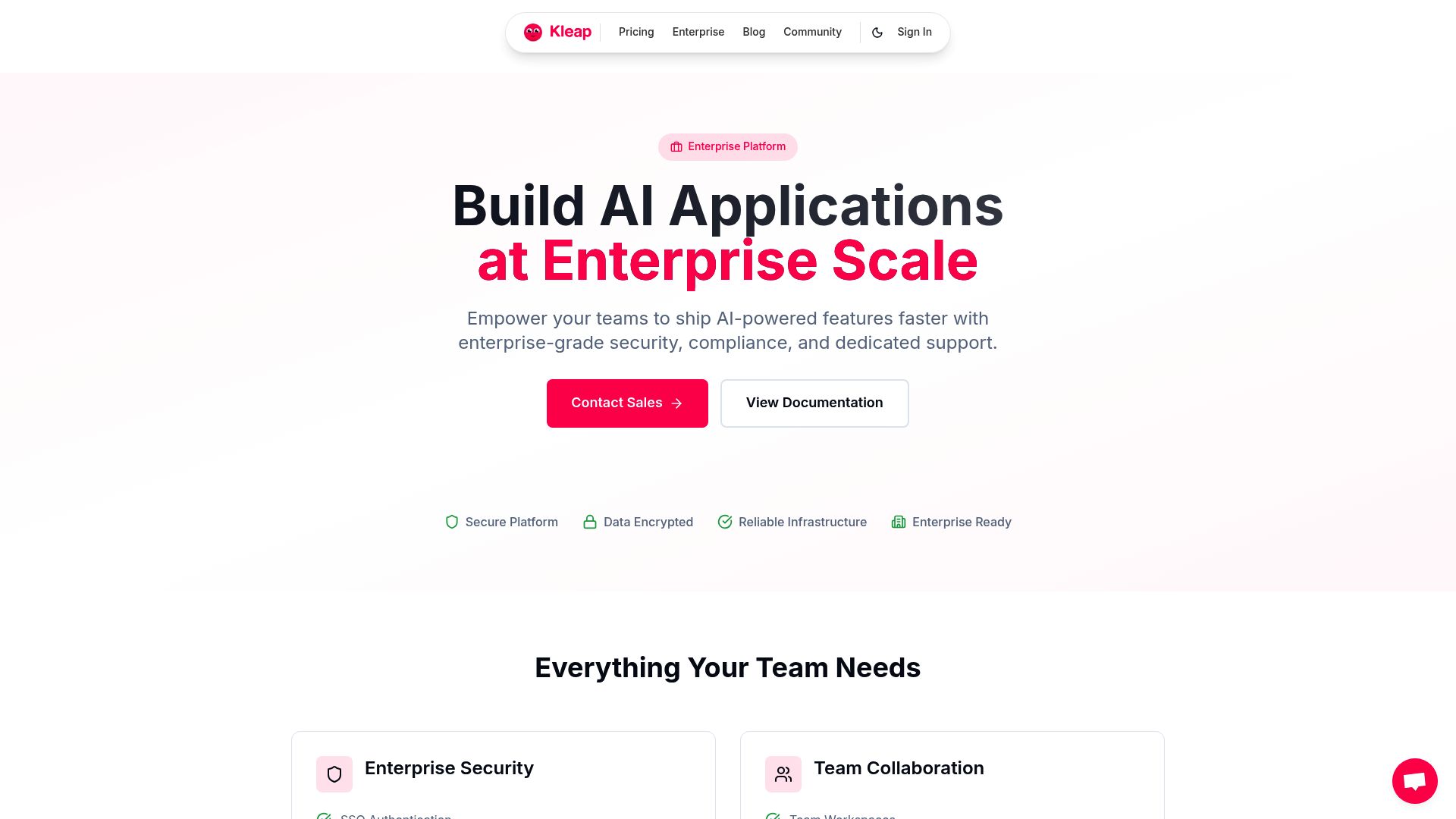
Automated Backups and Recovery
Mistakes happen. Sometimes it's not a hacker.
Sometimes you or someone on your team deletes the wrong page.
The platform includes automated backups.
This is your safety net.
Recovery is often where businesses fail. They have security but no plan for when things go wrong.
With automated backups, you can restore your site to a previous state.
It turns a potential disaster into a minor hiccup.
Compliance: SOC 2, GDPR, and More
Regulatory compliance is boring until you get fined. Then it becomes the most exciting thing in the world.
When asking 'is kleap safe for business websites?', you have to look at the legal and regulatory framework.
SOC 2 Type II Certified: This is a big deal. It validates the effectiveness of security controls over a period of time.
It covers security, availability, processing integrity, confidentiality, and privacy. If you are selling to enterprise clients, they will ask for this. Having your site built on a SOC 2 compliant platform makes those conversations much easier.
GDPR Compliance: If you have a single visitor from Europe, you need to care about GDPR.
Kleap is built to be GDPR compliant. This respects user privacy and data handling protocols required by EU law.
It saves you from legal headaches down the road.
HIPAA Support: For those in the medical or health tech space, data privacy is a matter of life or death.
Through related services from KLEAP Technologies, there is support for HIPAA compliance. This opens the door for healthcare apps and sites that handle sensitive patient information.
Documentation is available for security questionnaires. This is vital for agencies pitching to big clients.
You can hand over the security specs and pass their vendor assessment with flying colors.
Authentication: Who Has the Keys?
Most breaches involve stolen passwords. They are the weakest link in the chain.
Kleap addresses this with advanced authentication methods suitable for teams of all sizes.
Single Sign-On (SSO)
If you are running a business with more than five people, you know the pain of managing passwords.
The platform plugs right into SSO systems like SAML and OAuth, which means your team can log in with the same credentials they already use for everything else. If someone leaves the company, you just disable their main work account, and their access to Kleap is cut off instantly.
It completely eliminates those frantic moments of wondering, "Did we remember to change the admin password after Bob left?"
And speaking of access, not everyone on your team needs to be an admin.
Role-Based Access Control (RBAC)
Let's be real: the intern writing blog posts probably shouldn't have the power to delete your entire website.
That's where RBAC comes in. It lets you assign specific roles to people, so you can control who has access to certain projects or features.
It's all based on the principle of least privilege, which is a way of saying you minimize the potential damage from a stray click or a compromised account.
This kind of granular control is a huge part of why we can confidently answer the question, "Is Kleap safe for business websites?" The answer leans heavily towards yes for growing organizations.
Vulnerability Assessments and Anti-Hacker Tech
Security is not static. New threats emerge every day.
What sets Kleap apart is its proactive approach to vulnerability.
They offer something remarkably rare in the SaaS world: Free beta onboarding for penetration testing.
You can request a pen test on your website or app.
Reports on risks and prevention are delivered within 1 to 4 hours post-approval. That's ridiculously fast. Normally, you'd have to bring in an expensive outside firm to get that kind of analysis.
The fact that this is baked right into their service shows they are genuinely serious about keeping you safe.
On top of that, the platform has anti-hacker features built in to shrink your attack surface.
Because the AI generates and manages all the code within a controlled system, you don't get the messy spaghetti code that's notorious for creating security holes in hand-coded sites.
For high-stakes enterprises, there are even private cloud and self-hosting options. This allows you to take the entire infrastructure and put it behind your own firewalls if you are truly paranoid or regulated.
Peter Conrad / Unsplash 
Kleap vs. Traditional CMS: A Security Comparison
Comparing this to what you might be used to is helpful. Most of the web runs on platforms like WordPress.
While WordPress is powerful, it is also the most targeted platform in the world.
The 'Plugin Problem'
In a traditional CMS, you need plugins for everything: SEO, forms, backups, and security.
Each plugin is a potential door for a hacker. If a plugin developer stops updating their tool, your site becomes vulnerable.
Kleap is an all-in-one secure website builder. The forms, design tools, hosting—everything is native to the platform. That means there are zero third-party plugins you have to worry about patching.
The team behind Kleap comes from the WordPress world. They built this specifically to fix the maintenance overhead that business owners dislike.
Physical vs. Digital Security Analogy
Let's try a physical security analogy for a moment. If you lose your house keys or your lock breaks, you call a locksmith, right?
For example, if you're in Switzerland, you'd probably call Serrurier KAD to get your doors sorted out right away.
In the digital world, you don't want to be the one trying to fix a broken lock at 3 AM.
You need a platform that acts as your locksmith, security guard, and surveillance system all rolled into one.
That's what Kleap does; it automates that protection.
You're not making panicked calls; the system is already watching over things and patching itself.
| Feature | Traditional CMS (e.g., WordPress) | Kleap AI Builder |
|---|---|---|
| Updates | Manual (Core + Plugins) | Automated & Managed |
| Security Plugins | Required | Built-in |
| Hosting | Third-party | Integrated Managed Hosting |
| SSL | Often manual setup | Auto-renewal included |
| Support | Community forums | Dedicated Enterprise Support |
E-commerce & Transaction Safety
If you're taking payments online, the stakes get a whole lot higher.
Is Kleap safe for business websites that process money?
The AI e-commerce store builder is designed with transaction security in mind.
SSL Certificates: Every site gets an SSL certificate.
This is the padlock icon in the browser.
It encrypts data between your customers and your site. Kleap handles the auto-renewal, so you never have that embarrassing moment when your site says "Not Secure" because you forgot a deadline.
Data Isolation: Customer data is treated with strict confidentiality protocols.
Because Kleap supports enterprise clients, the security standards usually reserved for big banks extend to the Pro accounts.
You get big-business protection on a small-business budget.
The Human Element: Support and SLAs
Technology fails. This is a fact of life.
When it does, you need humans to help.
Enterprise plans include dedicated support with Service Level Agreements (SLAs).
They guarantee 99.99% uptime via the global CDN.
If there is an issue, you aren't shouting into a void. You get to talk to a team that knows the platform backward and forward.
Plus, for SMBs, KLEAP Technologies even offers custom cybersecurity services.
It is rare to find a website builder that also offers to hack you (ethically) to prove they are safe.
That really shows how much confidence they have in their own product.
Pascal Meier / Unsplash 
No Major Incidents: A Track Record
At the end of the day, a company's track record matters.
From what we can see, digging through public records, there are no major security incidents or data breaches on Kleap's record.
Its features are clearly built for what global users actually need, whether they are running membership sites or building internal tools.
While no system is 100% immune to everything forever, a clean track record is a strong indicator of competence.
For those involved in high-stakes industries, it is always wise to verify the latest SOC 2 reports directly from the company, as compliance is an evolving process.
Actionable Security Tips for Kleap Users
Even with the most secure website builder, you play a role in safety.
Here is how to maximize your security posture on Kleap.
Use Strong Passwords: Flip on SSO if you have a team plan. If not, make sure everyone on your team is using a unique, strong password.
And please, never share logins over email.
Limit Who Has Access: Use the role-based controls (RBAC) and consider doing a quick audit of your user list each month.
If someone doesn't need access anymore, remove them. Keep Your Devices Clean: The easiest way for a secure site to get hit is through an infected laptop.
Make sure your team is running antivirus software and keeping their operating systems up to date.
Get Tested: Take them up on that vulnerability assessment offer. You might think your site is too small to be a target, but the automated bots trawling the web for weaknesses really don't care how big you are.
Just get tested.
The Future of AI and Web Security
Looking ahead, it's clear we're in the middle of a major shift in how websites are built and protected.
We're getting to a point where AI agents can spot unusual traffic patterns and flag anomalies much faster than any person could, and Kleap is right at the front of that wave.
Think about it: one AI agent builds the whole thing, from the initial idea to the live site. Having it all centralized like that means security can be integrated much more tightly.
The fact that you own the code is a huge deal, too. You actually own what you build. Unlike some platforms that lock you into their system, Kleap gives you the full stack.
That transparency means you're not dealing with some mysterious 'black box' where hidden security flaws could be lurking.
So, is Kleap safe for business sites?
As the digital world keeps changing, Kleap seems to be changing even faster, using AI not just to create but to defend.
Is Kleap Safe for Business Websites? Final Verdict
So, what's the final verdict?
The digital world runs on trust.
Your customers have to trust you with their data, and you have to trust your platform to keep it safe.
After digging into their compliance certificates, the infrastructure they run on, and even the team's background, the verdict feels pretty clear.
Kleap provides a solid, enterprise-level security setup that confidently answers the question, 'is Kleap safe for business websites?' with confidence.
It shields you from the complexities of server management while providing the advanced tools needed to stay compliant and secure.
For entrepreneurs and agencies, it removes the fear of the unknown. You can focus on growth, marketing, and sales, knowing the digital doors are locked and the alarm system is on.
Don't leave your business out in the open.
It's time to check out what the secure, AI-powered future of web development looks like.
Start building your secure website with Kleap today.
FAQ
Is Kleap safe for business websites that handle sensitive data?
Yes.
Kleap's SOC 2 Type II certification and GDPR compliance mean it is built to handle sensitive customer data securely. It can also support HIPAA compliance through its related services, which is great for healthcare projects.
How does Kleap protect against hackers?
Kleap fights off hackers with a layered defense that includes managed hosting, a global CDN that acts as a shield, automated vulnerability checks, and a tough, attack-resistant infrastructure.
They even offer penetration testing to users.
Do I need to pay extra for SSL certificates on Kleap?
Nope, SSL certificates are part of the deal. They are included with the managed hosting and renew automatically, so your site always has a secure connection without you having to lift a finger.
Can I manage team access securely on Kleap?
Absolutely. Kleap gives you tools like Single Sign-On (SSO) and Role-Based Access Control (RBAC) so you can be very specific about who has permission to edit, publish, or manage different parts of your site.
What happens if my Kleap website goes down?
Kleap's enterprise plans are backed by a global CDN and come with a 99.99% uptime guarantee, so downtime is extremely rare. Plus, with automated backups, you can quickly restore your data if something ever gets accidentally deleted or goes wrong.