Kleap vs Adalo for App Building
Kleap vs Adalo for app building: Kleap excels at launching AI-powered web apps in minutes, while Adalo specializes in native mobile apps for iOS and Android.
- Kleap deploys functional web applications in under 10 minutes using AI assistance.
- Choose Adalo when distribution to native mobile app stores is your primary goal.
- Evaluate based on your target platform, technical complexity, and launch timeline needs.
Need an app yesterday? The platform you choose determines whether you launch this week or next quarter.
Entrepreneurs, freelancers, and agencies face a critical fork in the road when selecting no-code tools. The Kleap vs Adalo for app building debate isn't just about features; it's about matching your project's DNA to the right architecture because rebuilding on a different platform six months in drains budgets fast, and nobody talks about migration costs upfront.
This comparison cuts through marketing fluff. You'll discover why Kleap's AI transforms ideas into deployed web apps within minutes. You will learn how Adalo's mobile-first approach serves native iOS and Android needs. Each platform claims undisputed victory in specific scenarios, but there are limitations that the sales pages conveniently omit. You will also find out which solution delivers superior ROI for your specific use case.
In this article, we cover the following topics: why your 2026 app strategy hinges on this platform decision; Kleap's AI-powered rapid deployment capabilities; Adalo's native mobile app building strengths; a feature-by-feature showdown revealing clear winners; hidden platform limitations that competitors ignore; transparent pricing analysis for ROI comparison; project-specific recommendations; and answers to your most pressing questions. By the end, you'll know exactly which platform aligns with your timeline, budget, and technical requirements, with no guesswork required.
Why choosing between Kleap and Adalo matters for your business in 2026.
App development previously required six-figure investments and several months of dedicated coding work. Those days are gone now, with no-code platforms removing traditional barriers completely. Entrepreneurs can launch fully functional applications within days instead of waiting entire quarters.
However, this accessibility introduces a significant challenge that affects long-term business success today. With numerous builders available in the market, selecting the wrong platform creates problems. Your business could accumulate technical debt before validating even a single paying customer.

The Kleap versus Adalo debate for app building reveals two fundamentally different approaches. Adalo pioneered mobile-first development designed specifically for iOS and Android app store publishing. It delivers unmatched speed for rapid prototypes, with pricing beginning at zero dollars.
Business plans scale up to $250 monthly for teams requiring additional features and support. Meanwhile, Kleap uses AI automation to speed up the entire application build process. It prioritizes intelligent feature generation and speed over traditional manual component assembly methods.
The no-code revolution is reshaping app development.
Traditional development agencies continue to charge over $50,000 for basic mobile applications today.
This significant shift has created more than 200 visual development tools available now. Some of these tools excel specifically at internal workflow automation for teams.
Others prioritize consumer-facing experiences or focus on data-heavy enterprise solutions instead.
What makes this comparison critical for entrepreneurs?
Selecting the wrong platform costs far more than just your monthly subscription fees. Platform migration typically means starting over completely, wasting weeks of setup and potentially disrupting customers.
Your choice must consider three key factors: your required launch timeline, whether AI development matches your process, and growth needs past early validation. This decision ultimately determines if your app drives business growth or becomes an ongoing technical burden.
Try it — build your site while you read
Describe what you want and get a live, publishable site in seconds. Free to start, no code.
Join 200,000+ makers building real websites with Kleap.
AI-powered app building that launches in minutes with Kleap.
Speed defines modern digital competition in ways that traditional platforms simply cannot match. While conventional systems require weeks of design decisions and technical configurations to complete, Kleap's AI engine generates production-ready websites and progressive web apps in under five minutes. You describe your project in plain language, like "landing page for a fitness coaching business."
The system delivers a complete, branded site with copy, images, and mobile optimization already configured. This isn't merely faster template selection or browsing through dozens of pre-made design options. Kleap's AI analyzes your industry, competitors, and target audience to generate contextually relevant content automatically.
No drag-and-drop fatigue.
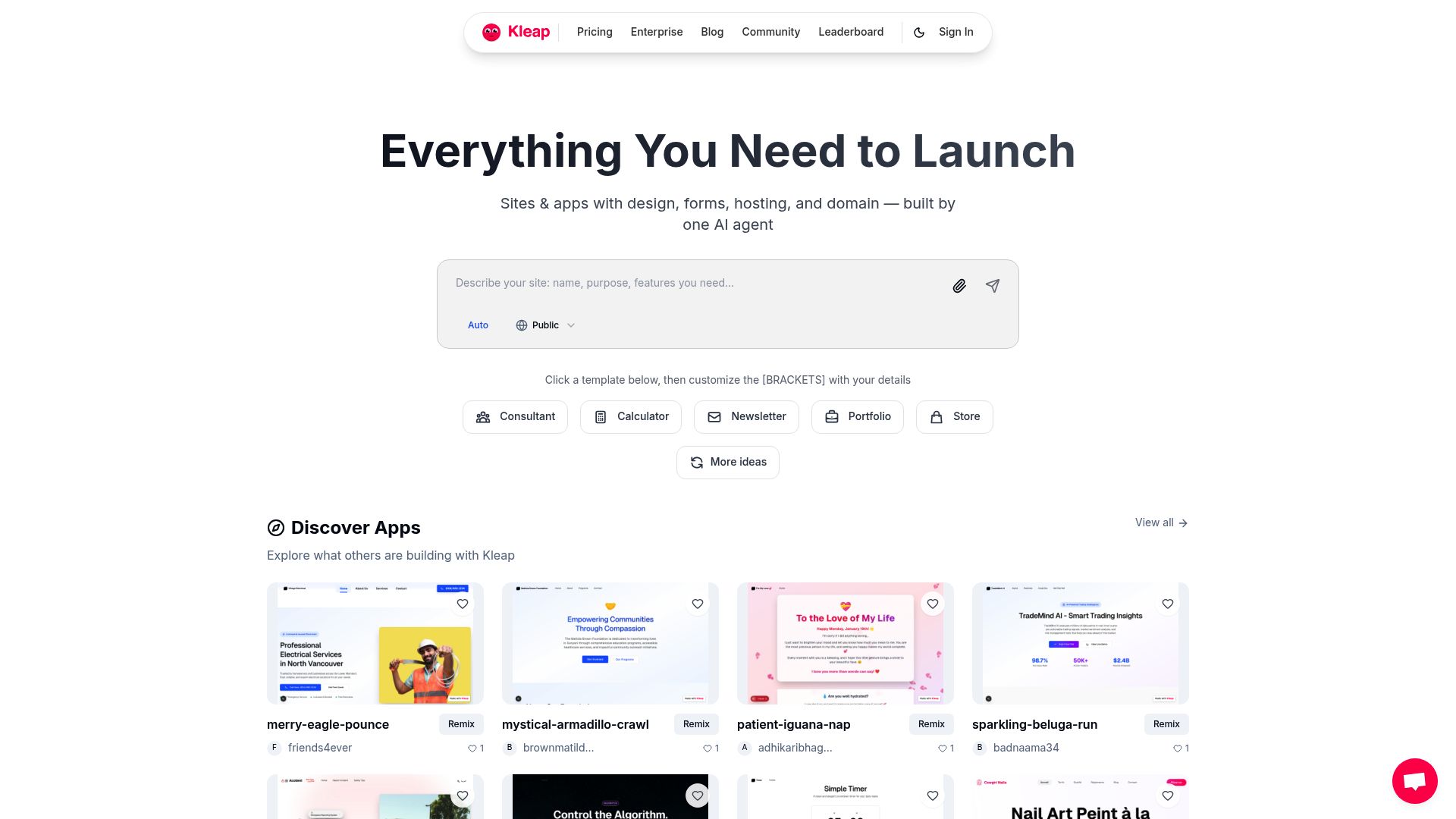
The platform creates design systems that would typically require hiring a copywriter and designer. For entrepreneurs comparing options like Kleap vs Wix Website Builder: The 2025 Showdown, the distinction becomes clear when evaluating the actual value. You're paying for intelligence and automation, not just hosting and a basic visual editor.
For entrepreneurs comparing options like [[KEEPLINK_0]], the distinction becomes clear: you're paying for intelligence, not just hosting and a visual editor.
How Kleap's AI engine accelerates development.
The platform integrates three automation layers that significantly reduce traditional development timelines. Natural language processing interprets your project description to establish structure and hierarchy automatically.
A design engine applies brand-appropriate color schemes, typography, and spacing without any manual work. Content generation produces SEO-optimized copy across all pages, eliminating blank-page problems entirely.
Changes happen through conversational prompts like "make the hero section bolder" instead of menus. Our team found this approach particularly valuable when iterating quickly with clients on projects.
Core features that set Kleap apart.
Beyond speed, several technical capabilities set this platform apart from traditional website builders. Integrated hosting removes the need for separate infrastructure providers or external service agreements. Automatic SSL certificates and CDN distribution manage security and performance without any manual configuration. Progressive web app functionality converts any site into an installable mobile experience for users.
People can add your site to their home screen exactly like a native app. The system manages version control internally, letting you revert changes or test variations easily. You don't need third-party tools to handle these essential development and testing tasks.
Pricing structure and value proposition
Kleap provides four distinct pricing tiers that cater to different operational scales and needs. The free plan delivers core AI generation capabilities with Kleap branding for testing purposes. Pro accounts cost approximately fifteen dollars monthly and remove branding while adding custom domains.
Business plans run around fifty dollars monthly and introduce team collaboration features with support. Enterprise solutions require consultation for pricing and include dedicated infrastructure for agencies managing clients. When comparing Kleap vs. Adalo for app building, note that Kleap includes hosting infrastructure.
Competitors often charge separately for hosting and deployment, which affects your total ownership costs. This pricing structure makes Kleap competitive for businesses seeking all-inclusive solutions without hidden fees. The included infrastructure represents significant value compared to platforms requiring additional hosting purchases for deployment.
Mobile-first app builder for native iOS and Android
Adalo established its unique position by focusing on mobile-native experiences rather than web-first design approaches. Unlike other platforms that treat mobile as secondary, Adalo allows direct publishing to the App Store and Play.
This strategy appeals to entrepreneurs needing tangible mobile products quickly, especially for consumer-facing applications requiring native functionality.
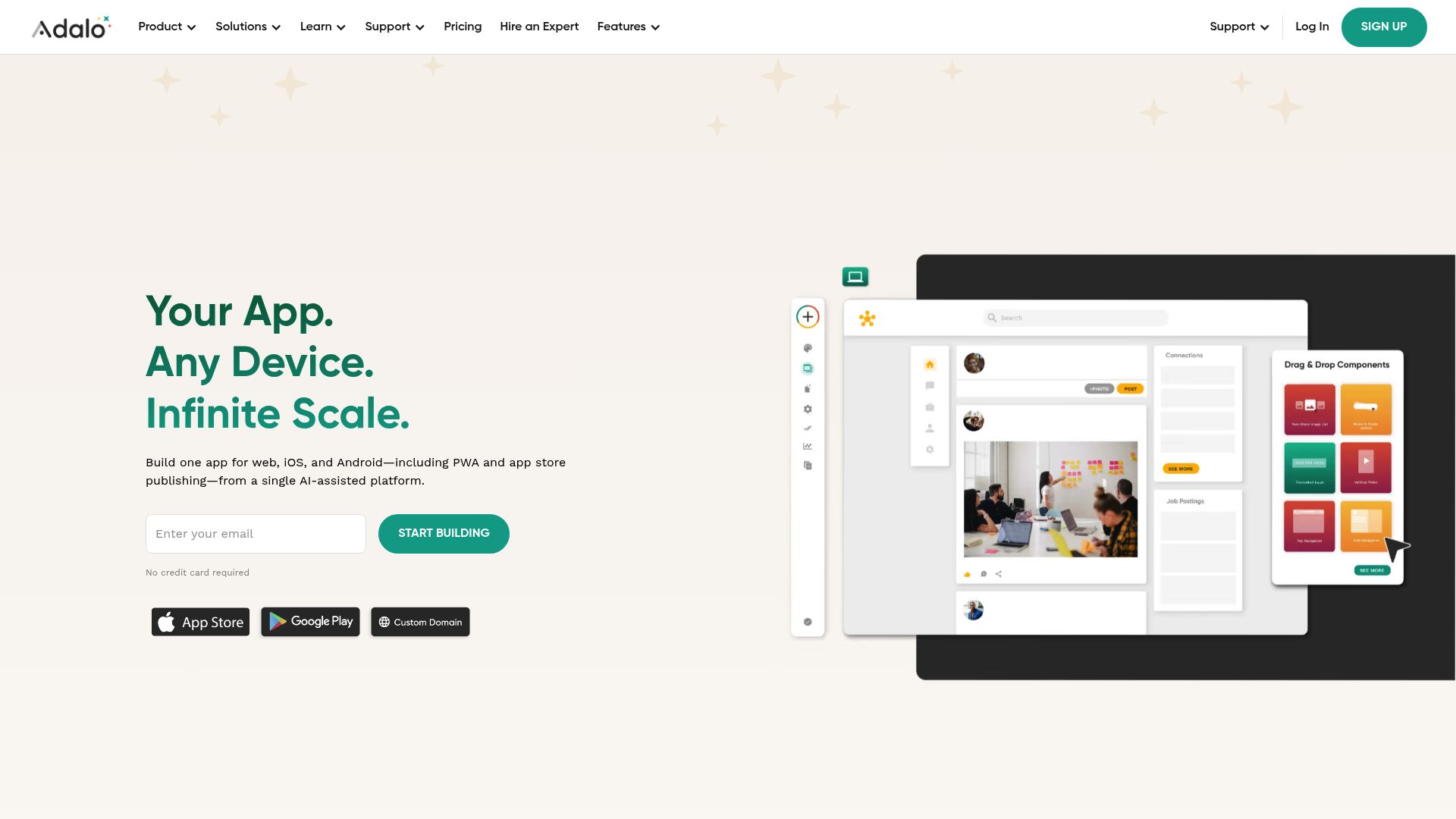
The platform uses a component-based drag-and-drop system that makes building applications remarkably intuitive for users. You construct screens using pre-built elements, including lists, forms, and various image gallery options available.
Backend logic operates through an integrated database offering relational capabilities, while Zapier connects over 5,000 external services. For startups validating their concepts, this development speed consistently delivers significant value and competitive advantages.
However, experienced developers frequently encounter limitations when custom workflows require capabilities beyond what visual tools offer.
Why Adalo dominates native mobile app publishing
Publishing to app stores continues to be Adalo's most valuable feature for users. The platform manages provisioning profiles, certificates, and all submission requirements automatically for you.
Small businesses can launch legitimate native apps without needing to hire mobile developers. This democratization explains why freelancers frequently choose Adalo for client projects with limited budgets.
However, this simplicity hides underlying complexity. Users must eventually address this complexity carefully. Apps still require App Store review compliance, and performance optimization becomes your responsibility.
Key features and platform capabilities
Adalo offers features that balance ease of use with some practical constraints for users. The visual editor maintains UI consistency through its component library quite effectively. However, advanced customization often requires creative workarounds to achieve the desired results.
Database relationships support common patterns like one-to-many and many-to-many connections successfully. Complex queries can strain the simplified architecture that Adalo relies on fundamentally. Push notifications, user authentication, and in-app purchases are included as standard features.
For deeper context on how different builders handle these capabilities, explore our 2025 AI Website Builder Comparison Guide for Business Owners.
| Pricing Tier | Monthly Cost | App Store Publishing | Database Records |
|---|---|---|---|
| Free | $0 | Adalo branding | 50 records |
| Pro | $45 | Included | Unlimited |
| Business | $250 | Priority support | Unlimited |
Pricing tiers and limitations
Adalo's pricing appeals to bootstrapped founders, but scaling issues surface within several months of growth. Applications handling significant data volumes show clear performance drops as their user numbers increase steadily. Most successful Adalo projects transition to custom code eventually, not necessarily due to platform failure.
Business complexity simply grows faster than what visual tools can flexibly accommodate in practice. The real question when evaluating it comes down to this: Does your project require native mobile distribution today, or would faster web deployment better serve validation?
Kleap tip worth considering: If app store presence isn't immediately critical for your business model right now, test your concept through progressive web apps first, and you'll validate demand without native constraints.
Where Each Platform Wins: Feature Showdown
Choosing the right no-code platform depends on understanding which capabilities matter most for your project. Both tools excel in different areas, making your decision about which strengths align with your goals. The comparison reveals distinct advantages that could save months of development headaches or create them.
Speed versus publishing flexibility creates the fundamental trade-off between these two platforms for builders. Kleap's AI-driven approach generates functional prototypes in minutes for rapid testing and iteration cycles. Adalo requires more manual component assembly but delivers true native mobile apps for distribution.
If you need an iOS app in the Apple App Store, Adalo wins outright. For web applications and progressive web apps, Kleap provides faster deployment with better performance. The platform delivers superior characteristics across devices for most standard business use cases today.
Design and Development Speed Comparison
Kleap converts ideas into functional websites using conversational artificial intelligence prompts for creation. You describe your vision, and the platform automatically generates pages and content structures.
This method reduces initial setup time by seventy to eighty percent compared to manual builders. Adalo requires more hands-on work, including dragging components and configuring properties and data sources.
While this provides precision control, it demands a significantly greater time investment from users upfront.
| Capability | Kleap | Adalo |
|---|---|---|
| Initial Build Speed | Minutes with AI generation | Hours with manual assembly |
| Mobile Publishing | PWA only (web-based) | Native iOS Android app stores |
| AI Automation | Content generation, layout suggestions | Limited (manual configuration) |
| Database Complexity | Simple relational structures | Relational with Zapier integration |
| Customization Depth | Template-based flexibility | Component-level control |
AI Capabilities and Automation
Kleap's most impressive capability is its smart assistance during the entire building process. The AI recommends design enhancements, creates placeholder content, and refines layouts for conversion.
Adalo doesn't offer similar automation, forcing manual decisions for every single element. For teams lacking design expertise, this distinction makes a significant difference.
Publishing and Deployment Options
Deployment approaches differ significantly between these two platforms for modern application development. Adalo specializes in simplifying the process of app store distribution, managing all technical complexities involved in native mobile publishing. Kleap concentrates on web deployment with PWA capabilities that function across devices.
Your distribution strategy matters because native apps provide superior device integration capabilities. Web apps deliver instant updates without requiring any app store review processes.
Customization and Scalability
Both platforms eventually reach their technical limits in different ways for users. Adalo's component library restricts advanced functionality unless you add custom code yourself.
Kleap's template system limits structural changes beyond what the AI initially generates. Neither platform works well for enterprise-grade applications that require complex business logic.
However, for small to medium projects, these constraints rarely become problems today. You'll likely validate your concept and secure funding for custom development first.
What other no-code platforms won't tell you about app building
Ever notice how no-code platforms showcase their success stories but rarely mention the apps that stalled? The industry thrives on aspirational marketing, yet critical limitations remain deliberately obscured.
When evaluating platforms like this option, understanding these unspoken realities becomes essential. Most builders hit performance ceilings faster than advertised, creating friction precisely when traction begins.
The hidden costs of 'free' no-code builders
Free tiers bring in users, but costs escalate quickly when you start scaling operations. Native app publishing requires separate Apple Developer accounts at ninety-nine dollars yearly, plus Google Play.
Push notifications need third-party services that start at forty-nine dollars each month at a minimum. Database limits force upgrades around ten thousand records, which is modest for growth.
Traditional platforms charge per user seat, so a five-person team multiplies fees by four hundred percent.
| Hidden Cost | Traditional Platforms | AI-Powered Solutions |
|---|---|---|
| App store fees | $124+ annually | Often bundled |
| Team collaboration | $40-80 per seat/month | Flat pricing common |
| API integrations | Custom dev required | Pre-built connectors |
Why most apps get rebuilt within 18 months
Vendor lock-in creates difficult migration challenges for growing businesses and development teams. Proprietary databases complicate data export processes, and custom logic remains confined within platform workflows.
Performance issues worsen with increased complexity, as systems handling 50 users instantly now struggle with 500.
The AI advantage competitors are scrambling to copy
AI-powered builders eliminate repetitive layout adjustments and automate responsive design logic effectively. Our team observed how these tools significantly reduce build time by identifying arrangements.
Legacy platforms now rush to retrofit AI features onto architectures that were never designed properly.
Which platform delivers better ROI? Pricing breakdown
Pricing transparency matters when evaluating Kleap versus Adalo for building mobile applications effectively. Both platforms offer free entry points, but real costs emerge as projects scale.
Adalo's structure charges separately for native app publishing after you invest development time. Kleap bundles AI-powered optimization into its tiers, which eliminates any surprise fees altogether.
The question isn't just about monthly costs but what you actually get for your investment. Understanding the full financial picture requires looking beyond basic subscription fees and features.
Our team has analyzed multiple client migrations, and hidden costs accumulate quickly over time. Custom integrations, third-party tools to fill gaps, and developer time for workarounds add up.
A platform that seems cheaper upfront can cost significantly more over twelve months. You must factor in productivity losses and technical debt when comparing these platforms.
Speed to market carries monetary value that directly impacts your bottom line. If Kleap launches your MVP three weeks faster than Adalo, you will capture revenue earlier.
Kleap pricing tiers and what you get
Kleap bases its pricing on AI capabilities instead of random feature limitations. The platform provides responsive design automation, smart content suggestions, and performance optimization features. Unlike competitors charging extra for essential tools, you will not hit paywalls here.
Kleap tip: Begin with the mid-tier plan for client work right away. The AI features justify their cost by reducing revision cycles by half.
Adalo Pricing Plans Compared
Adalo offers a tiered pricing model that begins with a free option but escalates rapidly. According to Adalo's official pricing page, if you want to publish apps to stores, you will need to upgrade to paid plans that cost between $50 and $250 monthly.
Their Business tier provides white-labeling capabilities and removes all platform branding from applications. However, performance limitations continue to exist even at higher subscription tiers, as documented by several user communities.
Performance limitations persist even at higher tiers, which several user communities have documented extensively.
Total Cost of Ownership Over 12 Months
| Cost Factor | Kleap | Adalo |
|---|---|---|
| Base subscription | Predictable monthly fee | Starts low, scales quickly |
| App store publishing | Included in plan | Requires paid upgrade |
| Performance optimization | AI-automated | Manual tweaking needed |
| Development time | Standard timeframe |
ROI calculation depends entirely on how your specific business model operates today. For agencies that bill clients by the hour, faster delivery directly improves margins.
For startups validating ideas, time-to-market determines whether you capture opportunities before your competitors do.
The cheapest option rarely delivers the best value when your project eventually succeeds.
Which Platform Should You Choose for Your Project?
Choosing your platform depends entirely on what your project needs and your specific timeline. Most companies require speed, flexibility, and AI features that traditional mobile builders cannot deliver effectively. The Kleap vs Adalo debate really comes down to native app presence versus quick deployment.
Progressive web applications eliminate all the frustrating delays associated with app store approval processes. This approach delivers faster results while maintaining the functionality that your users expect daily.
When Kleap Is the Superior Choice
Choose this platform when speed creates your main competitive advantage in the market today. AI-assisted design speeds up development by several weeks compared to manual component assembly methods.
PWAs deliver experiences like apps without the $99 annual Apple fees or approval cycles. Marketing sites, customer portals, and internal tools launch much faster using this specific platform.
Businesses that prioritize innovation find the AI features absolutely indispensable for their daily operations. Automated layouts adapt seamlessly to content changes without requiring any manual intervention from teams. If your team lacks dedicated developers, the learning curve proves gentler than component-based systems.
When Adalo Makes More Sense
Native mobile apps requiring official app store distribution remain the primary choice for businesses today. Consumer-facing apps where users expect to download from the App Store benefit significantly from this. However, you should consider the trade-offs that come with this traditional approach carefully. Approval delays average around two to three weeks for each submission you make.
Updates require complete resubmission through the app store review process every single time. Scaling limitations force eventual rebuilds when your user base grows beyond initial expectations. Budget-conscious teams appreciate the zero to two hundred fifty dollar monthly pricing structure. Long-term costs accumulate through workarounds and eventual migration to more scalable solutions.
Hybrid Strategies and Switching Considerations
Smart teams carefully test their assumptions before making any significant commitments to development paths. Launch your MVP as a PWA first to validate actual market demand effectively. Then evaluate whether app store presence truly justifies all the added complexity involved. Migration between platforms typically requires complete rebuilding rather than simple importing of existing code.
Choose your initial platform wisely from the start to avoid costly mistakes later. Factor in your team's specific technical composition when deciding on development approaches today. Platforms requiring less custom code significantly reduce dependency on increasingly scarce developer resources available.
Your Questions About Kleap vs Adalo for App Building Answered
Choosing between platforms raises several practical concerns that teams must carefully consider. Can you migrate your work later if needed for business reasons or growth?
Both Kleap and Adalo allow data export, though neither offers full code portability options. Switching means rebuilding your entire application, which is painful but definitely remains possible.
Most teams find locked-in design frameworks less problematic than losing all customer records permanently.
Non-technical users typically prefer Kleap's AI-guided setup for building applications without requiring technical expertise. You describe your app concept clearly, and the system generates layouts automatically for you.
Adalo requires more manual component dragging to build the same features and functionality. Neither platform demands coding skills, but Adalo's visual builder assumes you understand app logic well.
Navigation flows, data relationships, and conditional displays require careful planning in Adalo's environment.
| Question | Kleap | Adalo |
|---|---|---|
| Launch speed | Hours to days | Days to weeks |
| Coding required | None | None (logic understanding helpful) |
| Data export | CSV/JSON available | CSV available |
| Support channels | Email, documentation | Email, community forum, video tutorials |
Kleap abstracts these technical complexities behind conversational prompts that guide users through development steps. Launch timelines differ dramatically between both platforms depending on your project's scope and complexity.
Kleap's AI shortcuts compress development significantly, and simple apps deploy in just hours. Adalo projects typically span several weeks as you refine interactions manually through testing.
Customer support approaches differ between platforms based on their business models and user communities. Adalo maintains an active community forum community forums where users troubleshoot together and share solutions.
Kleap relies on direct email support and knowledge base articles to help users. Both platforms respond within 24 hours for paying customers, but Adalo's peer network helps solve common issues much faster.
FAQ - Frequently Asked Questions
Can you switch from Adalo to Kleap or vice versa after building an app?
No direct migration path exists between these different no-code platforms. You will need to rebuild your entire application from scratch when switching platforms. This means recreating all screens, workflows, and database structures manually without automated tools.
However, there is some good news for developers planning this transition carefully. If you plan ahead and document your app logic thoroughly, rebuilding takes less time.
Which platform is easier for complete beginners with no technical skills?
Kleap wins for absolute beginners. The interface feels more like building a website than coding an app, and you can launch something functional within hours instead of days.
Adalo requires understanding database relationships, collections, and app logic from the start. That learning curve pays off later with more powerful features, but expect a steeper first week.
I've seen beginners struggle with Adalo's component system initially, then love it once they grasp the concepts.
How long does it take to launch an app with Kleap vs Adalo?
With Kleap, you can publish a basic app in 2-4 hours if you have your content ready. The AI tools speed up design decisions significantly, and the template system handles most technical setup automatically.
Adalo projects typically need 1-2 weeks for a functional MVP, even for simple apps. You're building more from foundational elements, which takes longer but gives you precise control over every interaction and data flow.
Can I publish to app stores with both platforms?
Both platforms allow you to publish to the Apple App Store and Google Play Store, but Adalo handles this process more smoothly. Their higher-tier plans include native app builds that submit directly to the stores with proper app icons, splash screens, and all technical requirements managed.
Kleap focuses primarily on progressive web apps that function like native apps but reside in browsers. You can still submit to stores, but the process requires additional steps and workarounds.
For many users, the PWA approach works perfectly and completely avoids the app store approval hassle.
Which platform offers better AI-powered features?
Kleap incorporates AI features directly into every step of the website building process. The AI automatically generates professional layouts and suggests relevant content improvements for your pages.
It optimizes mobile responsiveness without manual adjustments and creates complete page sections from descriptions. Adalo currently provides minimal built-in AI features for users who need automated assistance.
You can connect external AI services through APIs, but that approach requires additional technical setup. If AI-assisted building is important to your workflow, Kleap delivers significantly more automation capabilities.
What happens to my app if I cancel my subscription?
Your app becomes inaccessible on both platforms as soon as you stop making payments. Kleap stores your project data for sixty days after cancellation occurs. This gives you enough time to reactivate your subscription or export your content safely.
Adalo keeps your app data indefinitely on free plans with certain limitations. However, published apps become completely inaccessible to users immediately after you cancel your subscription. Always export your database and assets before downgrading to avoid losing valuable work.
Conclusion: Making the Right Choice Between Kleap and Adalo for App Building
The decision between Kleap and Adalo for app building depends on your specific goals. If you need AI-powered speed and instant deployment, Kleap delivers unmatched efficiency for modern applications.
For complex native mobile apps targeting iOS and Android stores, Adalo provides traditional mobile infrastructure. However, most businesses prioritizing speed to market benefit from Kleap's AI capabilities that eliminate weeks of development.
Start by defining your core requirement between lightning-fast deployment and native app store presence. Then choose the platform that aligns best with that specific priority and timeline.
Ready to experience AI-powered app building with minimal complexity and maximum speed? Create your free Kleap account today and launch your first application in minutes.
See firsthand how Kleap's intelligent automation transforms ideas into live applications without traditional development complexity. No credit card is required, just your vision and Kleap's AI handling the heavy lifting.
Your next breakthrough application is just minutes away with this innovative approach to development.