The Best App Developers Barcelona Has to Offer (And a Smarter Alternative)

Barcelona hosts a dense ecosystem of app developers and Barcelona studios, from boutique mobile agencies to full-stack product teams, making partner selection the critical first decision.
- The city has one of Europe's most active tech talent pools, with dozens of established agencies and hundreds of independent developers to evaluate.
- Vetting criteria matter more than location: assess portfolio depth, tech stack transparency, and post-launch support before signing any contract.
- AI-powered no-code and low-code platforms now offer a credible alternative for founders who need speed without enterprise-level budgets.
Most founders searching for app developers in Barcelona make the same costly mistake before a single line of code is written: they improve for proximity instead of fit.
Barcelona's tech scene is genuinely impressive, a Mediterranean hub where design culture meets serious engineering talent, attracting agencies that serve clients from Berlin to São Paulo.
For entrepreneurs, marketing teams, and product leads weighing their options, the local market offers real choice but also real noise. Knowing which signals separate a reliable partner from an expensive disappointment changes everything about how a project starts.
The sharpest takeaway this article delivers is a framework for that choice, including when a Barcelona agency is the right call and when a leaner, AI-driven build path gets you to market faster.
Try it — build your site while you read
Describe what you want and get a live, publishable site in seconds. Free to start, no code.
Join 200,000+ makers building real websites with Kleap.
The Barcelona App Development Scene in 2026
Barcelona's app development market is larger and more fragmented than most guides acknowledge. Sortlist alone lists 175 mobile app agencies in the city, while TechBehemoths tracks 49 companies, and Clutch shows multiple ranked providers with verified reviews.
In practice, this density means you're choosing from a genuinely competitive field rather than a handful of options, which keeps pricing honest and quality high.

What local agencies actually build
The technology split across Barcelona's ecosystem covers three distinct tiers. Native iOS and Android development anchors the premium end, with cross-platform frameworks like Flutter and React Native sitting in the mid-market.
Then there's a fast-growing no-code and low-code tier, where agencies using tools like FlutterFlow and WeWeb explicitly market delivery "3× faster than traditional development," targeting startups that need rapid MVP validation without enterprise budgets.
Hourly rates on Clutch range from under $25 to $50-$99, which translates to a wide spread in project economics. A basic MVP might start around $5,000, while full-stack builds can reach considerably more depending on complexity and team size.
Talent supply reinforces quality across the board. LinkedIn currently shows 196 iOS Developer job listings in Barcelona, a signal that agencies are actively competing for skilled engineers rather than coasting on existing teams.
The mechanism is straightforward: high talent demand forces agencies to specialize, which means clients benefit from sharper focus areas rather than generalist shops.
The no-code shift is especially relevant for entrepreneurs who need speed over customization. If that tradeoff interests you, explore whether is Kleap truly no-code fits your specific use case before committing to an agency engagement.
Top App Developers Barcelona Businesses Actually Hire
Three agency tiers dominate the Barcelona market: native mobile specialists for performance-critical builds, cross-platform studios targeting startups on tighter budgets, and MVP-focused shops using no-code stacks to ship faster. Knowing which tier fits your project saves weeks of back-and-forth.
Below are the categories worth shortlisting, with the data points that actually matter for budgeting.

Agencies excelling at native iOS and Android builds
Native-first agencies in Barcelona typically position around long-term product ownership, full NDA compliance, and dedicated QA teams. Projects in this tier start at $5,000 with Clutch-listed providers, with realistic budgets for production-grade apps sitting between $15,000 and $60,000.
Enterprise clients, particularly in banking and logistics, gravitate here specifically because these agencies carry verified reviews, disclosed hourly rates ($50–$99/hr being the common band), and documented processes. Clutch-ranked agencies are the right starting point; unverified directory listings are not.
Cross-platform and MVP-focused studios worth considering
Studios building on Flutter, React Native, and hybrid frameworks deliver a single codebase for both iOS and Android, which meaningfully reduces delivery time and cost compared to dual native builds. For a typical e-commerce startup needing a shopping app on both platforms, cross-platform agencies in the $10,000–$30,000 range are the realistic shortlist.
Several Barcelona studios explicitly market these stacks for startups that need to validate quickly without committing to two separate codebases.
MVP-focused shops represent the fastest-moving segment. At least one Barcelona-based no-code agency claims builds delivered three times faster than traditional development, using tools like FlutterFlow and WeWeb.
Speed is the pitch. The tradeoff: no-code stacks can hit scalability ceilings as products grow, so this tier suits validation-stage projects more than long-term platforms.
- Native iOS/Android agencies: best for enterprise, fintech, and logistics apps with complex backend requirements
- Cross-platform studios (Flutter/React Native): ideal for startups wanting iOS and Android from a single codebase at lower cost
- No-code/MVP shops: fastest time-to-market, best for early validation before committing to full custom development
Kleap tip: Before approaching any Barcelona agency, build a working prototype with Kleap's AI app builder. Arriving with a live demo instead of a brief cuts scoping sessions in half and gives agencies a concrete foundation to quote against, which typically sharpens pricing and reduces misaligned expectations from day one.
What Barcelona App Agencies Won't Tell You Before You Sign
The hidden cost drivers that inflate your final invoice
That $50,000 minimum project threshold you saw on Sortlist? It doesn't guarantee better output than a $5,000 no-code MVP for a startup that needs market validation, not enterprise architecture.
What it guarantees is a longer contract.
The real math gets worse once you dig into scope. Most agencies advertise projects "from €15,000"; however, complex authentication flows, payment gateway integrations, and third-party API connections can triple that floor without triggering a formal change order.
These aren't surprises to the agency. They're line items that experienced sales teams know to omit until you're already three weeks into discovery.
Why the cheapest hourly rate rarely delivers the cheapest project
Cross-platform development is another area where the pitch rarely matches the invoice. "One codebase" sounds like one price, but agencies routinely bill separate QA cycles for iOS and Android, even when sharing a Flutter or React codebase. Two test environments, two device matrices, two billing cycles.
The savings you expected from going cross-platform quietly evaporate.
Post-launch maintenance is where agencies recoup their margin. Before comparing any two app developers in Barcelona, ask each one for a 12-month maintenance estimate in writing.
Hosting, bug fixes, OS compatibility updates, and security patches add up fast. Without that number, you're comparing incomplete quotes.
The deeper issue: traditional agencies have little incentive to frame the build-vs-buy-vs-AI-generate decision honestly. Their revenue model runs on billable hours, not your launch speed.
Tools like Kleap let teams go from idea to live product without a single development sprint, which is precisely the conversation most Barcelona agencies will never start.
- Always request an all-in quote that includes QA, PM, and design revisions
- Get a 12-month post-launch maintenance estimate before signing
- Clarify whether cross-platform means one or two QA billing cycles
- Ask specifically what triggers a change order in their contract
How to Evaluate and Shortlist Any Barcelona App Developer
Most founders pick the wrong agency for one reason: they compare hourly rates instead of total delivery cost. Two app developers in Barcelona can both quote $5,000 minimum engagements, yet one bundles QA, project management, and three revision rounds while the other bills every post-launch fix at $75 an hour.
The gap between those two deals only becomes visible if you know exactly what to ask before signing anything.

The questions to ask in the first discovery call
Skip the portfolio PDF. Instead, request three shipped apps in your specific category, with live App Store or Play Store links you can download and test yourself.
Then push on stack rationale: why native iOS/Android over Flutter, or why a no-code platform like FlutterFlow over a custom build? An agency that can't answer that question clearly hasn't thought through your use case.
Finally, ask directly who owns the code at handoff. Full code ownership is non-negotiable for any product you plan to scale.
What the numbers actually tell you
Clutch listings for Barcelona agencies show hourly rates ranging from under $25 to $99, but that spread means almost nothing without a full scope breakdown. Demand a line-item proposal covering design, development, QA, project management, and revisions.
Then verify the agency's reputation on neutral platforms like Clutch rather than testimonials hosted on their own site.
- Ask for live app links, not mockups or case study PDFs
- Request a written stack justification tied to your use case
- Confirm full code ownership at project completion
- Compare total delivery cost across proposals, not just day rates
- Check reviews on Clutch or Google, not the agency's own website
If building and iterating fast matters more than a custom codebase, AI-powered builders like Kleap let you move from idea to live product without agency timelines or agency budgets.
Want to Skip the Agency Queue? Build Your App with Kleap Instead
Agency quotes take weeks. Contracts take longer.
By the time a traditional Barcelona development shop finalizes your scope document, your launch window may already be closing. Kleap flips that timeline entirely. It is an AI-powered builder that takes you from idea to live digital product using plain language, with no coding, no sprint planning, and no waiting.
What Kleap builds in minutes that agencies quote in months
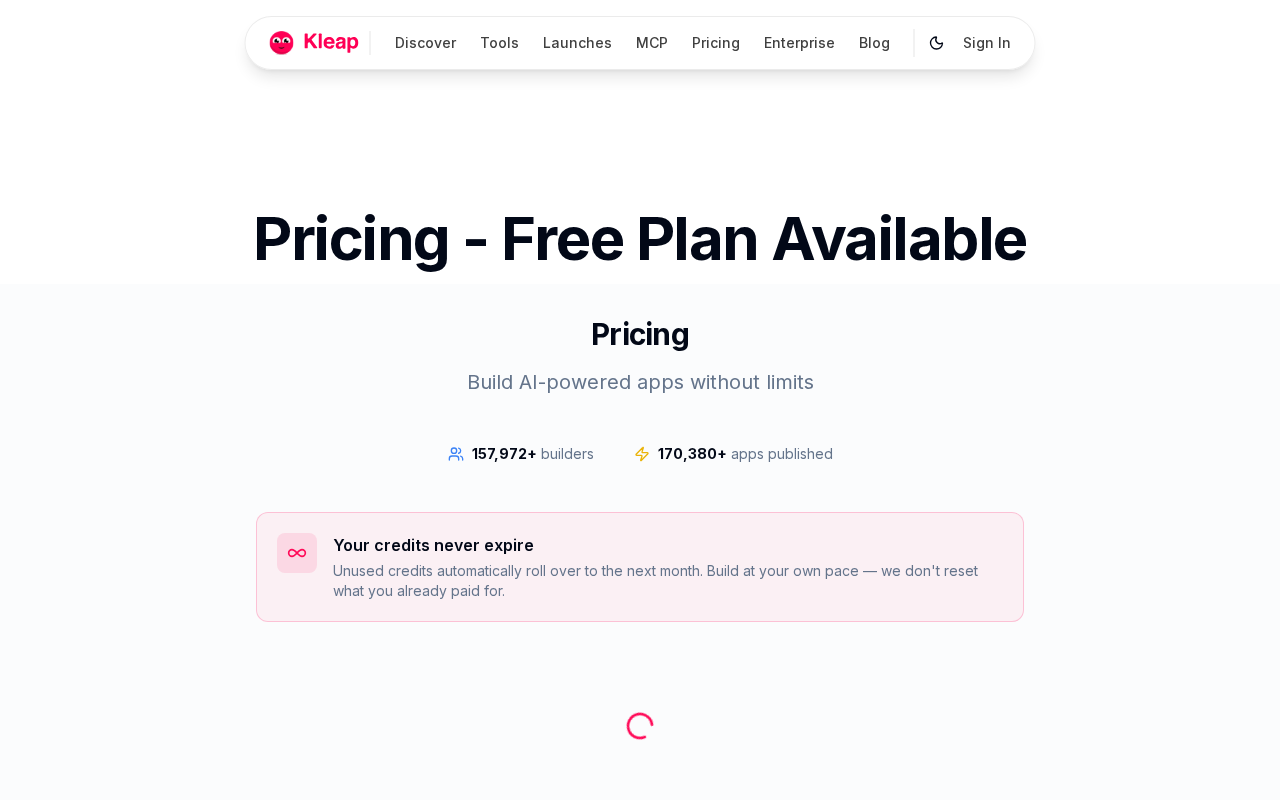
Kleap handles the full range of most early-stage digital needs within a single platform: design, hosting, custom domains, forms, e-commerce stores, landing pages, portfolios, and internal tools. Unlike agency engagements that start in the thousands and routinely climb much higher for complex builds, Kleap Pro starts at $25/month.
That gap is not a rounding error; it is the difference between validating an idea this week or next quarter.
- MVPs and prototypes, launch a testable product before committing to a full agency budget
- E-commerce stores, fully functional storefronts with no developer dependency
- Landing pages, conversion-ready pages live in hours, not sprints
- Portfolios and internal tools, professional-grade output with complete code ownership included
When Kleap is the smarter choice over a traditional Barcelona agency
Traditional agencies earn their fees on genuinely complex work: custom hardware integration, regulated enterprise architecture, or deep native API builds. Outside those cases, the vast majority of digital products, including storefronts, service sites, booking flows, and lead-gen tools, fall squarely within what Kleap delivers at a fraction of the cost and time.
For entrepreneurs in New York, Los Angeles, or Chicago targeting global markets digitally, Kleap removes local agency dependency entirely. One AI agent builds everything from brief to live, with full code ownership so you are never locked into a vendor.
Kleap tip: Start with a free Kleap account to build and validate your MVP before spending a dollar on agency fees. If the concept gains traction, you already have a live, ownable product ready to scale.
Frequently Asked Questions
How much do app developers in Barcelona typically charge?
Rates vary widely. Freelancers often sit at the lower end of the market, while established agencies command significantly more, especially for complex, full-stack builds.
What actually drives the final number is scope: a simple MVP is a very different conversation from a multi-platform product with custom integrations. Get itemized quotes, not ballpark figures.
What is the difference between native and cross-platform app development?
Native apps are built specifically for one platform, iOS or Android, using the platform's own language. They tend to perform better and feel more polished, but you're at its core building twice.
Cross-platform frameworks like React Native or Flutter let a single codebase run on both platforms. The tradeoff?
Occasional limitations with device-specific features and a slightly less native feel. For most startups and SMBs, cross-platform is the pragmatic starting point.
And the result? Often better than expected for the cost saved.
How do I verify the quality of a Barcelona app development agency?
Ask for live case studies, not just portfolio screenshots. A credible agency should walk you through a past project, including the problems they hit and how they solved them.
Check independent review platforms and ask specifically about post-launch support. Any agency can deliver on day one.
The real test is what happens at month three.
Can I build an app without hiring a developer at all?
Yes, genuinely. AI-powered builders have closed the gap dramatically.
Kleap, for instance, lets you describe your app in plain language and generates a fully functional, hosted product without a single line of code written by you.
This works especially well for MVPs: landing pages, internal tools, and e-commerce stores. Where it gets more complex is highly custom logic or deep third-party integrations, though even those boundaries are shifting fast.
For entrepreneurs who need to move quickly and validate an idea before committing to agency fees, this approach is worth taking seriously.
What is the average timeline to build a mobile app with a Barcelona agency?
A realistic MVP with a mid-sized agency runs roughly three to five months from kickoff to launch, assuming requirements are well-defined from the start.
Scope creep is the single biggest timeline killer. I've seen projects double in duration simply because discovery was rushed.
Lock down your feature list before signing anything, and build a buffer into every milestone.
Your Next App Doesn't Have to Wait for App Developers in Barcelona to Clear Their Schedule
The real question was never which agency has the best portfolio; it's whether a six-month development timeline and a five-figure invoice actually match what your project needs right now.
If your goal is speed and control, start by building a working prototype on Kleap today. Describe your app in plain language, see a live version in minutes, and decide with real evidence, not a sales deck, whether you need more.
Kleap's AI builder handles design, hosting, forms, and custom domains from a single platform. Plans start free, with Pro from $25/month, a fraction of what even a junior developer costs per day in Barcelona.
Visit kleap.co to build your first version before your next meeting with a development agency. Come in with a working prototype, not just an idea.
The best use you have in any development conversation is already having something built.