The Best Restaurant Website Builders 2026 Ranked by What Actually Matters

The best restaurant website builders 2026 include platforms like Squarespace, Wix, and Square Online, ranked by menu display, reservation tools, and mobile speed.
- Online ordering integration is now a baseline requirement, not a premium add-on
- Choose a builder with built-in SEO controls and Google Business Profile sync to capture local search traffic
- The right platform cuts setup time dramatically while handling table bookings, menus, and payments in one place
Most restaurant owners pick a website builder the same way they'd choose a tablecloth color, based on looks alone. That instinct costs them covers every single week.
However, A restaurant's website is its first maître d': it seats guests, answers questions, and takes reservations before a single staff member clocks in. When evaluating the best restaurant website builders 2026, the gap between platforms that understand the food service industry and generic drag-and-drop tools is wider than most operators realize.
For independent restaurants, ghost kitchens, and multi-location groups alike, the wrong builder means slow load times on mobile, clunky menu updates at 11pm, and reservation widgets that send customers straight to a competitor.
What this ranking delivers is a single, clear verdict on which platforms actually handle the operational weight of running a restaurant online, not just which ones look good in a demo.
Why Your Restaurant Website Can Make or Break Your Business in 2026
A guest in Los Angeles decides between two Italian spots. Therefore, Both have great reviews.
One website loads in under two seconds, shows the full menu with prices, and offers instant OpenTable booking. The other?
Because A blurry PDF menu and a phone number. The choice is obvious, and the reservation is already made before the second restaurant ever gets a chance.

The 10 Features Every Strong Restaurant Site Needs
Research into the best restaurant website builders 2026 consistently surfaces the same non-negotiable checklist. Although Miss even two of these and you're handing reservations to rivals:
- Complete menu with current prices
- Online ordering integration
- Reservation booking (OpenTable, Resy, or Tock)
- Mobile optimization and fast loading
- High-quality food photography
- Contact info, hours, and a Google Maps embed
- Local SEO support
How Platform Choice Shapes the Guest Experience
Platform decisions now split into three distinct lanes: design-first builders like Squarespace and Wix, restaurant-operations specialists like BentoBox and GloriaFood, and AI-first deployment tools like Kleap. Each lane serves a different priority, branding polish, ordering workflows, or raw speed to launch.
Picking the wrong lane means paying for features you don't need while missing the ones that actually drive covers.
Try it — build your site while you read
Describe what you want and get a live, publishable site in seconds. Free to start, no code.
Join 200,000+ makers building real websites with Kleap.
The 7 Best Restaurant Website Builders 2026 Reviewed
While Not all builders are created equal, and the wrong choice costs you more than time. According to SiteBuilderReport's 2026 restaurant-builder comparison, Squarespace ranks first, ahead of Wix, BentoBox, Webflow, and Hostinger.
That ranking reflects a simple truth: the best restaurant website builders 2026 splits cleanly into two camps, design-first platforms and restaurant-specific tools, and your operational priority determines which camp wins.

Design-First Platforms: Squarespace, Wix, and Webflow
Squarespace earns its top spot through polished templates and all-in-one simplicity. Since No plugin hunting, no fragmented toolset, just clean layouts that make food photography look intentional.
Wix counters with raw flexibility: a broader app marketplace, stronger SEO controls, and reservation integrations that connect directly with OpenTable, Resy, and Yelp Reservations. Webflow sits at the far end of the design spectrum, offering total visual control for operators who want a custom look without writing a single line of code.
The tradeoff? Steeper learning curve, higher price point.
Restaurant-Specific Platforms: BentoBox, GloriaFood, UpMenu, and Flavor Plate
Whereas BentoBox is built around hospitality workflows from the ground up. Menus, events, gift cards, and catering requests all live inside one dashboard.
GloriaFood goes narrower and deeper, specializing in online ordering and delivery operations, the right call for high-volume takeout restaurants where the website is basically a revenue engine. Thus, UpMenu and Flavor Plate round out the list with ordering-centric features and restaurant-specific templates that skip the generic design process entirely.
For what are the top choices of website builders for restaurants?, these four handle the operational layer that design-first platforms often leave to third-party plugins.
The practical takeaway: if your priority is brand identity, Squarespace or Webflow wins. If reservations and ordering drive revenue, BentoBox or GloriaFood handles that load better.
For restaurants that need an all-in-one launch without assembling multiple tools, explore what are the top choices of website builders for restaurants? to match your specific workflow before committing to any platform.
How Kleap Challenges Every Platform on This List
Finally, Most platforms on this list ask you to choose: design flexibility or restaurant-specific features. Kleap removes that trade-off entirely.
While Squarespace wins on aesthetics and BentoBox wins on food-service workflows, neither lets you describe your restaurant in plain English and watch a fully functional site appear in minutes. Additionally, That gap is exactly where Kleap operates, and it changes the calculus for any owner researching the restaurant website builder comparison landscape in 2026.
Building a Full Restaurant Site With AI in Minutes
One AI agent handles the entire build: layout, copy structure, contact forms, and mobile optimization, all triggered by a single natural-language prompt. A food truck owner in Houston and a fine dining concept in Chicago both get purpose-built designs without touching a single line of code.
Meanwhile, Unlike restaurant-locked platforms, Kleap adapts to any hospitality concept, which makes it a genuinely flexible option for operators who don't fit a template. For teams exploring an ai website builder for local businesses, this speed-to-launch model is hard to ignore.
All-in-One Hosting, Forms, and Custom Domain Without the Tool Stack
Where most builders charge separately for hosting, custom domains, and form integrations, Kleap bundles everything. As a result, No assembling a separate tool stack, no monthly add-ons creeping up your bill.
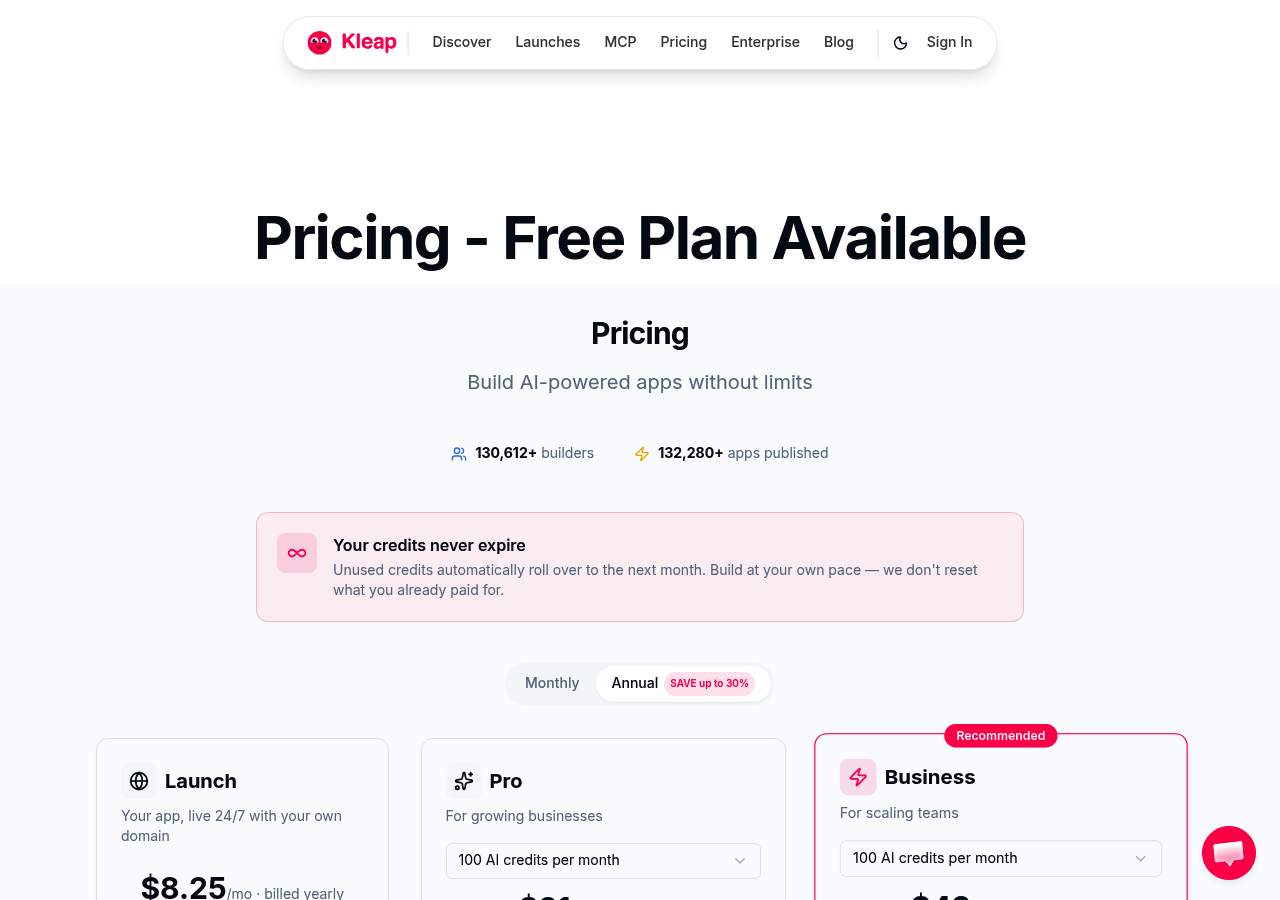
Pro starts at $25/month and Business at $50/month, competitive against every platform reviewed here. Complete code ownership means you're never locked in if you scale or migrate.
- AI-generated design from a plain-language description
- Hosting, forms, and custom domain included by default
- Free to start; Pro at $25/month; Business at $50/month
- Full code ownership, zero platform lock-in
Kleap tip: Describe your restaurant's concept, cuisine, and target neighborhood in your first AI prompt. On the other hand, The more specific your input, the more tailored your layout, menu structure, and contact section will be from the first generation.
What the Best Restaurant Website Builder Guides Won't Tell You
Every roundup of the best restaurant website builders 2026 leads with the headline price. Almost none of them follow the money past month one.
The "free" tier on most platforms locks online ordering, custom domains, and removal of platform branding behind paid upgrades, meaning the real cost only surfaces after you've already built your site and trained your staff on it.
The Hidden Costs That Add Up After Launch
For example, Restaurant-specific platforms like BentoBox charge monthly fees that scale alongside order volume. For a high-volume operator in Miami or Chicago, that commission structure quietly erodes margins in ways no comparison table mentions upfront.
Add third-party reservation integrations, premium templates, and analytics add-ons, and your $0 launch becomes a $200-plus monthly bill before you've served a single table. Above all, If you're evaluating broader digital commerce needs, the same pattern appears across categories, worth reading about when comparing any ai ecommerce website builder.
Why Restaurant-Specific Features Can Actually Lock You In
Template-locked designs create a subtler problem. Your Chicago seafood bistro may share an identical layout with hundreds of other restaurants on the same platform, brand differentiation disappears entirely.
Worse, builder-hosted sites typically restrict technical SEO control: canonical tags, structured data schema, and page speed optimizations that drive local search rankings in competitive markets are often inaccessible without developer access or a platform migration.
Nonetheless, AI-first builders with code export solve both problems simultaneously. Full code ownership means you're never trapped by a platform's roadmap, pricing changes, or design constraints.
That future-proofing is rarely mentioned in restaurant builder guides, but for any operator thinking beyond the next twelve months, it's the detail that matters most.
How to Pick the Right Platform for Your Restaurant Right Now
A Simple Decision Framework Based on Your Operational Priority
Most restaurant owners pick a platform based on what looks good in a demo. Subsequently, Wrong move.
The right choice depends entirely on your operational priority, because no single builder wins every category. Match your need to the tool, not the other way around.
| Priority | Best Fit | Trade-off |
|---|---|---|
| Brand storytelling and design | Squarespace or Webflow | Steeper learning curve, slower launch |
| High-volume online ordering | GloriaFood or UpMenu | Limited design flexibility |
| Speed, low cost, all-in-one workflow | Kleap | Less restaurant-specialist depth |
However, One number most guides skip: your real 12-month cost. Platform fee plus add-ons plus any designer time can quietly triple your headline monthly price.
Calculate the full stack before committing.
Getting Your Restaurant Site Live Faster Than You Think
Mobile performance and local SEO are non-negotiable in dense markets like New York or Houston. Therefore, Test both before you pay a dollar.
The smartest approach: start on a free tier, validate real traffic and conversion, then upgrade only when the numbers justify it.
That risk-free path is exactly where Kleap's free-to-start model earns its place among the best restaurant website builders 2026 contenders. Describe your restaurant in plain language, get a live seasoned site in minutes, and scale when you're ready.
No guesswork, no wasted budget.
FAQ - Frequently Asked Questions
What is the best free restaurant website builder in 2026?
Because Kleap stands out for restaurants that want to go from idea to live site in minutes, not days. Its AI handles layout, menus, and booking flows without requiring a single line of code.
That said, "best" depends on your priorities. Although If you need deep POS integrations out of the box, compare a few options.
But for speed, design quality, and zero upfront cost, Kleap's free tier is genuinely hard to beat.
Do I need a restaurant-specific platform or will a general builder work?
No, not necessarily. A restaurant-specific platform sounds appealing until you hit its ceiling: rigid templates, limited customization, and pricing that climbs fast once you add features.
While A capable general builder with AI, like Kleap, adapts to your exact use case rather than forcing you into a pre-built restaurant mold. You get menu pages, reservation forms, and custom domains without the niche-platform premium.
How important is online ordering integration for a restaurant website?
Critical, and increasingly non-negotiable. Since Diners expect to order or book directly from your site, not hunt for a third-party app that takes a cut of every transaction.
Restaurants that embed ordering and reservation flows directly into their website consistently see higher conversion than those relying on external links. Your website should be the hub, not a brochure pointing elsewhere.
Can I build a restaurant website without any coding skills?
Whereas Yes. Completely.
With Kleap, you describe what you want in plain language and the AI builds it, including layout, menu sections, contact forms, and custom domain setup. Thus, I've seen first-time users go live in under an hour with results that look like a professional agency built them.
The days of needing a developer for a polished restaurant site are genuinely over. What matters now is having the right AI tool.
What features should every restaurant website include in 2026?
At minimum: a mobile-fine-tune menu with photos, an online reservation or ordering system, Google Maps integration, and clear contact details above the fold.
Finally, Beyond the basics, structured data markup (so Google surfaces your hours and menu directly in search results), a fast-loading gallery, and a loyalty or email capture form are quickly becoming standard. Anything that reduces friction between a hungry customer and a confirmed booking earns its place.
How much does it cost to build and maintain a restaurant website?
The range is wide. Additionally, A basic site can start free, while a fully custom build with advanced integrations can run into thousands of dollars per month for enterprise setups.
With Kleap, the Pro plan runs $25/month and the Business plan $50/month, both covering hosting, custom domains, and core AI features. For most independent restaurants and small chains, that covers everything needed to run a professional, high-converting site without surprise costs.
The Best Restaurant Website Builders 2026 Come Down to One Question: Who Owns Your Growth?
Platforms that charge per feature, lock your menu behind paywalls, or hand you a template and call it a strategy are not partners, they are landlords.
Meanwhile, The best restaurant website builders 2026 separate into two camps: tools that give you a starting point, and tools that give you an engine. Kleap sits firmly in the second camp, with AI that builds from idea to live without a single line of code.
Start building your restaurant website on Kleap today, the free tier requires no credit card, and your first page can be live before your next lunch service.
Ready to own your digital presence? Visit kleap.co and let the AI handle the build while you focus on the kitchen.
Your restaurant deserves a website that works as hard as you do.